

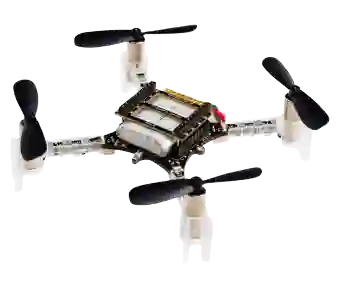
Recent advancements in drone technology have shown that commercial off-the-shelf Micro Aerial Drones are more effective than large-sized drones for performing flight missions in narrow environments, such as swarming, indoor navigation, and inspection of hazardous locations. Due to their deployments in many civilian and military applications, safe and reliable communication of these drones throughout the mission is critical. The Crazyflie ecosystem is one of the most popular Micro Aerial Drones and has the potential to be deployed worldwide. In this paper, we empirically investigate two interference attacks against the Crazy Real Time Protocol (CRTP) implemented within the Crazyflie drones. In particular, we explore the feasibility of experimenting two attack vectors that can disrupt an ongoing flight mission: the jamming attack, and the hijacking attack. Our experimental results demonstrate the effectiveness of such attacks in both autonomous and non-autonomous flight modes on a Crazyflie 2.1 drone. Finally, we suggest potential shielding strategies that guarantee a safe and secure flight mission. To the best of our knowledge, this is the first work investigating jamming and hijacking attacks against Micro Aerial Drones, both in autonomous and non-autonomous modes.
翻译:近期无人机技术的发展表明,商用现成微型无人机相较于大型无人机,在狭窄环境(如蜂群飞行、室内导航及危险区域巡检)中执行飞行任务时更具优势。由于其在众多民用和军事领域的应用,确保这些无人机在任务执行过程中的安全可靠通信至关重要。Crazyflie生态系统作为最受欢迎的微型无人机之一,具备全球部署潜力。本文通过实验方法,研究了针对Crazyflie无人机中实现的Crazy实时协议(CRTP)的两种干扰攻击。具体而言,我们探索了两种能够中断正在进行的飞行任务的攻击向量:干扰攻击与劫持攻击。实验结果表明,无论Crazyflie 2.1无人机处于自主飞行还是非自主飞行模式,此类攻击均具有显著成效。最后,我们提出了确保飞行任务安全可靠的潜在屏蔽策略。据我们所知,本研究是首次从自主与非自主两种飞行模式角度,系统探究针对微型无人机的干扰与劫持攻击。






相关内容





 微信扫码咨询专知VIP会员