

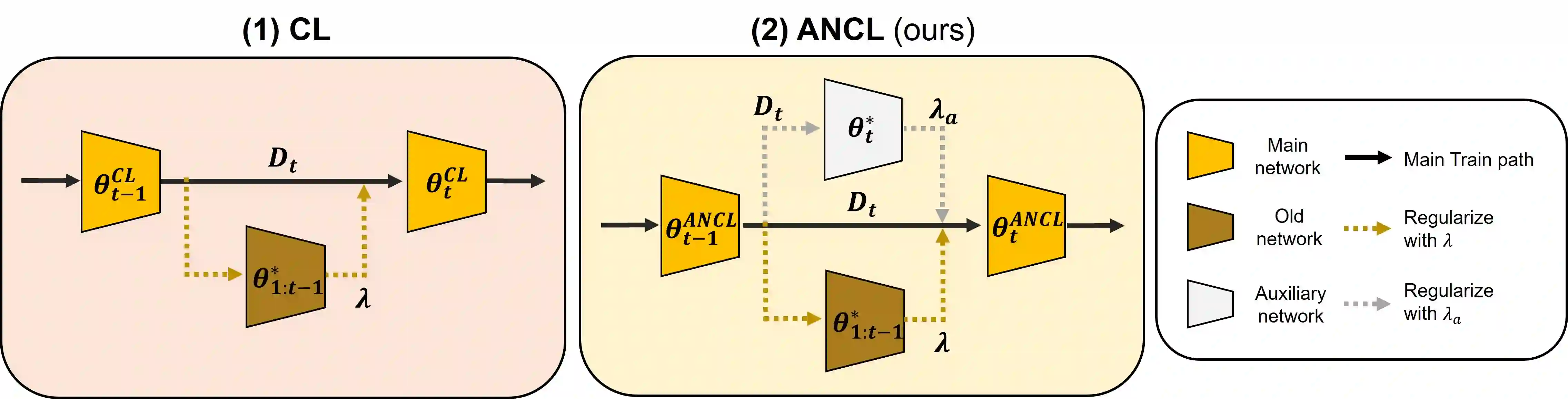
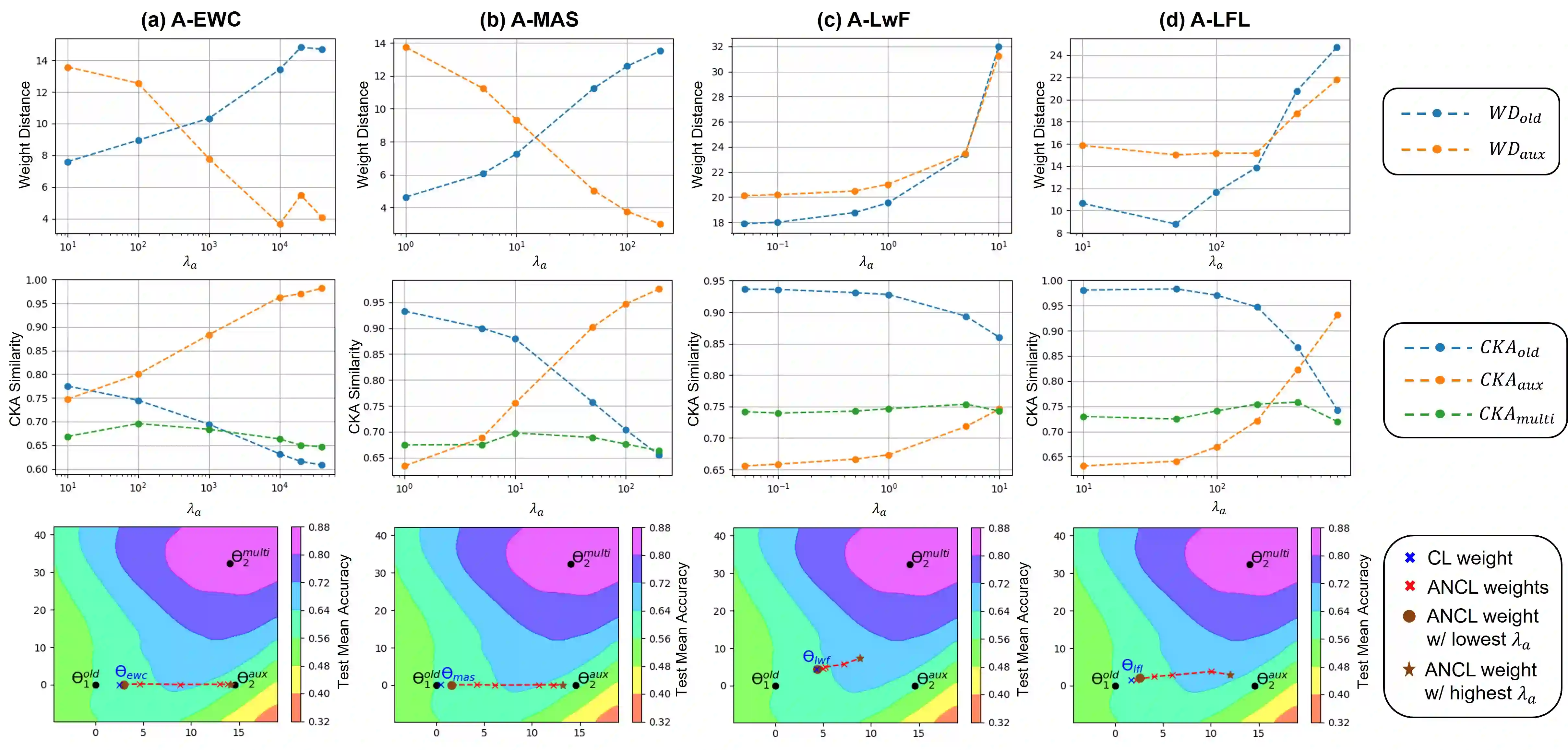
In contrast to the natural capabilities of humans to learn new tasks in a sequential fashion, neural networks are known to suffer from catastrophic forgetting, where the model's performances on old tasks drop dramatically after being optimized for a new task. Since then, the continual learning (CL) community has proposed several solutions aiming to equip the neural network with the ability to learn the current task (plasticity) while still achieving high accuracy on the previous tasks (stability). Despite remarkable improvements, the plasticity-stability trade-off is still far from being solved and its underlying mechanism is poorly understood. In this work, we propose Auxiliary Network Continual Learning (ANCL), a novel method that applies an additional auxiliary network which promotes plasticity to the continually learned model which mainly focuses on stability. More concretely, the proposed framework materializes in a regularizer that naturally interpolates between plasticity and stability, surpassing strong baselines on task incremental and class incremental scenarios. Through extensive analyses on ANCL solutions, we identify some essential principles beneath the stability-plasticity trade-off.
翻译:与人类能够顺序学习新任务的天然能力不同,神经网络存在灾难性遗忘问题——当模型针对新任务进行优化后,其在旧任务上的性能会急剧下降。为此,持续学习领域提出了多种解决方案,旨在赋予神经网络既能学习当前任务(可塑性)又能保持先前任务高准确率(稳定性)的能力。尽管取得了显著进展,但稳定性-可塑性权衡仍远未解决,其潜在机制也尚不明确。本文提出辅助网络持续学习(ANCL)这一新方法,通过引入额外的辅助网络增强可塑性,而主持续学习模型则侧重稳定性。具体而言,所提出的框架通过一个正则化器自然地在可塑性与稳定性之间进行插值,在任务增量场景和类别增量场景中均超越了强基线方法。通过对ANCL解决方案的深入分析,我们揭示了稳定性-可塑性权衡背后的一些关键原理。




相关内容

Source: Apple - iOS 8



 微信扫码咨询专知VIP会员