

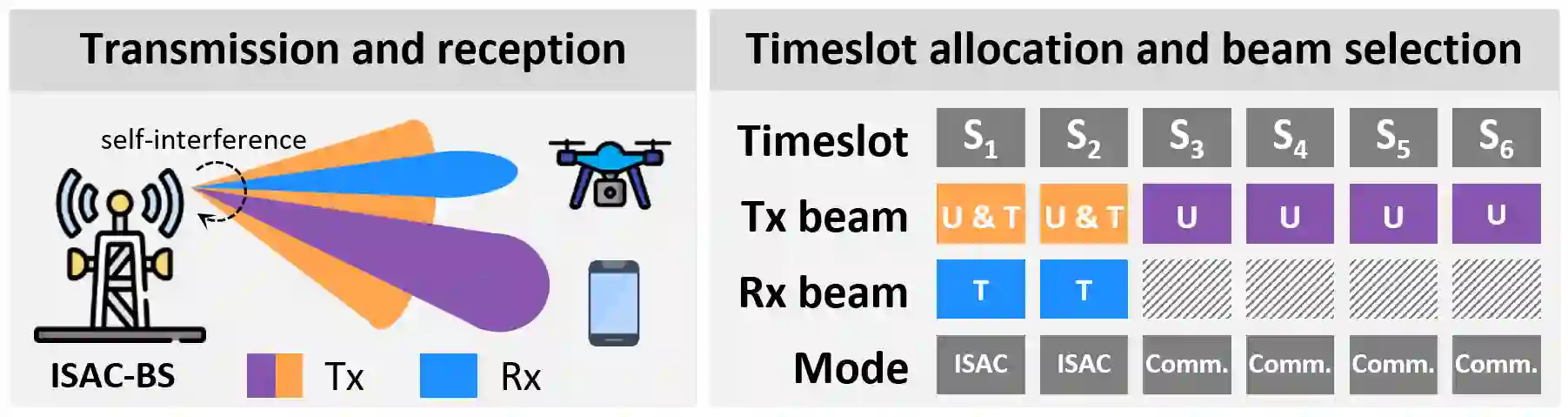
This work addresses the radio resource management (RRM) design in downlink full-duplex integrated sensing and communications (ISAC) systems, jointly optimizing timeslot allocation and beam selection under imperfect self-interference cancellation. Timeslot allocation governs the distribution of discrete channel uses between sensing and communication tasks, while beam selection determines transmit and receive directions along with adaptive beamwidths. The joint design leads to a semi-infinite, nonconvex mixed-integer nonlinear program (MINLP), which is difficult to solve. To overcome this, we develop a tailored reformulation strategy that transforms the problem into a tractable mixed-integer linear program (MILP), enabling globally optimal solutions. Our approach provides insights into the coordinated optimization of timeslot allocation and beam selection, enhancing the efficiency of full-duplex ISAC systems while ensuring resilience against residual self-interference.
翻译:本研究针对下行链路全双工集成感知与通信(ISAC)系统中的无线资源管理(RRM)设计,在非理想自干扰消除条件下联合优化时隙分配与波束选择。时隙分配控制感知与通信任务之间离散信道使用的分布,而波束选择则决定收发方向及自适应波束宽度。该联合设计导出一个半无限、非凸的混合整数非线性规划(MINLP)问题,求解难度较高。为克服此困难,我们提出一种定制化的重构策略,将原问题转化为可处理的混合整数线性规划(MILP),从而获得全局最优解。该方法深入揭示了时隙分配与波束选择的协同优化机制,在确保系统对残留自干扰具备鲁棒性的同时,显著提升了全双工ISAC系统的运行效率。




相关内容




 微信扫码咨询专知VIP会员