

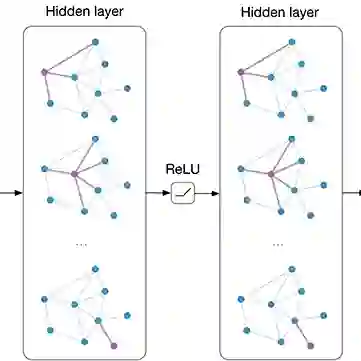
The information diffusion performance of GCN and its variant models is limited by the adjacency matrix, which can lower their performance. Therefore, we introduce a new framework for graph convolutional networks called Hybrid Diffusion-based Graph Convolutional Network (HD-GCN) to address the limitations of information diffusion caused by the adjacency matrix. In the HD-GCN framework, we initially utilize diffusion maps to facilitate the diffusion of information among nodes that are adjacent to each other in the feature space. This allows for the diffusion of information between similar points that may not have an adjacent relationship. Next, we utilize graph convolution to further propagate information among adjacent nodes after the diffusion maps, thereby enabling the spread of information among similar nodes that are adjacent in the graph. Finally, we employ the diffusion distances obtained through the use of diffusion maps to regularize and constrain the predicted labels of training nodes. This regularization method is then applied to the HD-GCN training, resulting in a smoother classification surface. The model proposed in this paper effectively overcomes the limitations of information diffusion imposed only by the adjacency matrix. HD-GCN utilizes hybrid diffusion by combining information diffusion between neighborhood nodes in the feature space and adjacent nodes in the adjacency matrix. This method allows for more comprehensive information propagation among nodes, resulting in improved model performance. We evaluated the performance of DM-GCN on three well-known citation network datasets and the results showed that the proposed framework is more effective than several graph-based semi-supervised learning methods.
翻译:图卷积网络(GCN)及其变体模型的信息扩散性能受限于邻接矩阵,这可能导致其性能下降。为此,我们提出了一种名为混合扩散图卷积网络(HD-GCN)的新型图卷积网络框架,以解决由邻接矩阵引起的信息扩散局限性。在HD-GCN框架中,我们首先利用扩散映射促进特征空间中相邻节点之间的信息扩散,这使得即使没有邻接关系的相似节点之间也能进行信息传播。随后,我们采用图卷积进一步在扩散映射后的相邻节点间传播信息,从而实现图中相邻相似节点间信息的扩散。最后,我们通过扩散映射得到的扩散距离来正则化并约束训练节点的预测标签,并将这种正则化方法应用于HD-GCN训练,从而获得更平滑的分类面。本文提出的模型有效克服了仅由邻接矩阵施加的信息扩散局限性。HD-GCN通过结合特征空间中邻域节点与邻接矩阵中相邻节点之间的信息扩散,实现了混合扩散。该方法使得节点间的信息传播更加全面,从而提升了模型性能。我们在三个著名的引文网络数据集上评估了DM-GCN的性能,结果表明,所提出的框架优于若干基于图的半监督学习方法。




相关内容


 微信扫码咨询专知VIP会员