

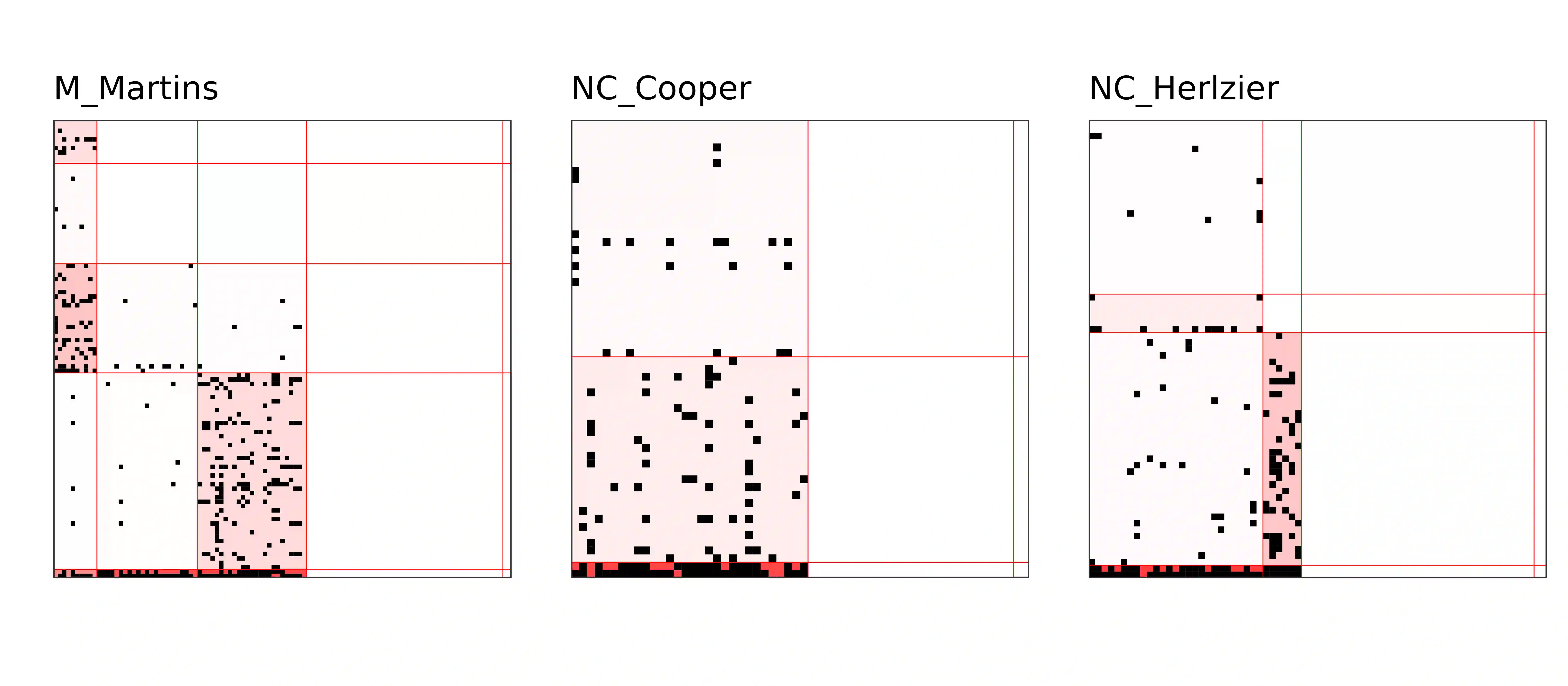
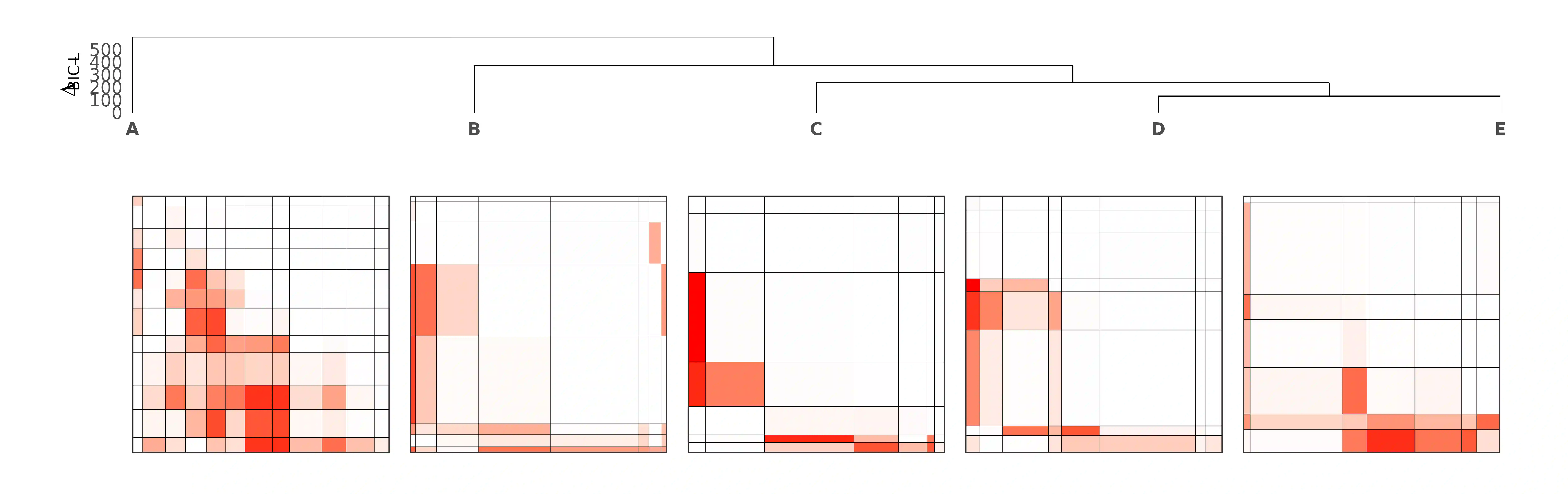
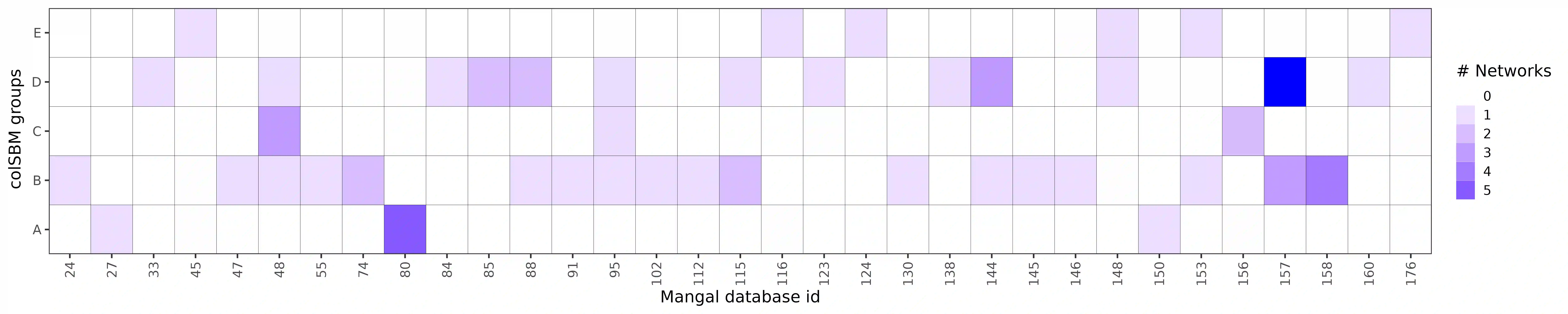
Let a collection of networks represent interactions within several (social or ecological) systems. We pursue two objectives: identifying similarities in the topological structures that are held in common between the networks and clustering the collection into sub-collections of structurally homogeneous networks. We tackle these two questions with a probabilistic model based approach. We propose an extension of the Stochastic Block Model (SBM) adapted to the joint modeling of a collection of networks. The networks in the collection are assumed to be independent realizations of SBMs. The common connectivity structure is imposed through the equality of some parameters. The model parameters are estimated with a variational Expectation-Maximization (EM) algorithm. We derive an ad-hoc penalized likelihood criterion to select the number of blocks and to assess the adequacy of the consensus found between the structures of the different networks. This same criterion can also be used to cluster networks on the basis of their connectivity structure. It thus provides a partition of the collection into subsets of structurally homogeneous networks. The relevance of our proposition is assessed on two collections of ecological networks. First, an application to three stream food webs reveals the homogeneity of their structures and the correspondence between groups of species in different ecosystems playing equivalent ecological roles. Moreover, the joint analysis allows a finer analysis of the structure of smaller networks. Second, we cluster 67 food webs according to their connectivity structures and demonstrate that five mesoscale structures are sufficient to describe this collection.
翻译:假设一个网络集合代表了多个(社会或生态)系统中的交互关系。我们追求两个目标:识别各网络间共有的拓扑结构相似性,并将该集合聚类为若干结构同质的子集。我们采用基于概率模型的方法解决这两个问题。我们提出了一种随机块模型(Stochastic Block Model, SBM)的扩展形式,适用于多个网络的联合建模。假设集合中的网络是SBM的独立实现,通过强制部分参数相等来施加共同的连接结构。模型参数使用变分期望最大化(Expectation-Maximization, EM)算法进行估计。我们推导出一个专门设计的惩罚似然准则,用于选择块数并评估不同网络结构间共识的充分性。同一准则还可基于连接结构对网络进行聚类,从而将集合划分为结构同质的子集。我们在两个生态网络集合上验证了所提方法的相关性。首先,对三个溪流食物网的应用揭示了其结构的同质性以及不同生态系统中扮演等效生态角色的物种群组间的对应关系。此外,联合分析允许对较小网络的结构进行更精细的解析。其次,我们根据连接结构对67个食物网进行聚类,并证明五个中尺度结构足以描述该集合。





相关内容

 微信扫码咨询专知VIP会员