

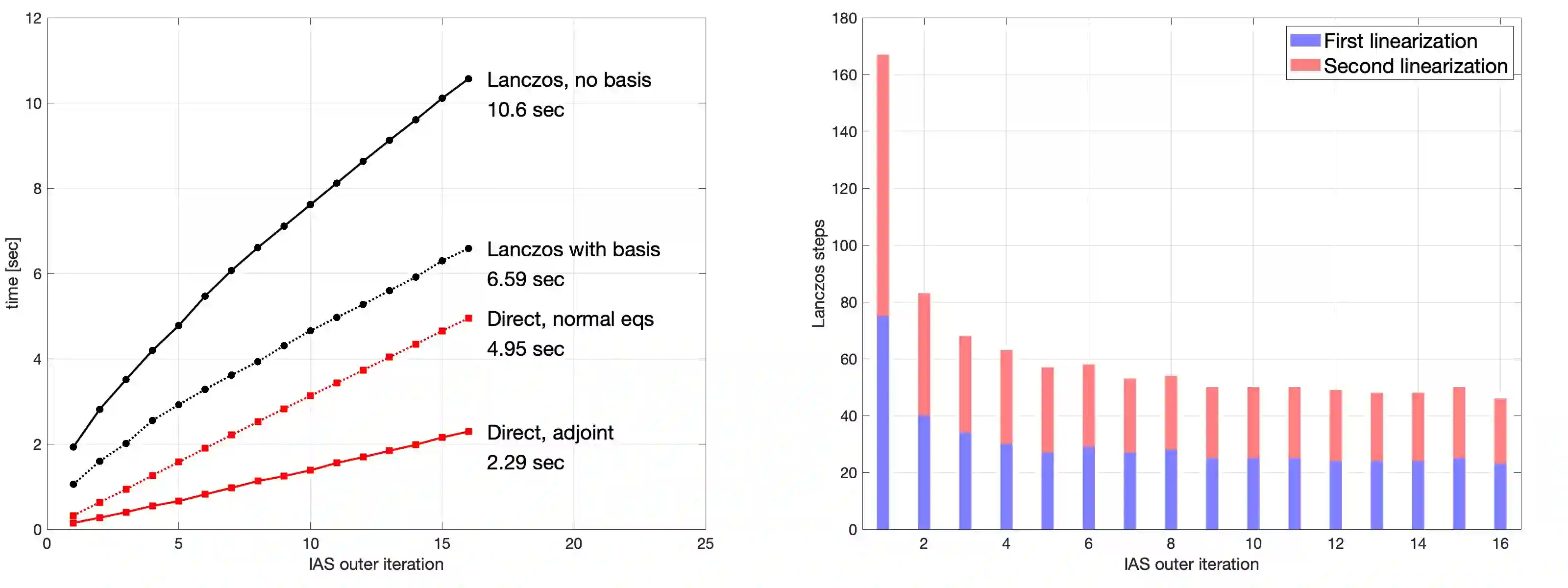
The electrical impedance tomography (EIT) problem of estimating the unknown conductivity distribution inside a domain from boundary current or voltage measurements requires the solution of a nonlinear inverse problem. Sparsity promoting hierarchical Bayesian models have been shown to be very effective in the recovery of almost piecewise constant solutions in linear inverse problems. We demonstrate that by exploiting linear algebraic considerations it is possible to organize the calculation for the Bayesian solution of the nonlinear EIT inverse problem via finite element methods with sparsity promoting priors in a computationally efficient manner. The proposed approach uses the Iterative Alternating Sequential (IAS) algorithm for the solution of the linearized problems. Within the IAS algorithm, a substantial reduction in computational complexity is attained by exploiting the low dimensionality of the data space and an adjoint formulation of the Tikhonov regularized solution that constitutes part of the iterative updating scheme. Numerical tests illustrate the computational efficiency of the proposed algorithm. The paper sheds light also on the convexity properties of the objective function of the maximum a posteriori (MAP) estimation problem.
翻译:电阻抗断层成像(EIT)问题旨在通过边界电流或电压测量值估计域内未知电导率分布,这需要求解一个非线性逆问题。稀疏性促进的分层贝叶斯模型已被证明在线性逆问题中恢复近似分段常数解方面非常有效。我们证明,通过利用线性代数考量,可以以计算高效的方式组织计算,通过有限元方法结合稀疏性促进先验,获得非线性EIT逆问题的贝叶斯解。所提出的方法使用迭代交替序列(IAS)算法求解线性化问题。在IAS算法内部,通过利用数据空间的低维性以及作为迭代更新方案一部分的Tikhonov正则化解的伴随形式,实现了计算复杂度的显著降低。数值测试展示了所提算法的计算效率。本文还阐明了最大后验(MAP)估计问题目标函数的凸性性质。




相关内容



 微信扫码咨询专知VIP会员