

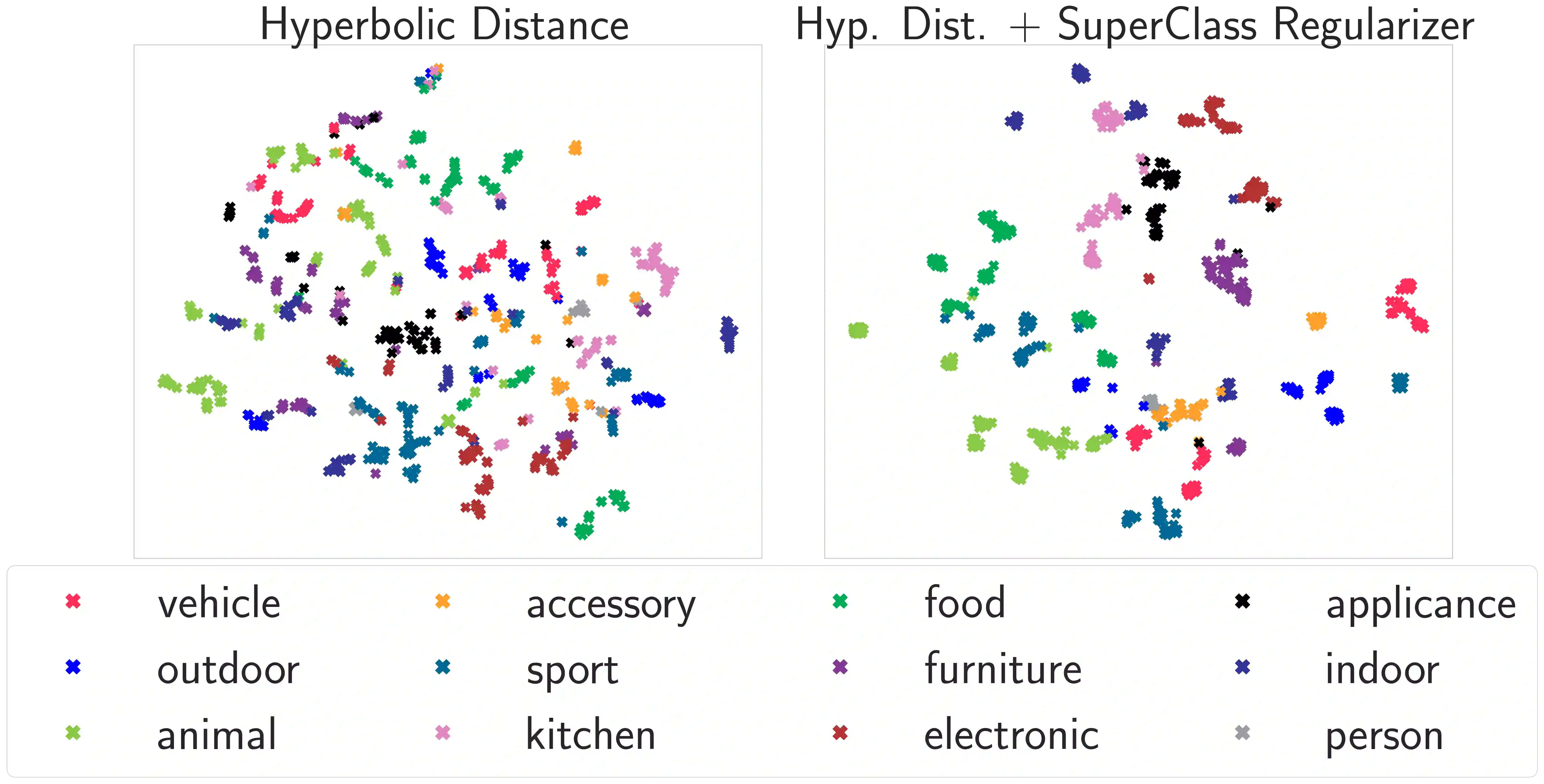
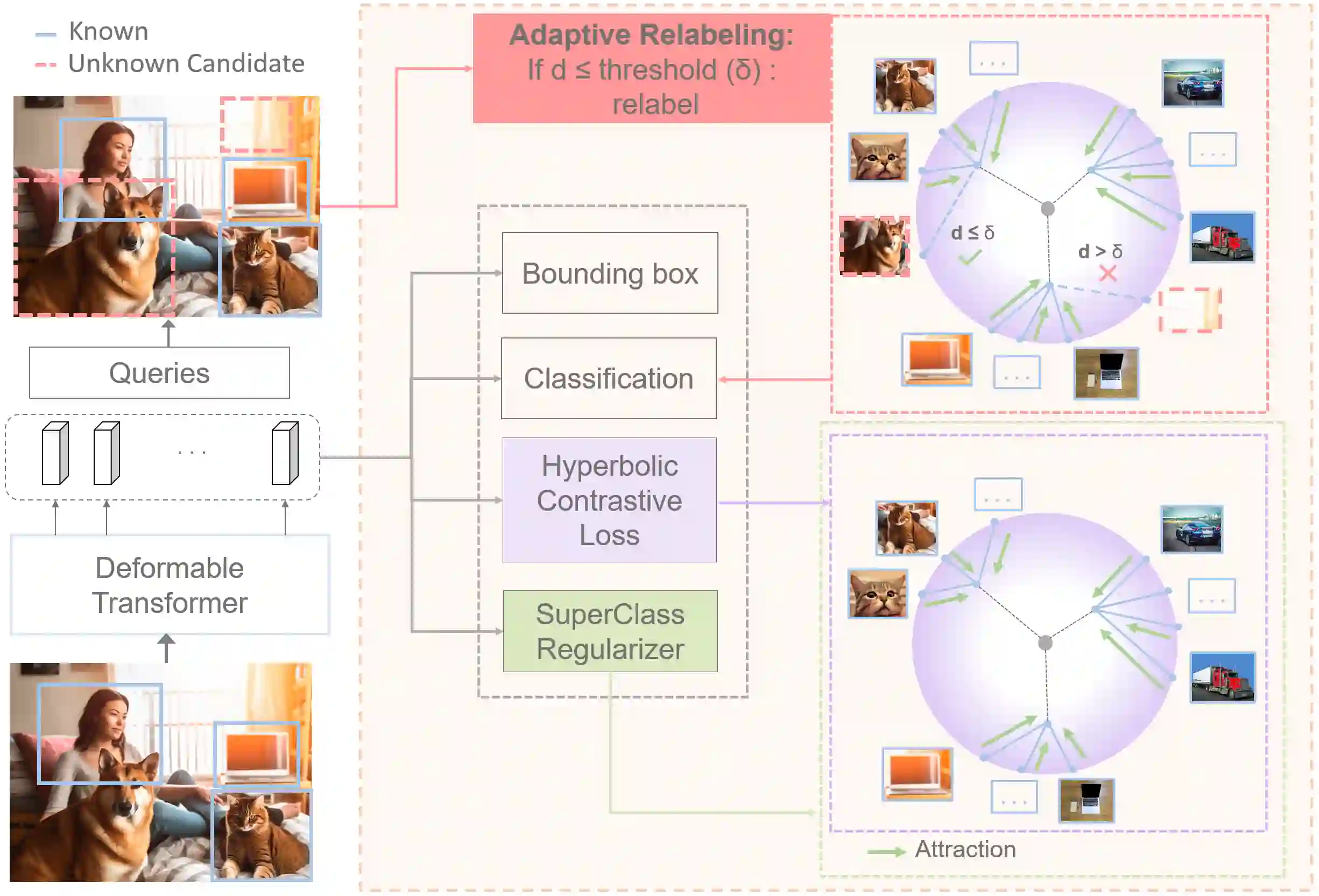
Open World Object Detection (OWOD) is a challenging and realistic task that extends beyond the scope of standard Object Detection task. It involves detecting both known and unknown objects while integrating learned knowledge for future tasks. However, the level of "unknownness" varies significantly depending on the context. For example, a tree is typically considered part of the background in a self-driving scene, but it may be significant in a household context. We argue that this contextual information should already be embedded within the known classes. In other words, there should be a semantic or latent structure relationship between the known and unknown items to be discovered. Motivated by this observation, we propose Hyp-OW, a method that learns and models hierarchical representation of known items through a SuperClass Regularizer. Leveraging this representation allows us to effectively detect unknown objects using a similarity distance-based relabeling module. Extensive experiments on benchmark datasets demonstrate the effectiveness of Hyp-OW, achieving improvement in both known and unknown detection (up to 6 percent). These findings are particularly pronounced in our newly designed benchmark, where a strong hierarchical structure exists between known and unknown objects. Our code can be found at https://github.com/boschresearch/Hyp-OW
翻译:开放世界目标检测(OWOD)是一项具有挑战性且更贴近实际的任务,其范畴超越了标准目标检测任务。该任务要求在检测已知与未知目标的同时,将所学知识整合至未来任务中。然而,“未知性”的程度会因上下文不同而显著变化。例如,在自动驾驶场景中,树木通常被视为背景的一部分,但在家庭环境中它可能具有重要意义。我们认为,此类上下文信息应已蕴含于已知类别之中。换言之,已知与未知目标之间应存在可挖掘的语义或潜在结构关系。基于此观察,我们提出Hyp-OW方法,该方法通过超类正则化器学习并建模已知目标的分层表征。利用这一表征,我们能通过基于相似距离的重标注模块有效检测未知目标。在基准数据集上的大量实验证明了Hyp-OW的有效性,其在已知与未知目标检测中均实现了性能提升(最高达6%)。该发现在我们新设计的基准测试中尤为显著——该测试中,已知与未知目标间存在强分层结构。我们的代码可访问:https://github.com/boschresearch/Hyp-OW





相关内容




 微信扫码咨询专知VIP会员