

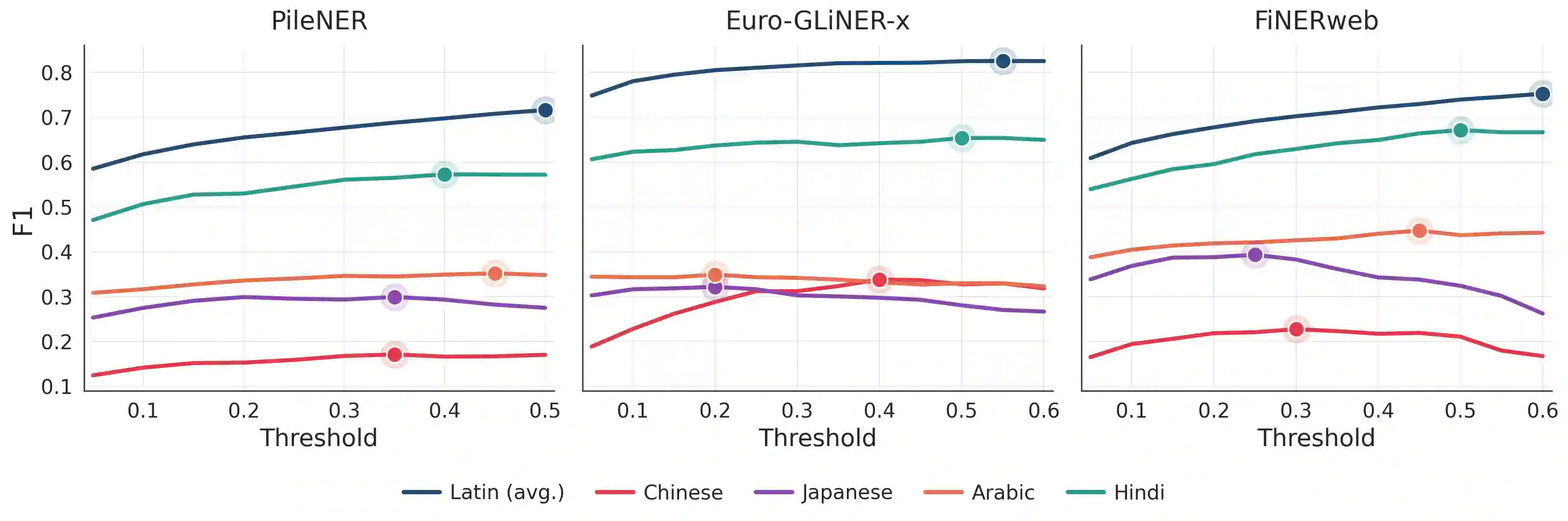
Recent progress in universal multilingual named entity recognition (NER) has been driven by multilingual transformer models, task-specific architectures, custom loss functions, and large-scale training datasets. However, despite substantial prior work, we find that many design decisions for such models are made without systematic justification, with individual components evaluated only in combination rather than in isolation. We argue that this impedes progress in the field by making it difficult to identify which choices improve multilingual generalization. In this work, we conduct an extensive empirical evaluation on transformer backbones, architectures, training objectives, data composition, and threshold selection for zero-shot, multilingual NER models. Building on these findings, we present Otter, a small encoder model that achieves consistent improvements over strong multilingual NER baselines, outperforming similarly sized models by 5.7 percentage points in F1. Further, it remains within 1.4 points of Qwen3-32B and 5.4 points below Gemma3-27B, while being roughly 90x smaller and one to two orders of magnitude faster at inference.
翻译:暂无翻译




相关内容





 微信扫码咨询专知VIP会员