

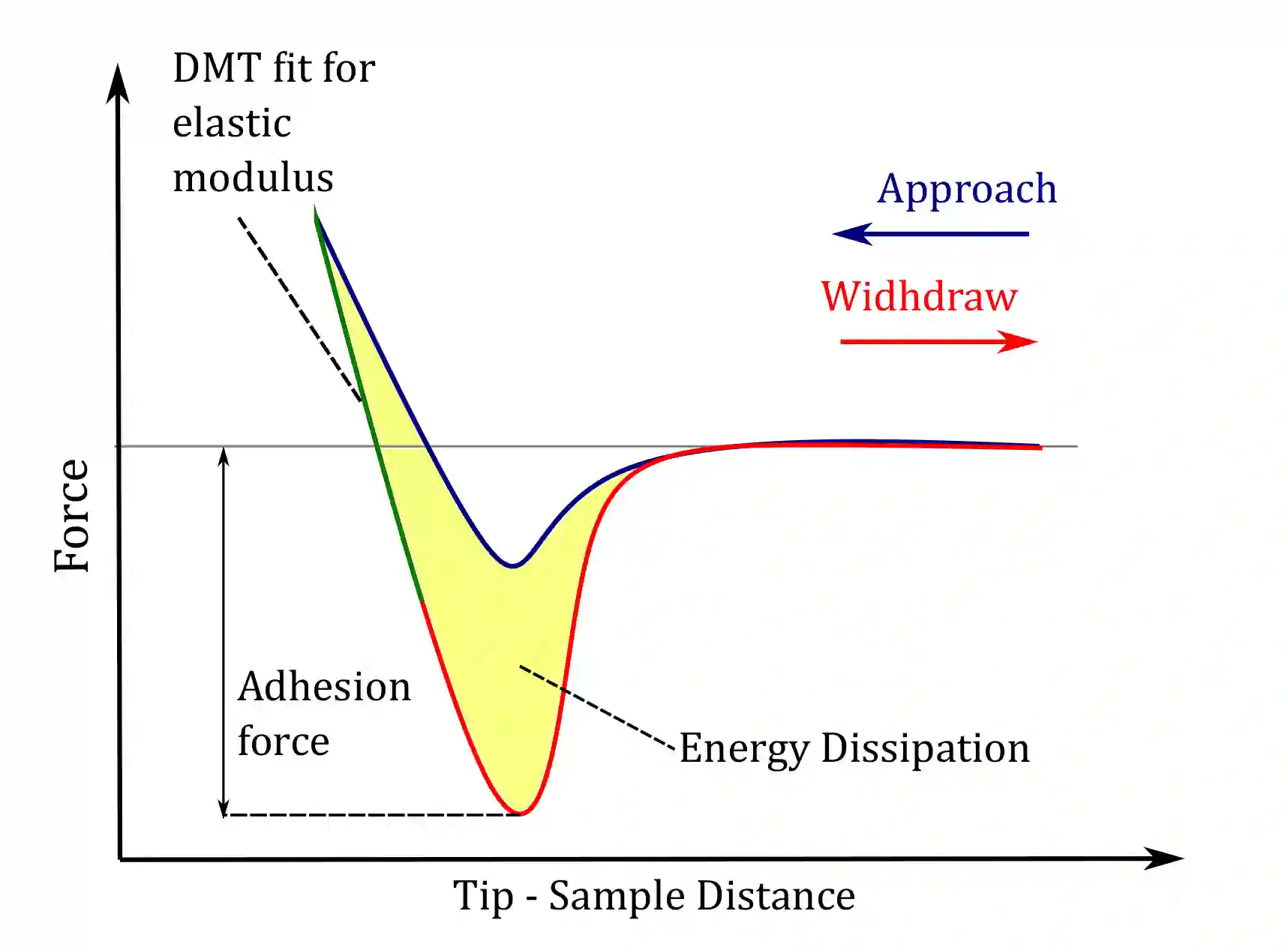
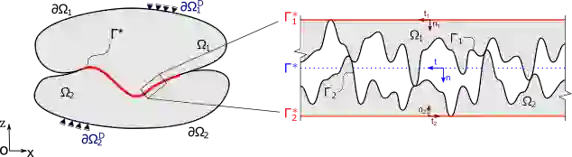
This study presents an advanced numerical framework that integrates experimentally acquired Atomic Force Microscope (AFM) data into high-fidelity simulations for adhesive rough contact problems, bridging the gap between experimental physics and computational mechanics. The proposed approach extends the eMbedded Profile for Joint Roughness (MPJR) interface finite element method to incorporate both surface topography and spatially varying adhesion properties, imported directly from AFM measurements. The adhesion behavior is modeled using a modified Lennard-Jones potential, which is locally parameterized based on the AFM-extracted adhesion peak force and energy dissipation data. The effectiveness of this method is demonstrated through 2D and 3D finite element simulations of a heterogeneous PS-LDPE (polystyrene matrix with low-density polyethylene inclusions) sample, where the bulk elastic properties are also experimentally characterized via AFM. The results highlight the significance of accounting for both surface adhesion variability and material bulk heterogeneity in accurately predicting contact responses.
翻译:本研究提出了一种先进的数值框架,将实验获取的原子力显微镜数据融入高保真度的黏附粗糙接触问题仿真中,从而弥合实验物理学与计算力学之间的鸿沟。该方法拓展了联合粗糙度嵌入轮廓界面有限元法,通过直接导入AFM测量数据,同时纳入表面形貌与空间变化的黏附特性。黏附行为采用修正的Lennard-Jones势函数进行建模,其局部参数化基于AFM提取的黏附峰值力与能量耗散数据。通过对异质PS-LDPE样品的二维与三维有限元仿真验证了该方法的有效性,其中聚苯乙烯基体与低密度聚乙烯夹杂物的体弹性特性亦通过AFM实验表征。研究结果凸显了同时考虑表面黏附变异性和材料体相异质性对于精确预测接触响应的重要性。







相关内容




 微信扫码咨询专知VIP会员