

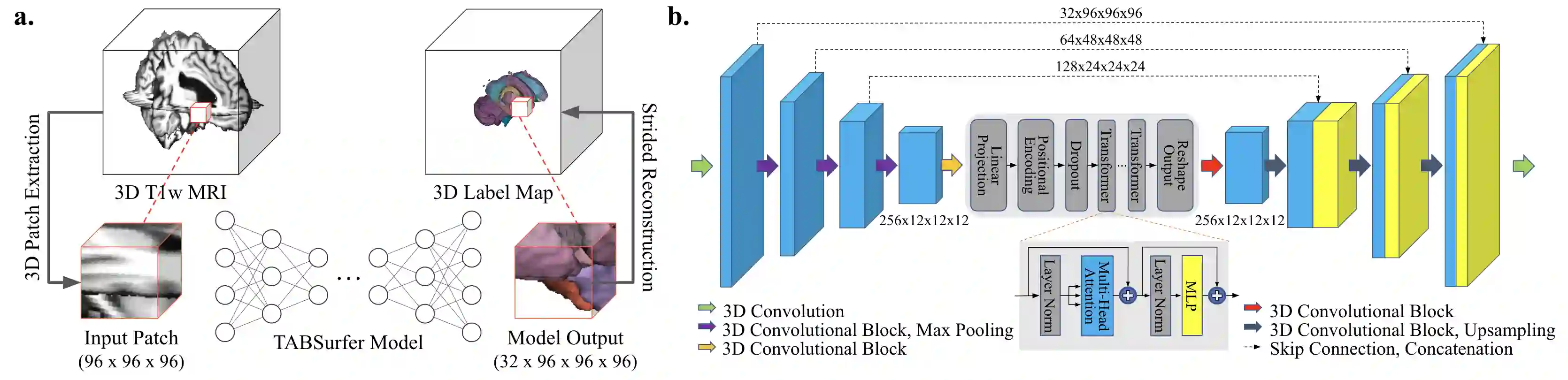
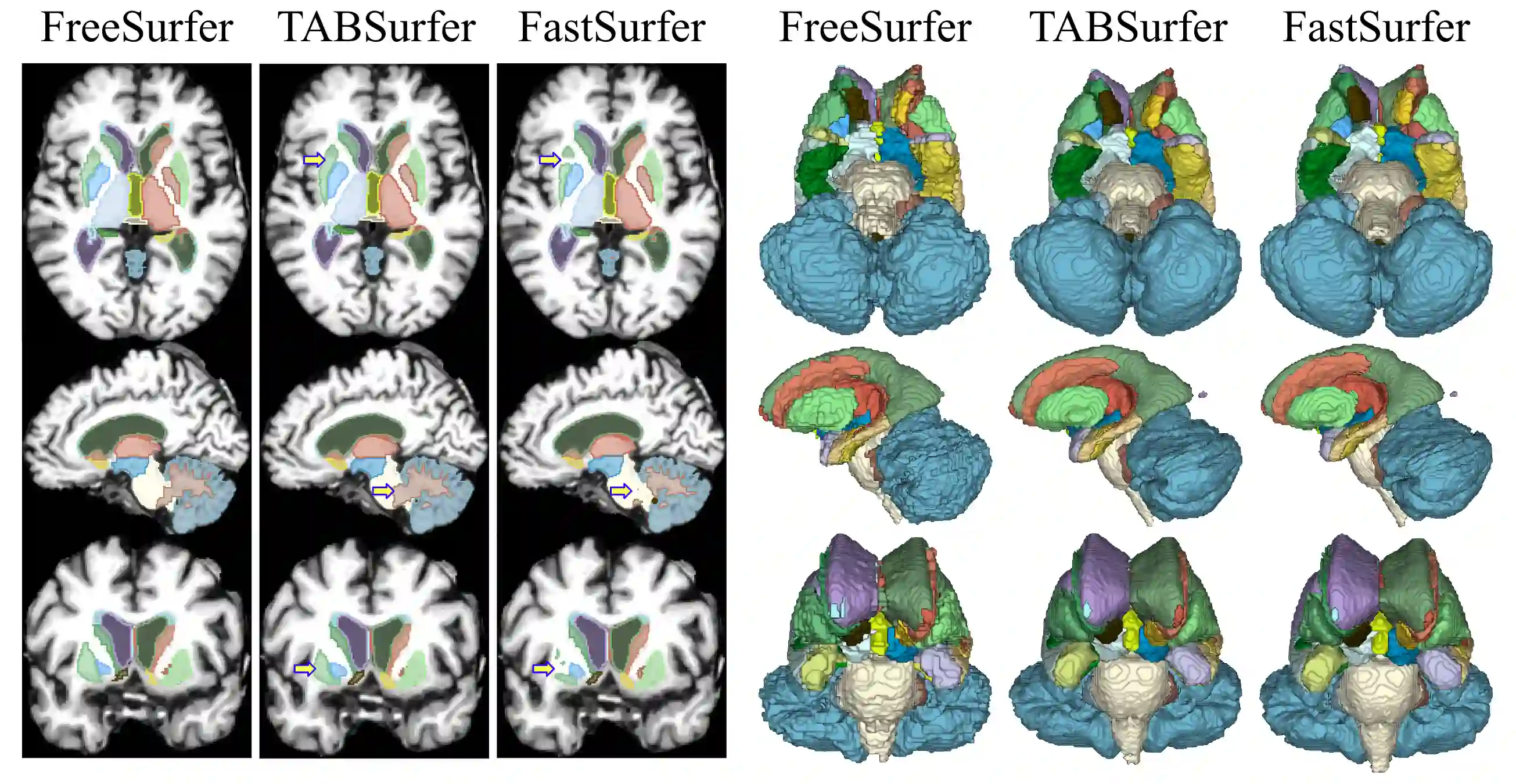
Subcortical segmentation remains challenging despite its important applications in quantitative structural analysis of brain MRI scans. The most accurate method, manual segmentation, is highly labor intensive, so automated tools like FreeSurfer have been adopted to handle this task. However, these traditional pipelines are slow and inefficient for processing large datasets. In this study, we propose TABSurfer, a novel 3D patch-based CNN-Transformer hybrid deep learning model designed for superior subcortical segmentation compared to existing state-of-the-art tools. To evaluate, we first demonstrate TABSurfer's consistent performance across various T1w MRI datasets with significantly shorter processing times compared to FreeSurfer. Then, we validate against manual segmentations, where TABSurfer outperforms FreeSurfer based on the manual ground truth. In each test, we also establish TABSurfer's advantage over a leading deep learning benchmark, FastSurferVINN. Together, these studies highlight TABSurfer's utility as a powerful tool for fully automated subcortical segmentation with high fidelity.
翻译:皮层下结构分割在脑部磁共振成像(MRI)扫描的定量结构分析中具有重要应用,但该任务仍具挑战性。最精确的方法是手动分割,但其高度耗时耗力,因此诸如FreeSurfer等自动化工具已被用于处理此任务。然而,这些传统流程在处理大型数据集时速度慢且效率低下。在本研究中,我们提出了TABSurfer,一种新颖的基于三维图像块的CNN-Transformer混合深度学习模型,旨在实现比现有最先进工具更优的皮层下结构分割效果。为进行评估,我们首先展示了TABSurfer在多种T1加权MRI数据集上的一致性能,其处理时间相较于FreeSurfer显著缩短。随后,我们以手动分割结果为金标准进行验证,结果表明TABSurfer的表现优于FreeSurfer。在每项测试中,我们还证实了TABSurfer相较于领先的深度学习基准模型FastSurferVINN的优势。综上所述,这些研究凸显了TABSurfer作为一种高保真度、全自动皮层下结构分割强大工具的实用性。




相关内容





 微信扫码咨询专知VIP会员