

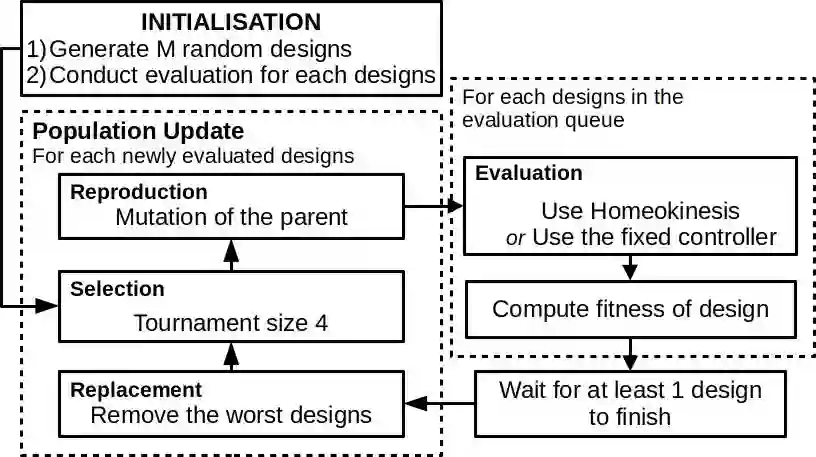
Methods for generative design of robot physical configurations can automatically find optimal and innovative solutions for challenging tasks in complex environments. The vast search-space includes the physical design-space and the controller parameter-space, making it a challenging problem in machine learning and optimisation in general. Evolutionary algorithms (EAs) have shown promising results in generating robot designs via gradient-free optimisation. Morpho-evolution with learning (MEL) uses EAs to concurrently generate robot designs and learn the optimal parameters of the controllers. Two main issues prevent MEL from scaling to higher complexity tasks: computational cost and premature convergence to sub-optimal designs. To address these issues, we propose combining morpho-evolution with intrinsic motivations. Intrinsically motivated behaviour arises from embodiment and simple learning rules without external guidance. We use a homeokinetic controller that generates exploratory behaviour in a few seconds with reduced knowledge of the robot's design. Homeokinesis replaces costly learning phases, reducing computational time and favouring diversity, preventing premature convergence. We compare our approach with current MEL methods in several downstream tasks. The generated designs score higher in all the tasks, are more diverse, and are quickly generated compared to morpho-evolution with static parameters.
翻译:机器人物理构型的生成式设计方法能够自动为复杂环境中的挑战性任务寻找最优且创新的解决方案。庞大的搜索空间包含物理设计空间与控制器参数空间,这使其成为机器学习和优化领域普遍面临的难题。进化算法通过无梯度优化在生成机器人设计方面已展现出良好前景。结合学习的形态进化方法运用进化算法同步生成机器人设计并学习控制器的最优参数。目前制约该方法向更高复杂度任务扩展的两个主要问题是:计算成本过高以及过早收敛至次优设计。为解决这些问题,我们提出将形态进化与内在动机相结合。内在动机行为产生于具身认知和简单学习规则,无需外部引导。我们采用一种动态平衡控制器,该控制器能在数秒内产生探索行为,且对机器人设计的认知需求较低。动态平衡机制替代了耗时的学习阶段,既减少了计算时间,又促进了设计多样性,从而避免过早收敛。我们在多项下游任务中将本方法与现有结合学习的形态进化方法进行对比。实验表明,相较于静态参数的形态进化方法,本方法生成的机器人设计在所有任务中均获得更高评分,具有更强的多样性,且生成速度显著提升。




相关内容




 微信扫码咨询专知VIP会员