

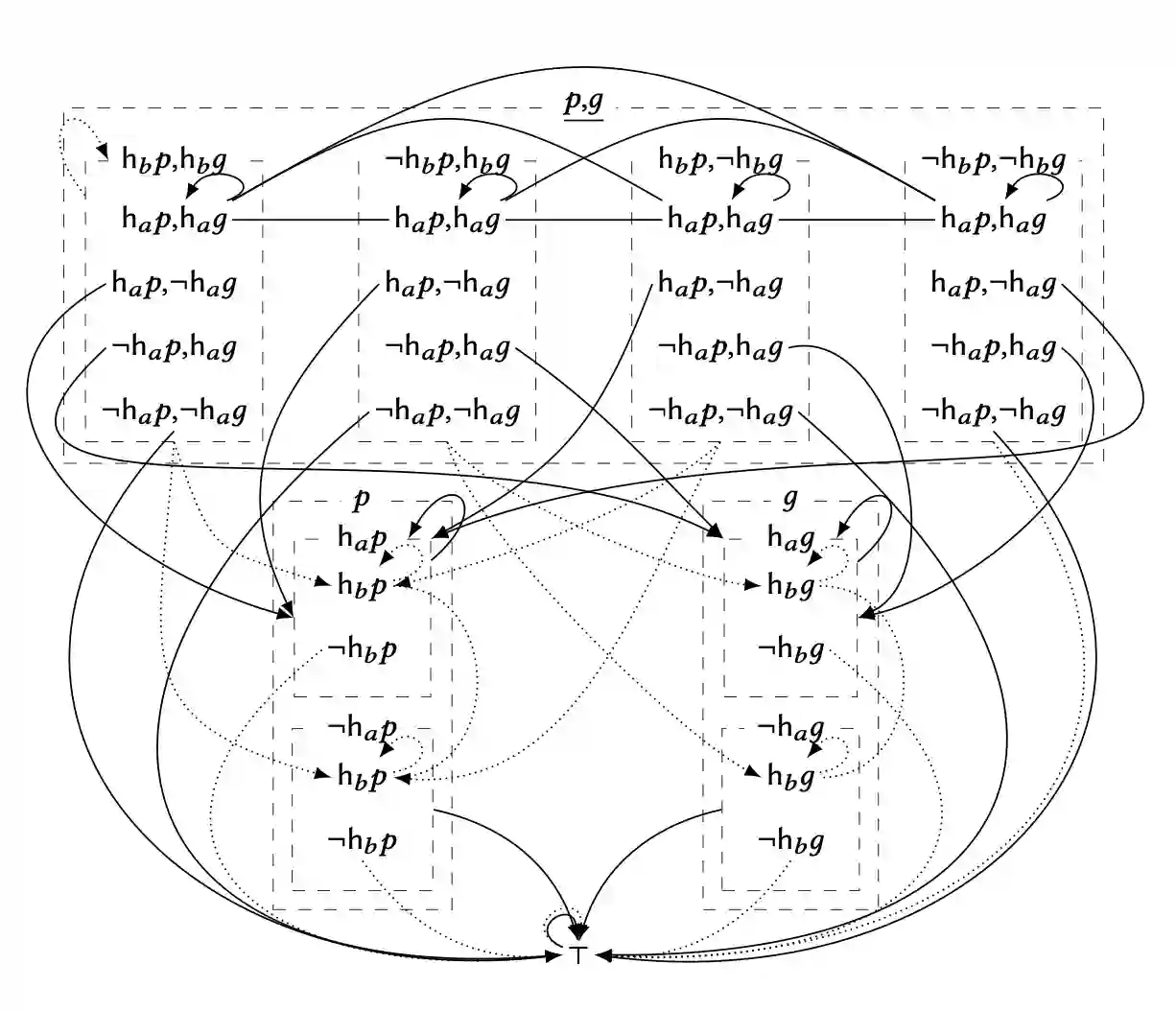
Attention is the crucial cognitive ability that limits and selects what information we observe. Previous work by Bolander et al. (2016) proposes a model of attention based on dynamic epistemic logic (DEL) where agents are either fully attentive or not attentive at all. While introducing the realistic feature that inattentive agents believe nothing happens, the model does not represent the most essential aspect of attention: its selectivity. Here, we propose a generalization that allows for paying attention to subsets of atomic formulas. We introduce the corresponding logic for propositional attention, and show its axiomatization to be sound and complete. We then extend the framework to account for inattentive agents that, instead of assuming nothing happens, may default to a specific truth-value of what they failed to attend to (a sort of prior concerning the unattended atoms). This feature allows for a more cognitively plausible representation of the inattentional blindness phenomenon, where agents end up with false beliefs due to their failure to attend to conspicuous but unexpected events. Both versions of the model define attention-based learning through appropriate DEL event models based on a few and clear edge principles. While the size of such event models grow exponentially both with the number of agents and the number of atoms, we introduce a new logical language for describing event models syntactically and show that using this language our event models can be represented linearly in the number of agents and atoms. Furthermore, representing our event models using this language is achieved by a straightforward formalisation of the aforementioned edge principles.
翻译:注意力是一种关键的认知能力,它限制并选择我们观察到的信息。Bolander等人(2016)先前的工作提出了一种基于动态认知逻辑(DEL)的注意力模型,其中主体要么完全注意,要么完全不注意。虽然该模型引入了“不注意的主体认为无事发生”这一符合现实的特性,但它并未表征注意力最本质的方面:选择性。在此,我们提出一个泛化模型,允许主体关注原子公式的子集。我们引入了相应的命题注意力逻辑,并证明其公理化系统的可靠性与完备性。接着,我们扩展该框架以考虑不注意的主体:它们并非默认无事发生,而是可能对其未能关注的命题采取特定的真值预设(一种关于未关注原子的先验)。这一特性使得对“非注意盲视”现象的认知表征更加逼真——在该现象中,主体因未能关注到显著但意外的事件而产生错误信念。两个版本的模型均通过基于少量清晰边原则的适当DEL事件模型,定义了基于注意力的学习过程。尽管此类事件模型的规模随主体数量和原子数量呈指数增长,我们引入了一种用于句法描述事件模型的新逻辑语言,并证明使用该语言可将事件模型表示为关于主体数量和原子数量的线性形式。此外,通过直接形式化上述边原则,我们即可用该语言简洁地表达事件模型。




相关内容




 微信扫码咨询专知VIP会员