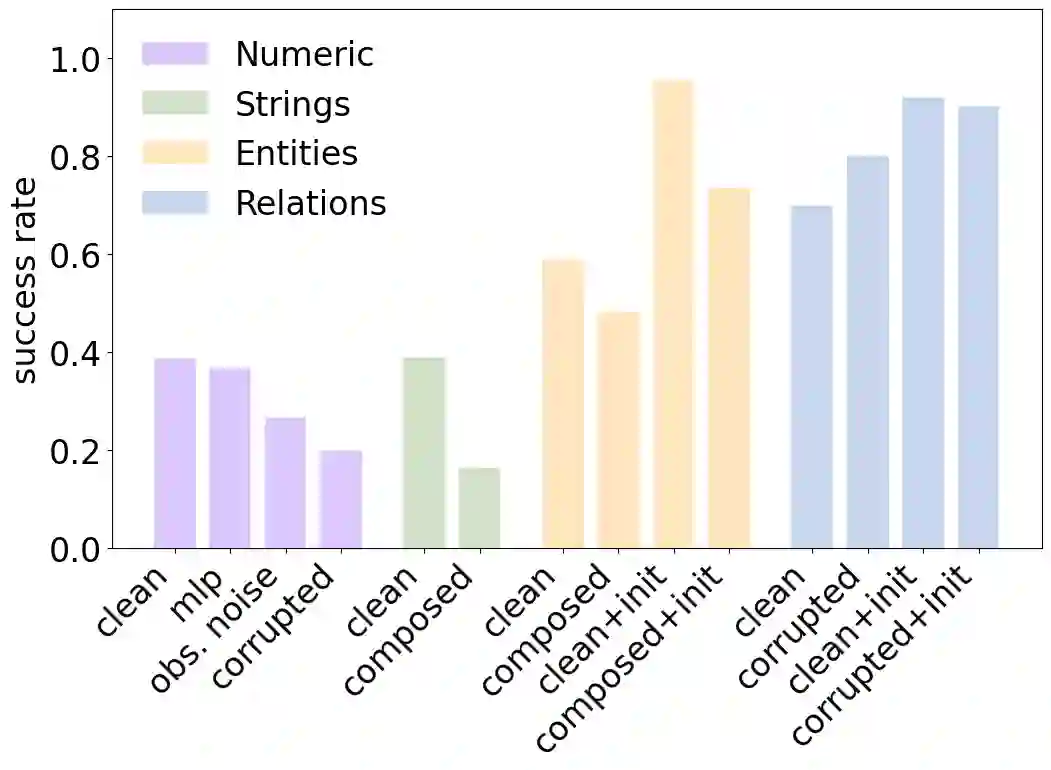
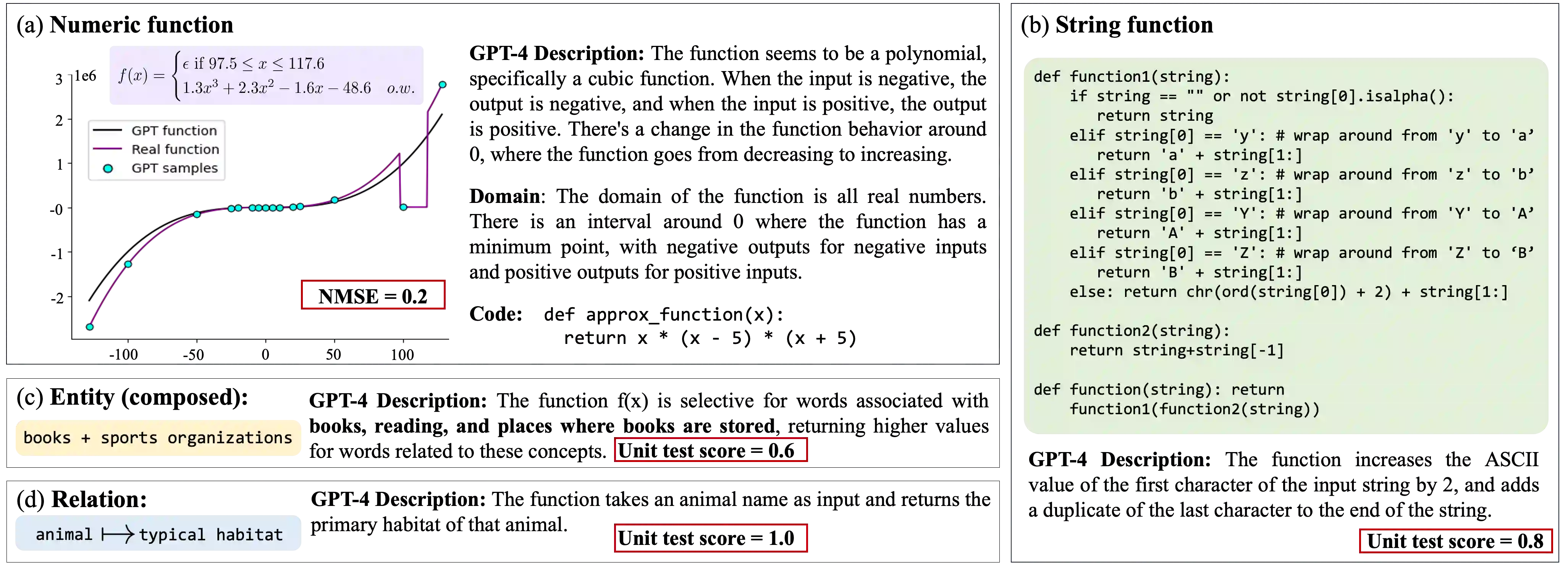
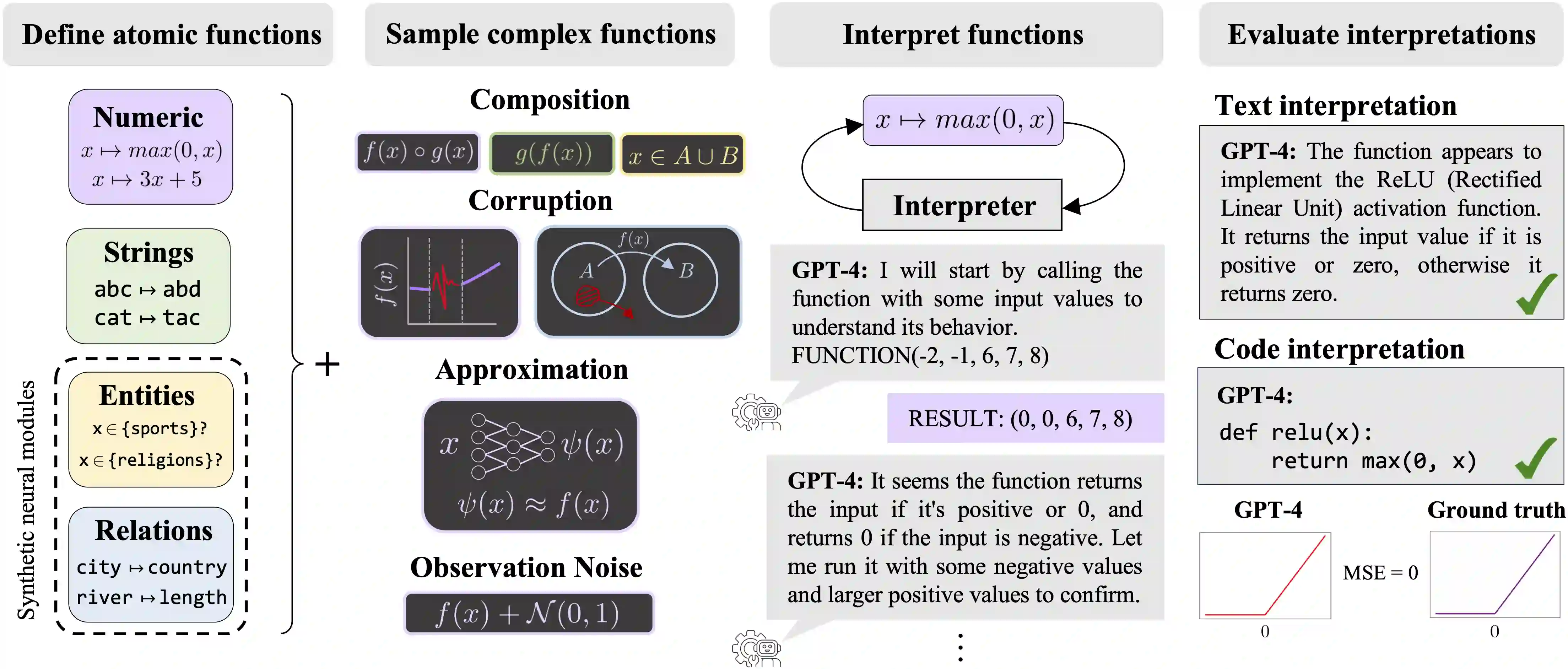
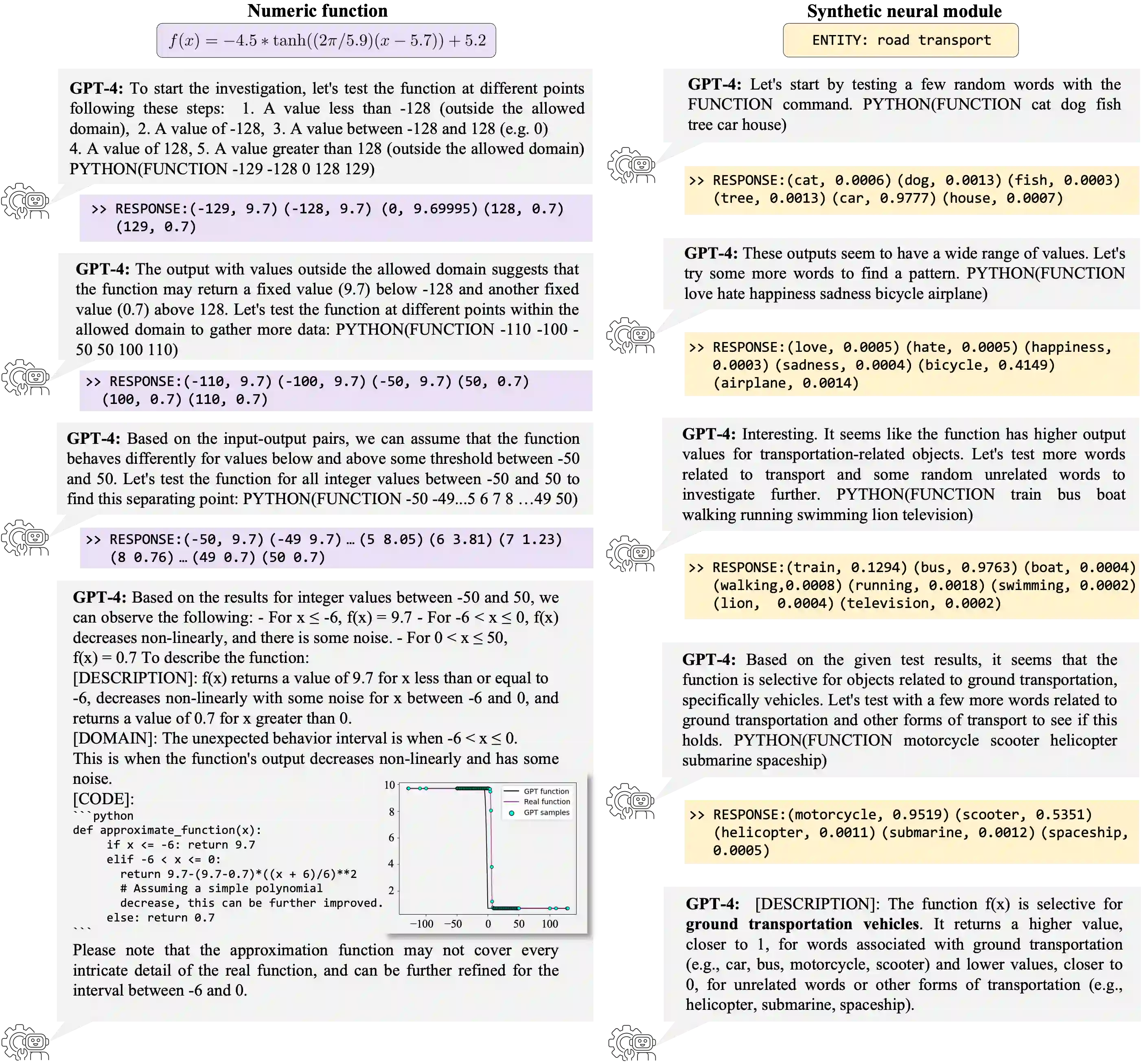
Labeling neural network submodules with human-legible descriptions is useful for many downstream tasks: such descriptions can surface failures, guide interventions, and perhaps even explain important model behaviors. To date, most mechanistic descriptions of trained networks have involved small models, narrowly delimited phenomena, and large amounts of human labor. Labeling all human-interpretable sub-computations in models of increasing size and complexity will almost certainly require tools that can generate and validate descriptions automatically. Recently, techniques that use learned models in-the-loop for labeling have begun to gain traction, but methods for evaluating their efficacy are limited and ad-hoc. How should we validate and compare open-ended labeling tools? This paper introduces FIND (Function INterpretation and Description), a benchmark suite for evaluating the building blocks of automated interpretability methods. FIND contains functions that resemble components of trained neural networks, and accompanying descriptions of the kind we seek to generate. The functions are procedurally constructed across textual and numeric domains, and involve a range of real-world complexities, including noise, composition, approximation, and bias. We evaluate new and existing methods that use language models (LMs) to produce code-based and language descriptions of function behavior. We find that an off-the-shelf LM augmented with only black-box access to functions can sometimes infer their structure, acting as a scientist by forming hypotheses, proposing experiments, and updating descriptions in light of new data. However, LM-based descriptions tend to capture global function behavior and miss local corruptions. These results show that FIND will be useful for characterizing the performance of more sophisticated interpretability methods before they are applied to real-world models.


翻译:用人类可读的描述对神经网络子模块进行标注,对许多下游任务非常有用:这类描述能够暴露故障、指导干预,甚至可能解释重要的模型行为。迄今为止,大多数对训练网络进行的机制性描述都涉及小型模型、狭窄界定的现象以及大量人力劳动。要为规模与复杂度日益增长的模型标注所有人类可解释的子计算,几乎必然需要能够自动生成并验证描述的工具。近年来,在标注过程中使用学习模型进行循环交互的技术开始受到关注,但评估其效能的方法既有限又缺乏统一性。我们应如何验证并比较开放式标注工具?本文提出了FIND(函数解释与描述基准),这是一个用于评估自动化可解释性方法构建模块的基准套件。FIND包含类似于训练神经网络组件的函数,以及我们期望生成的配套描述。这些函数通过程序化方式在文本与数值领域中构建,涉及噪声、组合、近似和偏置等现实世界中的复杂情况。我们评估了使用语言模型生成基于代码和自然语言的函数行为描述的各种新旧方法。研究发现,仅具备函数黑盒访问权限的现成语言模型有时能推断其结构——如同科学家般提出假设、设计实验、并根据新数据更新描述。然而,基于语言模型的描述倾向于捕捉全局函数行为,却遗漏局部损坏。这些结果表明,FIND将有助于在更复杂的可解释性方法应用于真实世界模型之前,表征其性能特征。
0
下载
关闭预览

相关内容

FlowQA: Grasping Flow in History for Conversational Machine Comprehension
专知会员服务
34+阅读 · 2019年10月18日
Stabilizing Transformers for Reinforcement Learning
专知会员服务
60+阅读 · 2019年10月17日
《DeepGCNs: Making GCNs Go as Deep as CNNs》
专知会员服务
32+阅读 · 2019年10月17日
Keras François Chollet 《Deep Learning with Python 》, 386页pdf
专知会员服务
164+阅读 · 2019年10月12日
【SIGGRAPH2019】TensorFlow 2.0深度学习计算机图形学应用
专知会员服务
41+阅读 · 2019年10月9日
Hierarchically Structured Meta-learning
CreateAMind
27+阅读 · 2019年5月22日
Transferring Knowledge across Learning Processes
CreateAMind
29+阅读 · 2019年5月18日
强化学习的Unsupervised Meta-Learning
CreateAMind
18+阅读 · 2019年1月7日
Unsupervised Learning via Meta-Learning
CreateAMind
44+阅读 · 2019年1月3日
A Technical Overview of AI & ML in 2018 & Trends for 2019
待字闺中
18+阅读 · 2018年12月24日
STRCF for Visual Object Tracking
统计学习与视觉计算组
15+阅读 · 2018年5月29日
Hierarchical Imitation - Reinforcement Learning
CreateAMind
19+阅读 · 2018年5月25日
Focal Loss for Dense Object Detection
统计学习与视觉计算组
12+阅读 · 2018年3月15日
IJCAI | Cascade Dynamics Modeling with Attention-based RNN
KingsGarden
13+阅读 · 2017年7月16日
From Softmax to Sparsemax-ICML16(1)
KingsGarden
74+阅读 · 2016年11月26日
国家自然科学基金
13+阅读 · 2017年12月31日
国家自然科学基金
18+阅读 · 2017年12月31日
国家自然科学基金
2+阅读 · 2015年12月31日
国家自然科学基金
1+阅读 · 2015年12月31日
国家自然科学基金
4+阅读 · 2015年12月31日
国家自然科学基金
2+阅读 · 2015年12月31日
国家自然科学基金
3+阅读 · 2015年12月31日
国家自然科学基金
0+阅读 · 2014年12月31日
国家自然科学基金
0+阅读 · 2014年12月31日
国家自然科学基金
2+阅读 · 2014年12月31日
Arxiv
0+阅读 · 2023年10月24日
Arxiv
12+阅读 · 2021年7月26日
Arxiv
11+阅读 · 2019年4月15日
Arxiv
18+阅读 · 2019年3月28日
A Comprehensive Survey on Graph Neural Networks
Arxiv
21+阅读 · 2019年1月3日
Arxiv
15+阅读 · 2018年2月4日
VIP会员
最新内容
ICML 2026 | SARDI:扩散语言模型的自增强检索
专知会员服务
5+阅读 · 6月6日
《国防领域安全采用大语言模型的战略蓝图》
专知会员服务
9+阅读 · 6月6日
ICML 2026 | 演化选择的因果建模
专知会员服务
8+阅读 · 6月5日
综述|学习式3D表征最新进展与趋势
专知会员服务
7+阅读 · 6月5日
人工智能重塑威慑:算法优势的兴起
专知会员服务
8+阅读 · 6月5日
AgentOps综述:智能体系统运维框架
专知会员服务
17+阅读 · 6月4日
相关资讯
Hierarchically Structured Meta-learning
CreateAMind
27+阅读 · 2019年5月22日
Transferring Knowledge across Learning Processes
CreateAMind
29+阅读 · 2019年5月18日
强化学习的Unsupervised Meta-Learning
CreateAMind
18+阅读 · 2019年1月7日
Unsupervised Learning via Meta-Learning
CreateAMind
44+阅读 · 2019年1月3日
A Technical Overview of AI & ML in 2018 & Trends for 2019
待字闺中
18+阅读 · 2018年12月24日
STRCF for Visual Object Tracking
统计学习与视觉计算组
15+阅读 · 2018年5月29日
Hierarchical Imitation - Reinforcement Learning
CreateAMind
19+阅读 · 2018年5月25日
Focal Loss for Dense Object Detection
统计学习与视觉计算组
12+阅读 · 2018年3月15日
IJCAI | Cascade Dynamics Modeling with Attention-based RNN
KingsGarden
13+阅读 · 2017年7月16日
From Softmax to Sparsemax-ICML16(1)
KingsGarden
74+阅读 · 2016年11月26日
相关基金
国家自然科学基金
13+阅读 · 2017年12月31日
国家自然科学基金
18+阅读 · 2017年12月31日
国家自然科学基金
2+阅读 · 2015年12月31日
国家自然科学基金
1+阅读 · 2015年12月31日
国家自然科学基金
4+阅读 · 2015年12月31日
国家自然科学基金
2+阅读 · 2015年12月31日
国家自然科学基金
3+阅读 · 2015年12月31日
国家自然科学基金
0+阅读 · 2014年12月31日
国家自然科学基金
0+阅读 · 2014年12月31日
国家自然科学基金
2+阅读 · 2014年12月31日
Top
微信扫码咨询专知VIP会员