

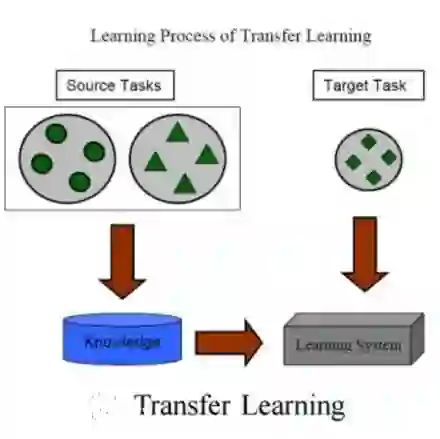
Transfer learning is a key component of modern machine learning, enhancing the performance of target tasks by leveraging diverse data sources. Simultaneously, overparameterized models such as the minimum-$\ell_2$-norm interpolator (MNI) in high-dimensional linear regression have garnered significant attention for their remarkable generalization capabilities, a property known as benign overfitting. Despite their individual importance, the intersection of transfer learning and MNI remains largely unexplored. Our research bridges this gap by proposing a novel two-step Transfer MNI approach and analyzing its trade-offs. We characterize its non-asymptotic excess risk and identify conditions under which it outperforms the target-only MNI. Our analysis reveals free-lunch covariate shift regimes, where leveraging heterogeneous data yields the benefit of knowledge transfer at limited cost. To operationalize our findings, we develop a data-driven procedure to detect informative sources and introduce an ensemble method incorporating multiple informative Transfer MNIs. Finite-sample experiments demonstrate the robustness of our methods to model and data heterogeneity, confirming their advantage.
翻译:迁移学习是现代机器学习的关键组成部分,通过利用多样化数据源来提升目标任务的性能。与此同时,过参数化模型(如高维线性回归中的最小$\ell_2$范数插值器)因其卓越的泛化能力而受到广泛关注,这一特性被称为良性过拟合。尽管二者各自具有重要意义,但迁移学习与最小$\ell_2$范数插值器的交叉研究仍基本处于空白。本研究通过提出一种新颖的两步迁移最小$\ell_2$范数插值器方法并分析其权衡关系,填补了这一空白。我们刻画了其非渐近超额风险,并确定了其性能优于仅使用目标数据的最小$\ell_2$范数插值器的条件。分析揭示了"免费午餐"协变量偏移机制,即利用异构数据能以有限成本获得知识迁移的收益。为实践应用这些发现,我们开发了数据驱动程序来检测信息源,并提出了集成多个信息性迁移最小$\ell_2$范数插值器的集成方法。有限样本实验证明了我们的方法对模型和数据异质性的鲁棒性,验证了其优势。




相关内容




 微信扫码咨询专知VIP会员