

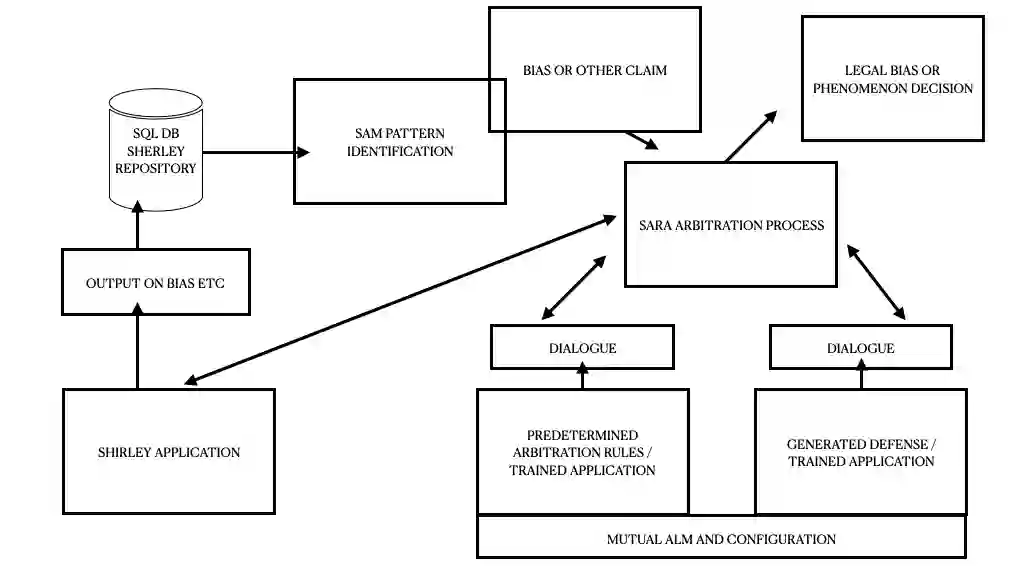
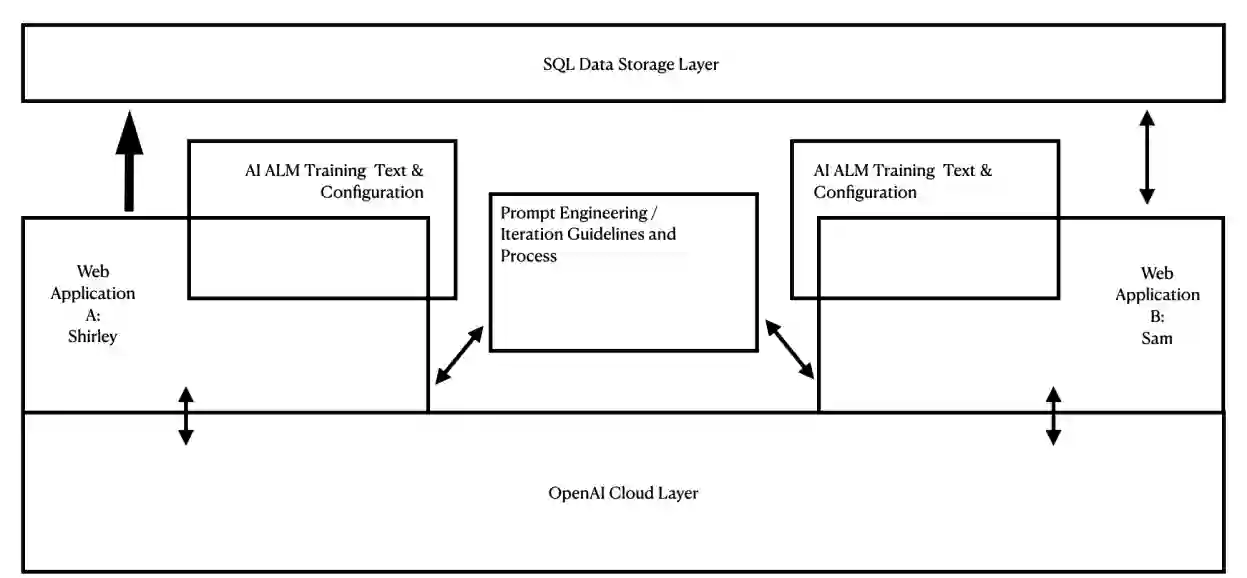
This study consists of a novel approach toward the analysis of court judgments spanning five countries, including the United States, the United Kingdom, Rwanda, Sweden and Hong Kong. This study also explores the intersection of the latest advancements in artificial intelligence (AI) and legal analysis, emphasizing the role of AI (specifically generative AI) in identifying human biases and facilitating automated, valid, and coherent multisided argumentation of court judgments with the goal of ensuring consistent application of laws in and across various jurisdictions. By incorporating Advanced Language Models (ALMs) and a newly introduced human-AI collaborative framework, this paper seeks to analyze Grounded Theory-based research design with Advanced Language Models (ALMs) in the practice of law. SHIRLEY is the name of the AI-based application (built on top of OpenAI's GPT technology), focusing on detecting logical inconsistencies and biases across various legal decisions. SHIRLEY analysis is aggregated and is accompanied by a comparison-oriented AI-based application called SAM (also an ALM) to identify relative deviations in SHIRLEY bias detections. Further, a CRITIC is generated within semi-autonomous arbitration process via the ALM, SARA. A novel approach is introduced in the utilization of an AI arbitrator to critically evaluate biases and qualitative-in-nature nuances identified by the aforementioned AI applications (SAM in concert with SHIRLEY), based on the Hague Rules on Business and Human Rights Arbitration. This Semi-Automated Arbitration Process (SAAP) aims to uphold the integrity and fairness of legal judgments by ensuring a nuanced debate-resultant "understanding" through a hybrid system of AI and human-based collaborative analysis.
翻译:本研究提出了一种新颖方法,用于分析涵盖美国、英国、卢旺达、瑞典和中国香港五个国家的法院判决。同时,本研究探讨了人工智能(AI)最新进展与法律分析的交叉领域,着重强调AI(尤其是生成式AI)在识别人类偏见、促进法院判决的自动化、有效且连贯的多方论证中的作用,旨在确保法律在不同法域内及跨法域的一致适用。通过整合高级语言模型(ALMs)与新型人机协作框架,本文试图分析基于扎根理论的研究设计与法律实践中ALMs的结合应用。SHIRLEY是基于OpenAI的GPT技术构建的AI应用名称,专注于检测不同法律判决中的逻辑不一致性与偏见。SHIRLEY的分析结果经过汇总,并辅以名为SAM(同为ALM)的对比型AI应用,以识别SHIRLEY偏见检测中的相对偏差。此外,通过ALM系统SARA在半自主仲裁流程中生成了CRITIC分析。本文引入了一种创新方法,即利用AI仲裁员基于《海牙商业与人权仲裁规则》,对前述AI应用(SAM与SHIRLEY协同工作)所识别的偏见及定性细微差异进行批判性评估。这一半自动仲裁流程(SAAP)旨在通过人机混合协作分析系统,确保形成细致论证后产生的"理解",从而维护法律裁判的完整性与公正性。




相关内容




 微信扫码咨询专知VIP会员