

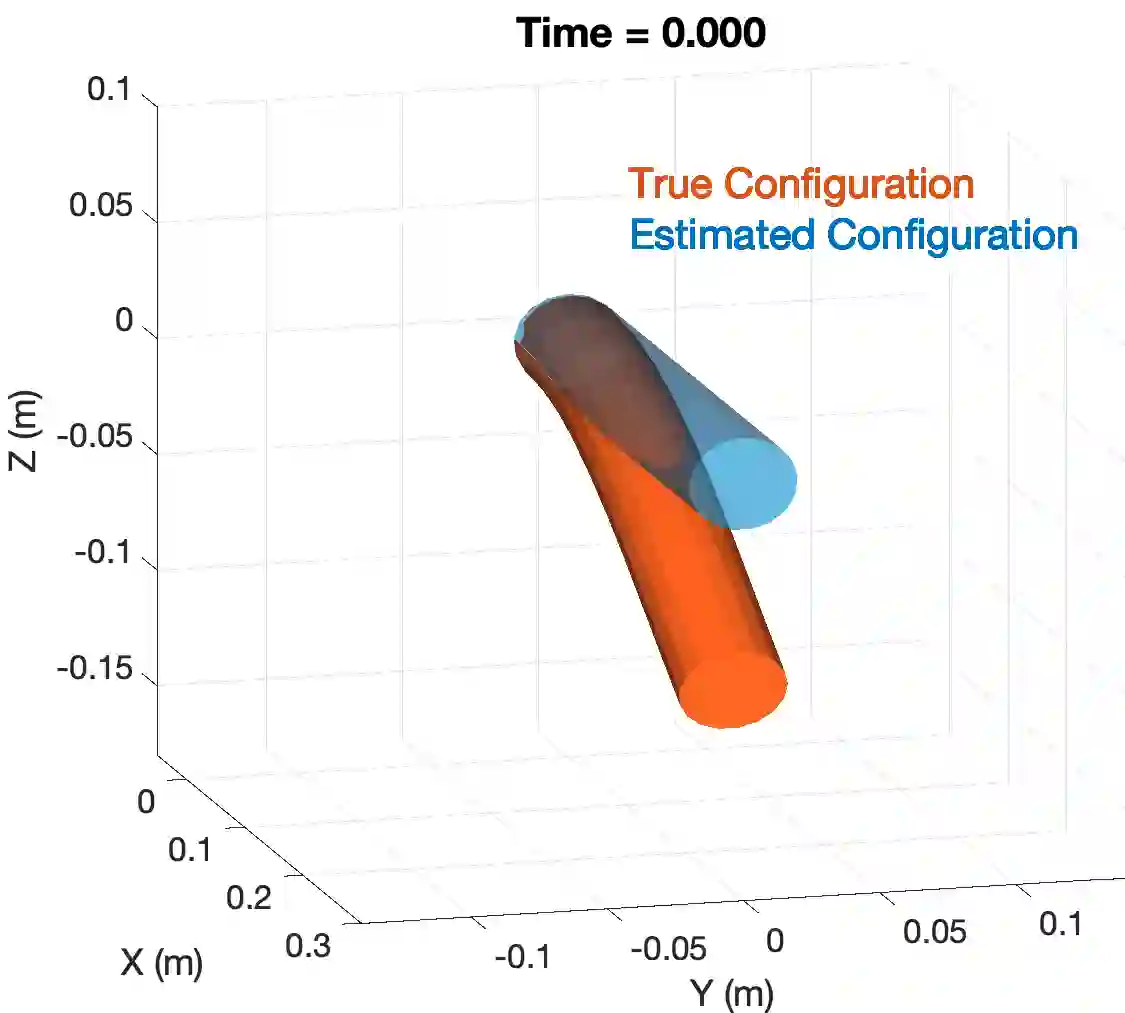
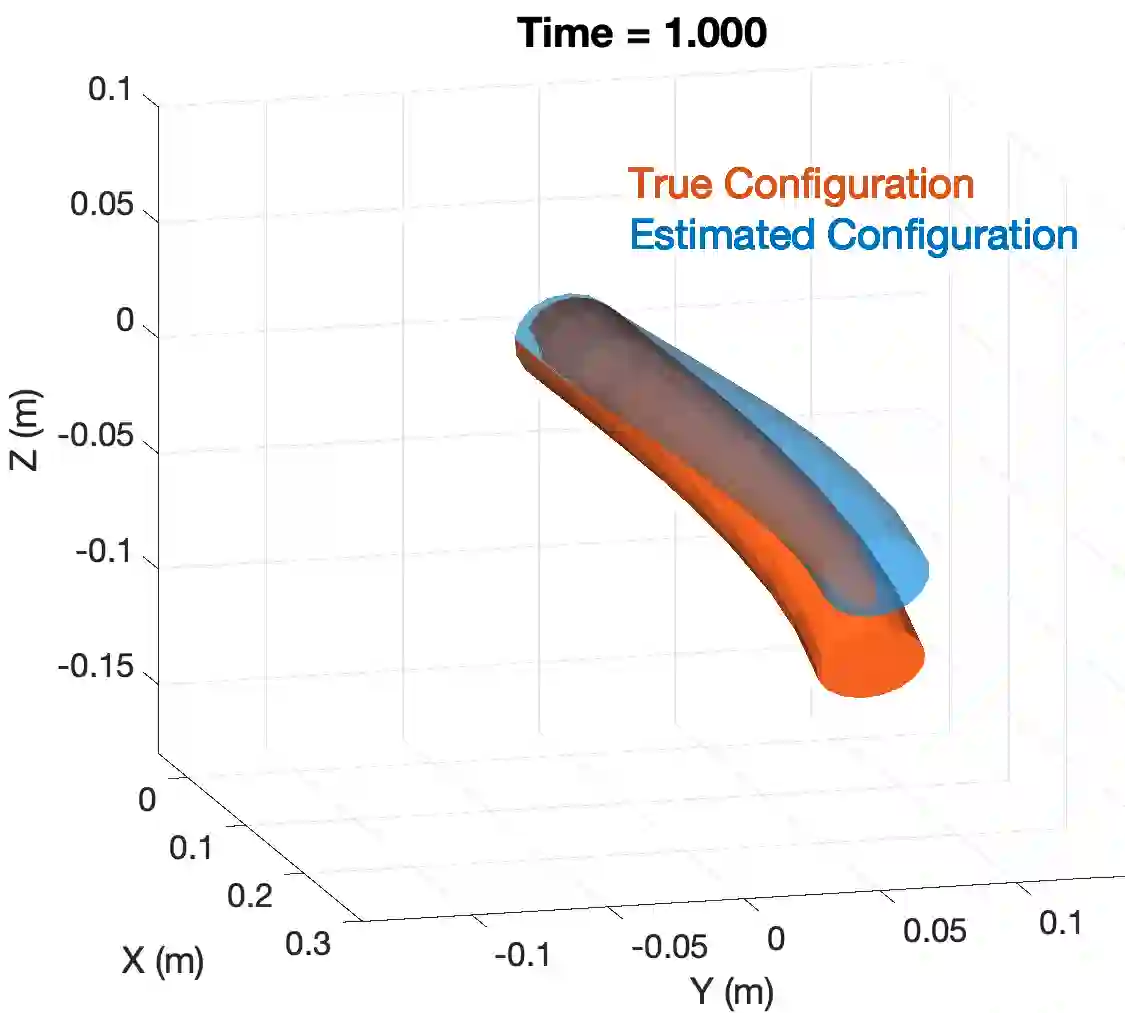
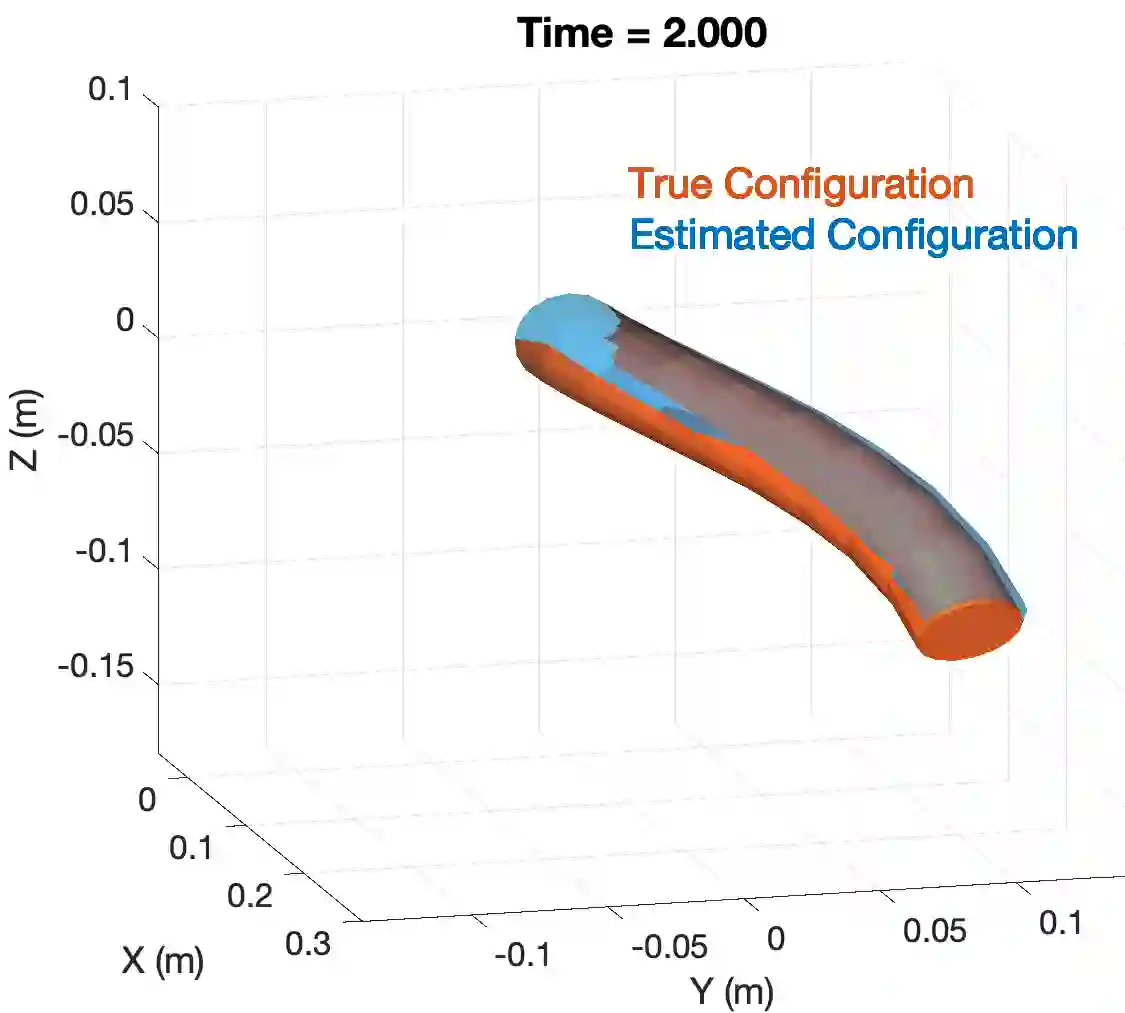
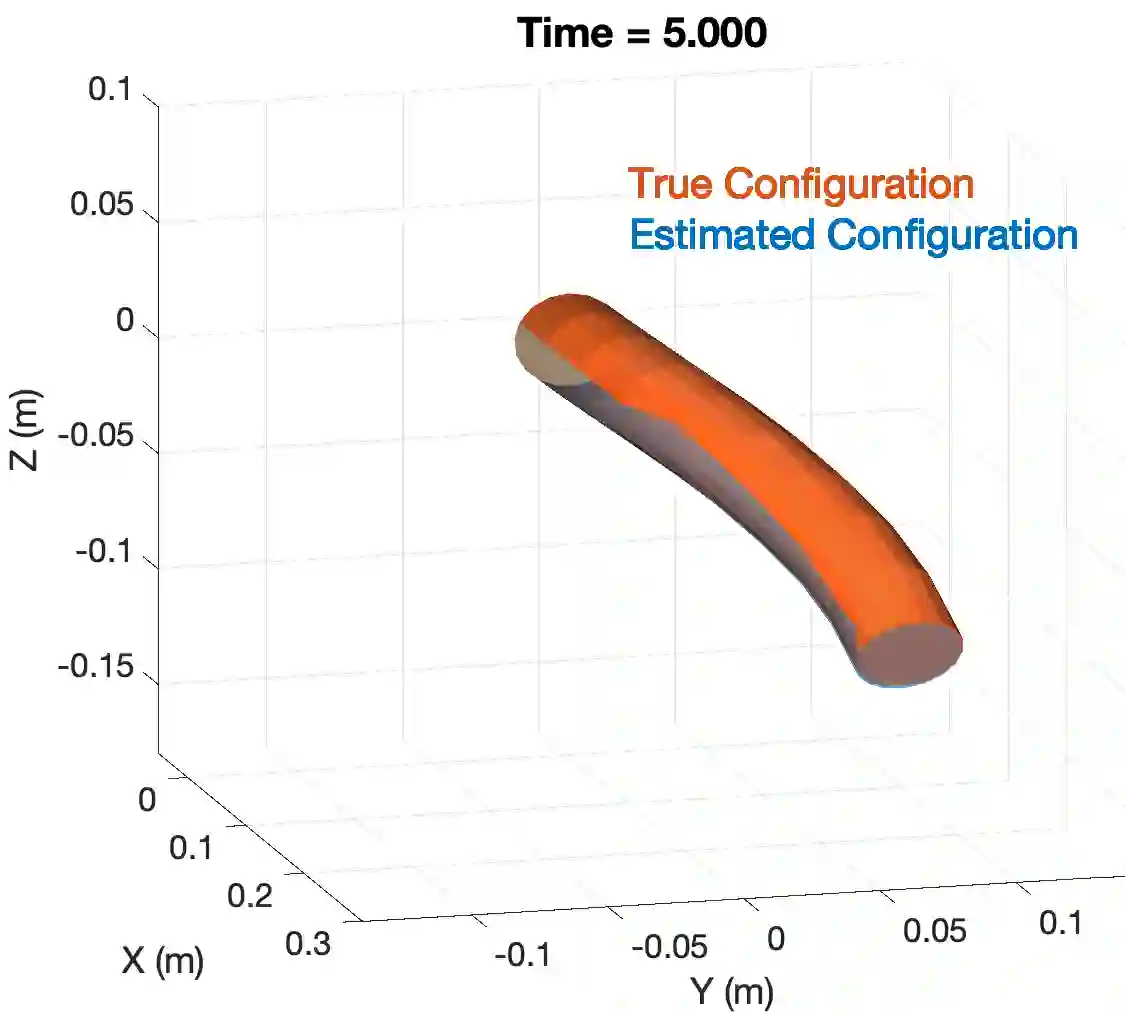
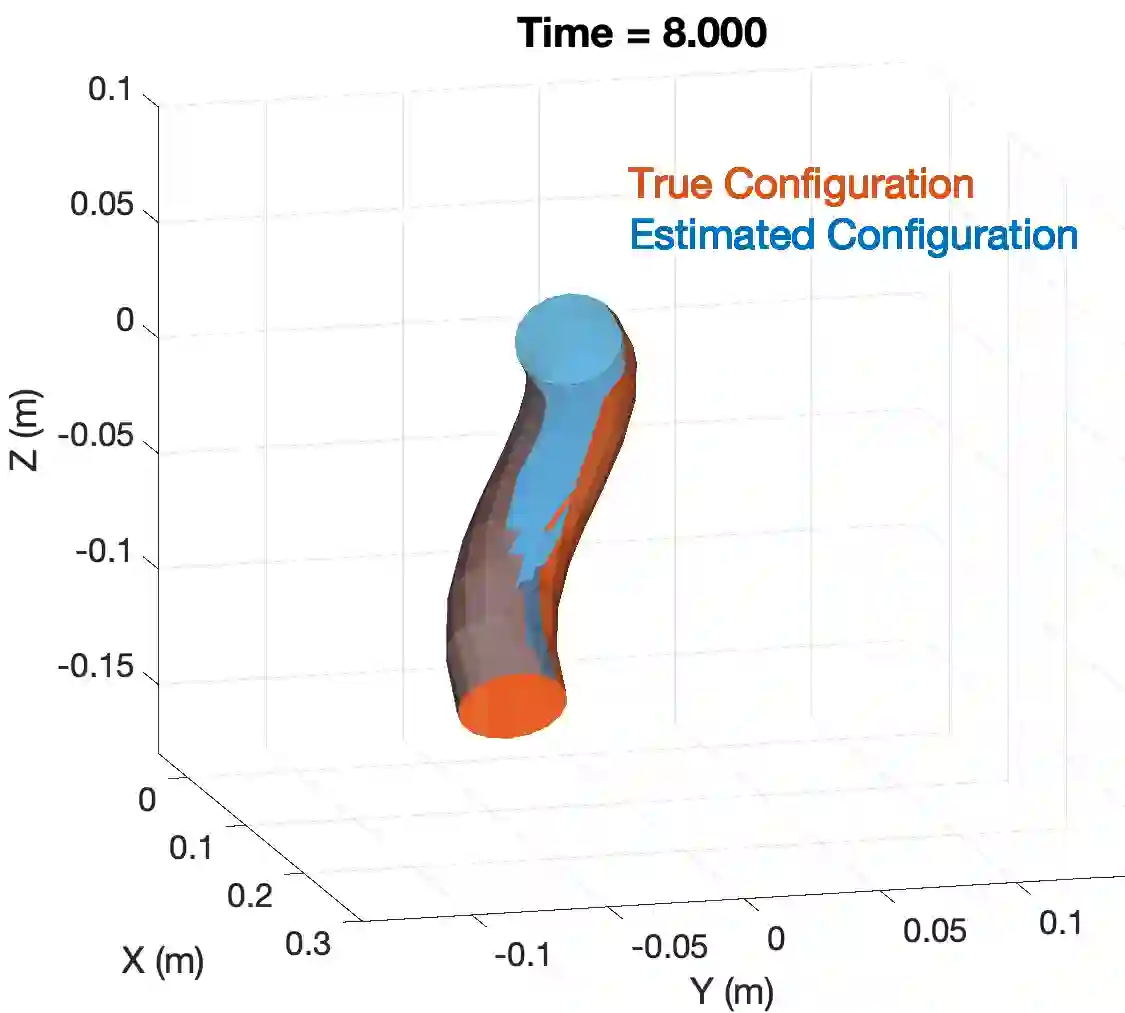
Soft robotics is a rapidly growing research area in robotics. Sensing of robotic systems is important for designing feedback controllers which usually provide robustness to modeling uncertainties. Sensing of soft robots, however, is considered a challenging task because theoretically, soft robots have infinite degrees of freedom while existing sensors only provide a limited number of measurements. One solution to this challenge is to design an observer/filter to estimate the unknown states from the sensor measurements. In this work, we design a boundary observer for soft robots based on the well-known Cosserat rod theory which models soft robots by nonlinear partial differential equations (PDEs). This boundary observer is able to estimate all the continuous robot states (poses, strains, and velocities) using the PDE model, inputs, and only tip velocity measurements (which explains the name "boundary" observer). The key idea is to inject sequential tip velocity measurements into the observer in a way that dissipates the energy of state estimation errors through the boundary. This boundary observer only requires sensing the tip velocity, can be implemented by simply changing a boundary condition in any numerical solvers of Cosserat rod models, and is proven to be locally input-to-state stable. Simulation studies are included and suggest that the domain of attraction is large and the observer is robust to measurement noise.
翻译:软体机器人是机器人学中一个快速发展的研究领域。机器人系统的感知对于设计反馈控制器至关重要,该类控制器通常能对建模不确定性提供鲁棒性。然而,软体机器人的感知被认为是一项具有挑战性的任务,因为理论上软体机器人具有无限自由度,而现有传感器仅能提供有限数量的测量值。解决这一挑战的方法之一是设计观测器/滤波器,从传感器测量值中估计未知状态。本文基于著名的Cosserat杆理论(该理论通过非线性偏微分方程对软体机器人建模)设计了一种软体机器人边界观测器。该边界观测器能够利用PDE模型、输入及仅有的末端速度测量值(因此得名"边界"观测器),估计所有连续的机器人状态(位姿、应变和速度)。其关键思想是通过边界耗散状态估计误差的能量,将连续的时间序列末端速度测量值注入观测器中。该边界观测器仅需感知末端速度,可通过更改任意Cosserat杆模型数值求解器中的边界条件来实现,且被证明具有局部输入-状态稳定性。仿真研究表明其吸引域较大,且对测量噪声具有鲁棒性。




相关内容





 微信扫码咨询专知VIP会员