

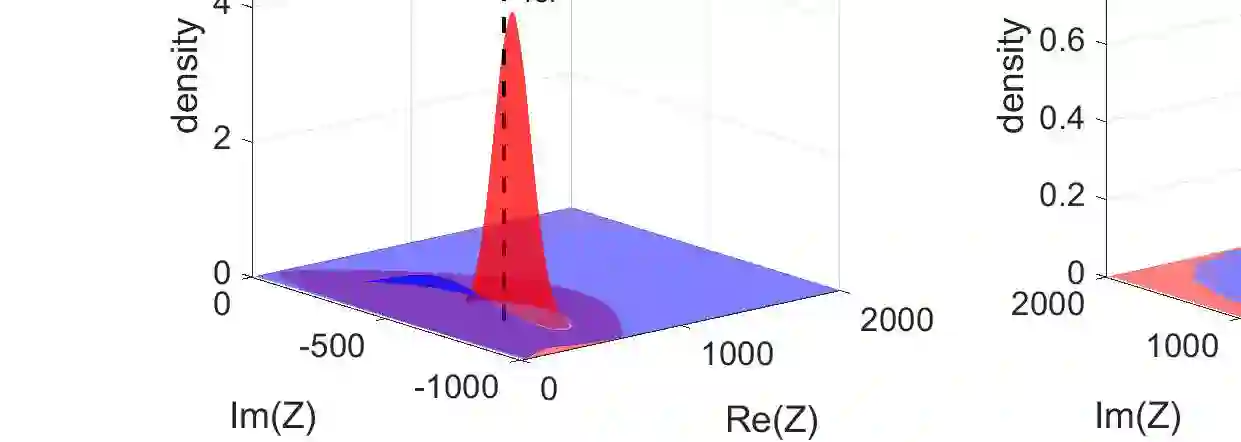
We consider the problem of identifying the acoustic impedance of a wall surface from noisy pressure measurements in a closed room using a Bayesian approach. The room acoustics is modeled by the interior Helmholtz equation with impedance boundary conditions. The aim is to compute moments of the acoustic impedance to estimate a suitable density function of the impedance coefficient. For the computation of moments we use ratio estimators and Monte-Carlo sampling. We consider two different experimental scenarios. In the first scenario, the noisy measurements correspond to a wall modeled by impedance boundary conditions. In this case, the Bayesian algorithm uses a model that is (up to the noise) consistent with the measurements and our algorithm is able to identify acoustic impedance with high accuracy. In the second scenario, the noisy measurements come from a coupled acoustic-structural problem, modeling a wall made of glass, whereas the Bayesian algorithm still uses a model with impedance boundary conditions. In this case, the parameter identification model is inconsistent with the measurements and therefore is not capable to represent them well. Nonetheless, for particular frequency bands the Bayesian algorithm identifies estimates with high likelihood. Outside these frequency bands the algorithm fails. We discuss the results of both examples and possible reasons for the failure of the latter case for particular frequency values.
翻译:我们考虑采用贝叶斯方法,从封闭房间内含噪声的压力测量数据中识别墙面声阻抗的问题。房间声学特性由带有阻抗边界条件的内亥姆霍兹方程建模。研究目标是计算声阻抗的矩,以估计阻抗系数的合适密度函数。在计算矩时,我们采用比率估计器和蒙特卡洛采样。我们考虑两种不同的实验场景:第一种场景中,含噪声测量数据来自以阻抗边界条件建模的墙面。在此情况下,贝叶斯算法使用的模型(忽略噪声)与测量数据一致,因此算法能以高精度识别声阻抗。第二种场景中,含噪声测量数据来自耦合声-结构问题(模拟玻璃墙面),而贝叶斯算法仍使用带阻抗边界条件的模型。此时,参数识别模型与测量数据不一致,因而无法良好表征数据。尽管如此,在特定频段内,贝叶斯算法仍能估计出高似然度的参数值;而在这些频段之外,算法失效。我们讨论了两种示例的结果,并分析了后一种情况在特定频率值失效的可能原因。




相关内容




 微信扫码咨询专知VIP会员