

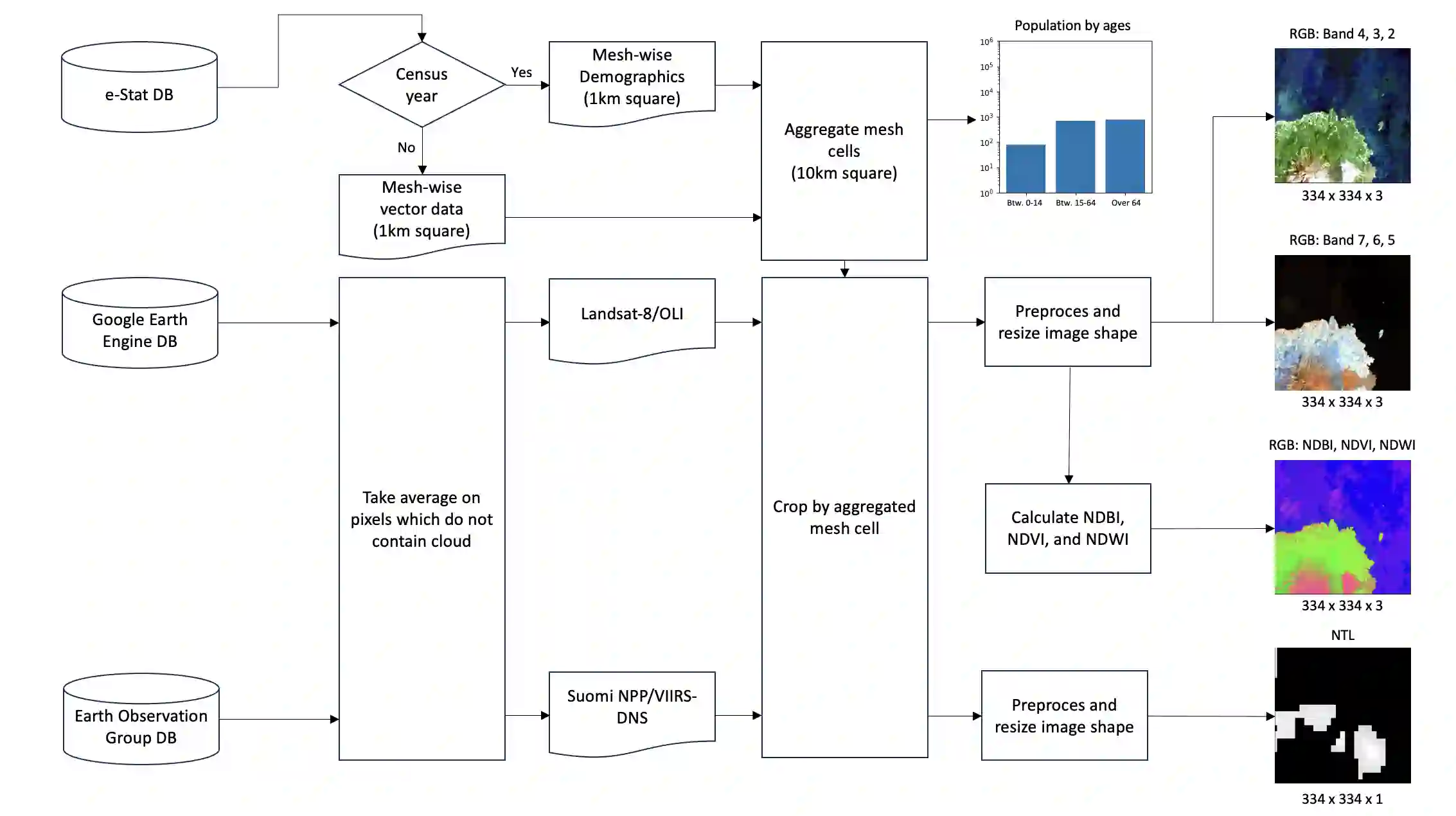
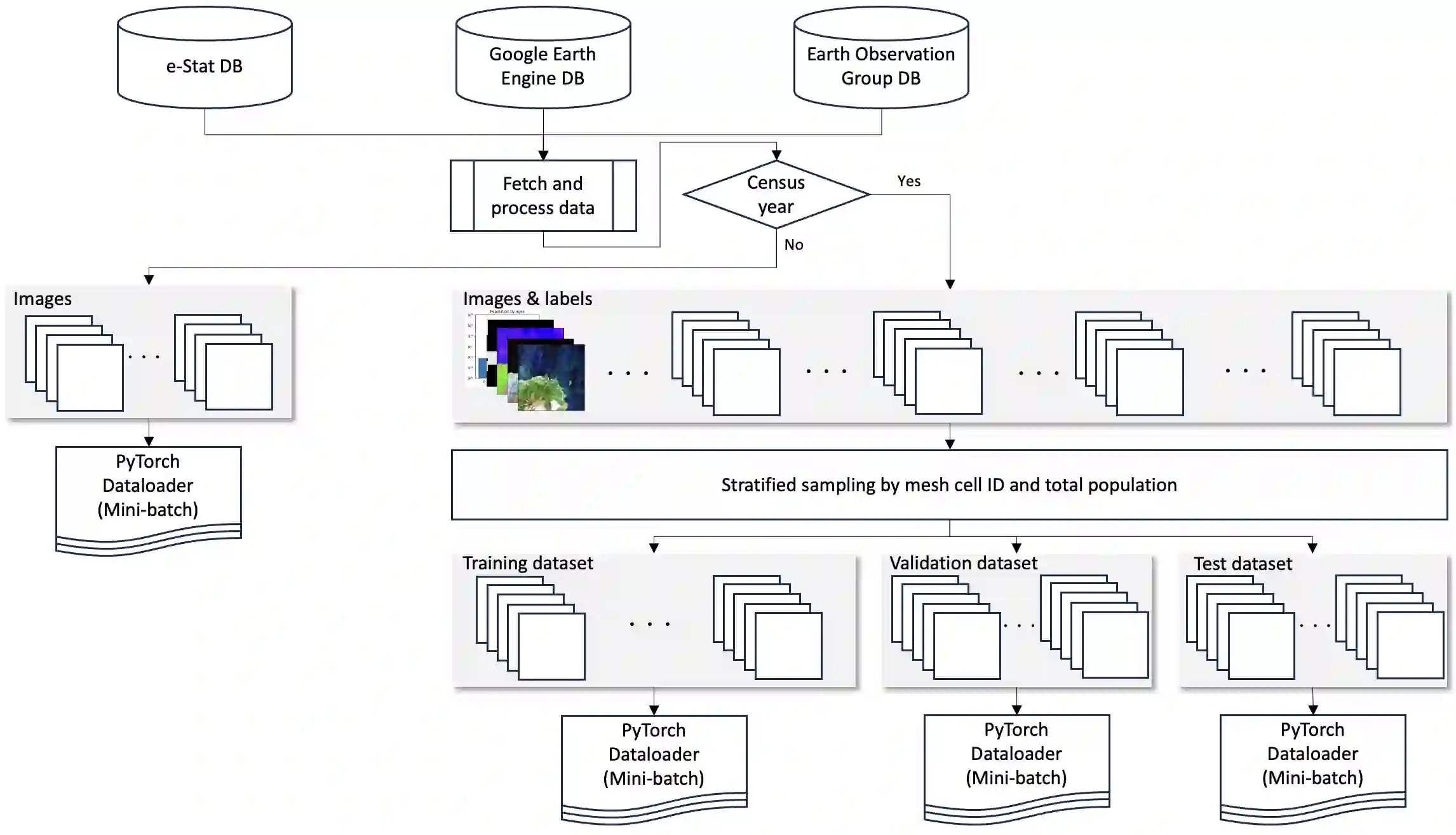
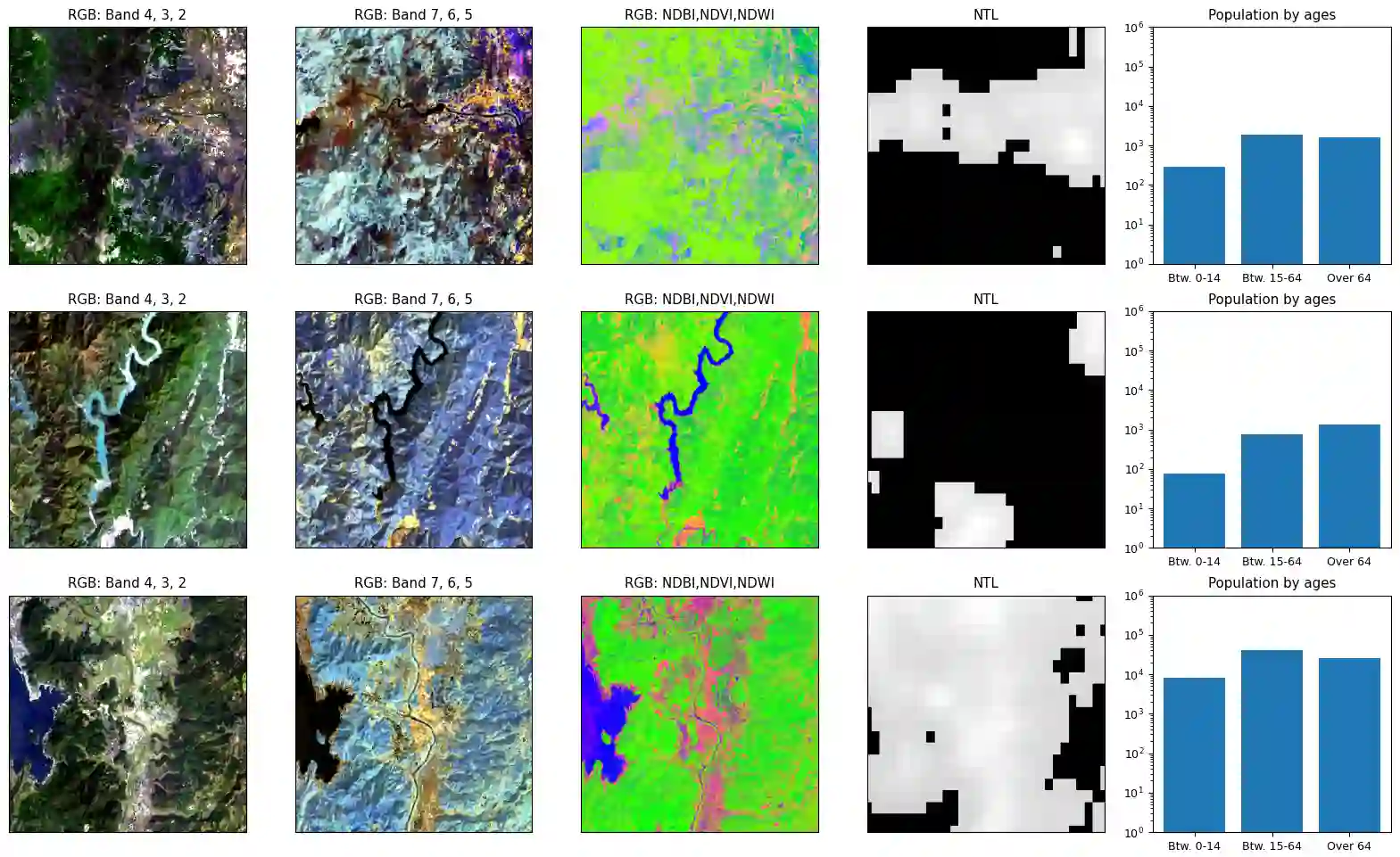
Population aging is one of the most serious problems in certain countries. In order to implement its countermeasures, understanding its rapid progress is of urgency with a granular resolution. However, a detailed and rigorous survey with high frequency is not feasible due to the constraints of financial and human resources. Nowadays, Deep Learning is prevalent for pattern recognition with significant accuracy, with its application to remote sensing. This paper proposes a multi-head Convolutional Neural Network model with transfer learning from pre-trained ResNet50 for estimating mesh-wise demographics of Japan as one of the most aged countries in the world, with satellite images from Landsat-8/OLI and Suomi NPP/VIIRS-DNS as inputs and census demographics as labels. The trained model was performed on a testing dataset with a test score of at least 0.8914 in $\text{R}^2$ for all the demographic composition groups, and the estimated demographic composition was generated and visualised for 2022 as a non-census year.
翻译:人口老龄化是某些国家面临的最严峻问题之一。为制定应对措施,亟需以高空间分辨率把握其快速进展。然而,受财政和人力资源限制,高频率、精细且严谨的人口调查难以实现。当前,深度学习以其显著的精度优势在模式识别领域广泛应用,并拓展至遥感应用。本文提出一种采用预训练ResNet50进行迁移学习的多头卷积神经网络模型,用于估算全球老龄化最严重国家之一——日本——的网格化人口构成。模型以Landsat-8/OLI和Suomi NPP/VIIRS-DNS卫星图像为输入,以人口普查统计数据为标签。在测试集上,该模型对所有人口构成组的预测精度至少达到$R^2$=0.8914,并据此生成并可视化了2022年(非人口普查年份)的估算人口构成。




相关内容





 微信扫码咨询专知VIP会员