

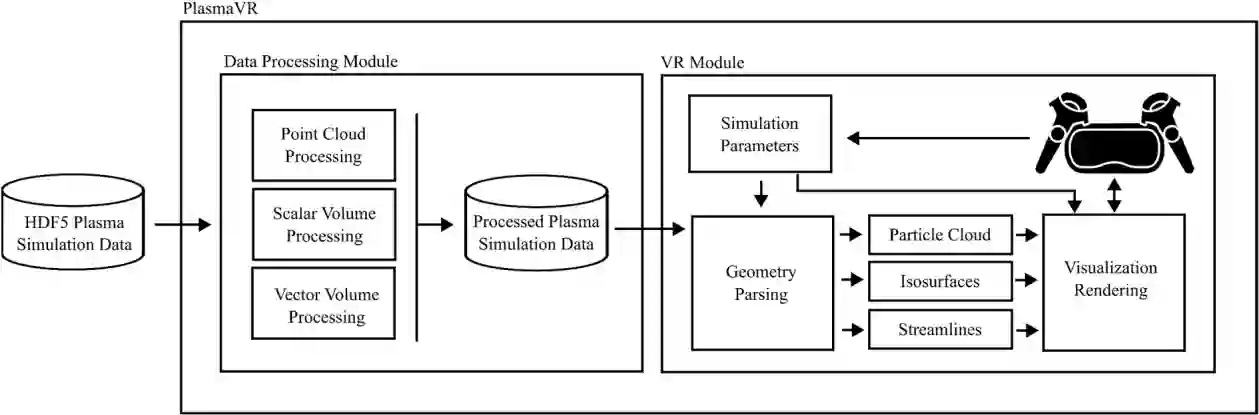
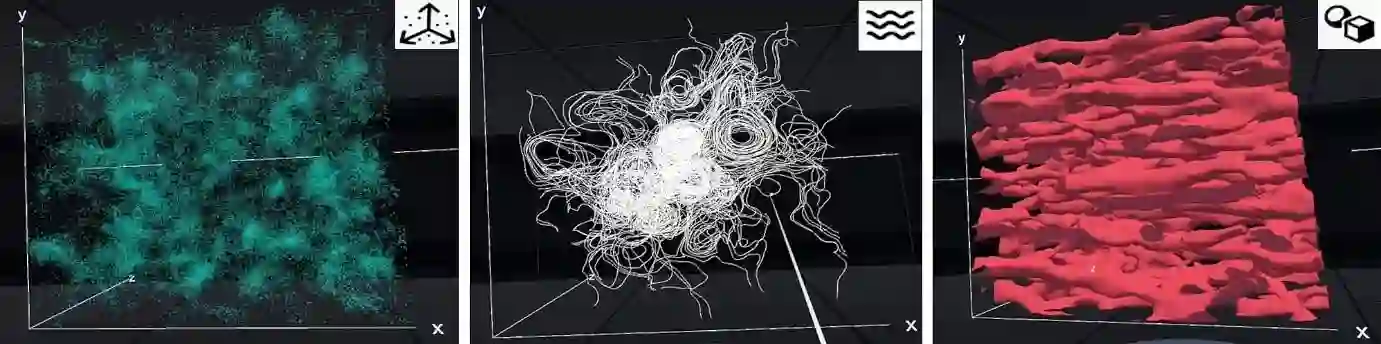
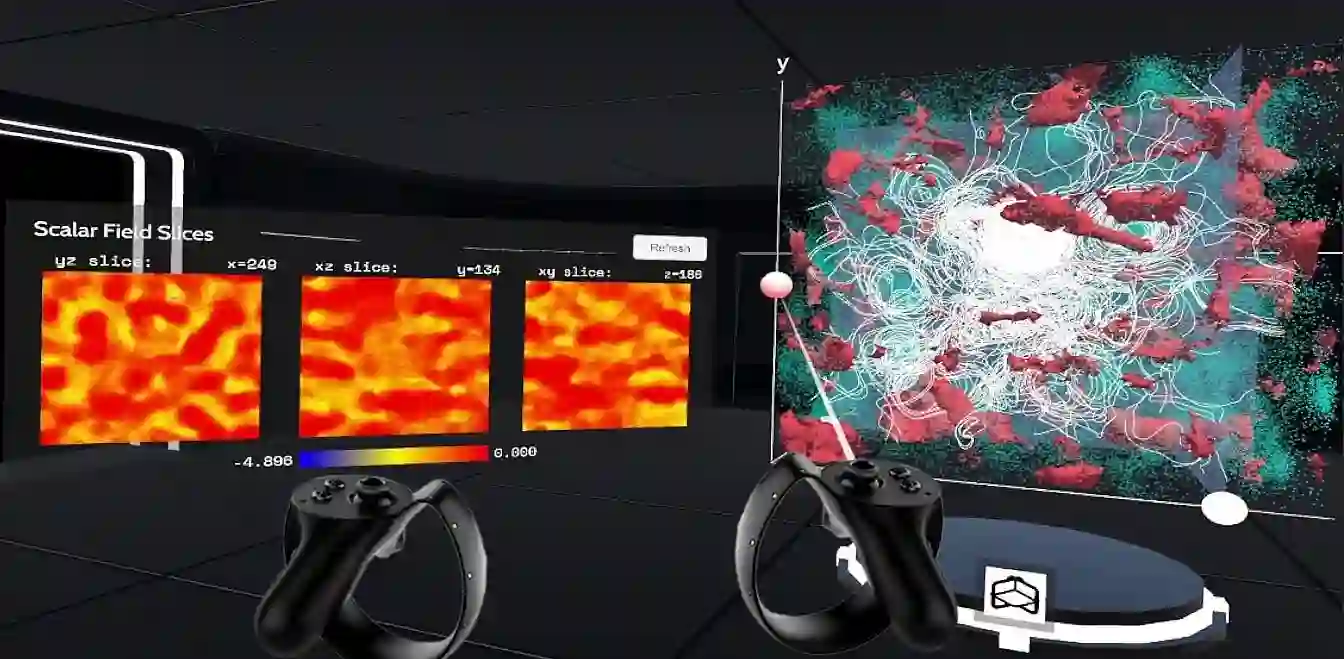
Plasma physics simulations create complex datasets for which researchers need state-of-the-art visualization tools to gain insights. These datasets are 3D in nature but are commonly depicted and analyzed using 2D idioms displayed on 2D screens. These offer limited understandability in a domain where spatial awareness is key. Virtual reality (VR) can be used as an alternative to conventional means for analyzing such datasets. VR has been known to improve depth and spatial relationship perception, which are fundamental for obtaining insights into 3D plasma morphology. Likewise, VR can potentially increase user engagement by offering more immersive and enjoyable experiences. Methods This study presents PlasmaVR, a proof-of-concept VR tool for visualizing datasets resulting from plasma physics simulations. It enables immersive multidimensional data visualization of particles, scalar, and vector fields and uses a more natural interface. The study includes user evaluation with domain experts where PlasmaVR was employed to assess the possible benefits of immersive environments in plasma physics visualization. The experimental group comprised five plasma physics researchers who were asked to perform tasks designed to represent their typical analysis workflow. To assess the suitability of the prototype for the different types of tasks, a set of objective metrics, such as completion time and number of errors, were measured. The prototype's usability was also evaluated using a standard System Usability Survey questionnaire.
翻译:等离子体物理模拟产生了复杂的数据集,研究人员需要最先进的可视化工具来分析这些数据,从而获得深入认识。这些数据集本质上是三维的,但通常使用在二维屏幕上显示的二维表示方式来进行描绘和分析。在空间感知至关重要的领域,这种方式提供的可理解性有限。虚拟现实(VR)可作为分析此类数据集的传统方法的替代方案。VR 已被证明能改善深度和空间关系感知,这对洞察三维等离子体形态至关重要。同样,VR 通过提供更具沉浸感和愉悦的体验,有可能提高用户的参与度。方法 本研究介绍了 PlasmaVR,一个用于可视化等离子体物理模拟所产生数据集的概念验证型 VR 工具。它能够对粒子、标量场和矢量场进行沉浸式多维数据可视化,并采用了更自然的交互界面。本研究包含与领域专家的用户评估,利用 PlasmaVR 来评估沉浸式环境在等离子体物理可视化中的潜在优势。实验组由五位等离子体物理研究人员组成,他们被要求执行旨在代表其典型分析工作流程的任务。为了评估该原型对不同类型任务的适用性,测量了一组客观指标,例如完成时间和错误次数。还通过标准系统可用性调查问卷对原型的可用性进行了评估。





相关内容



 微信扫码咨询专知VIP会员