

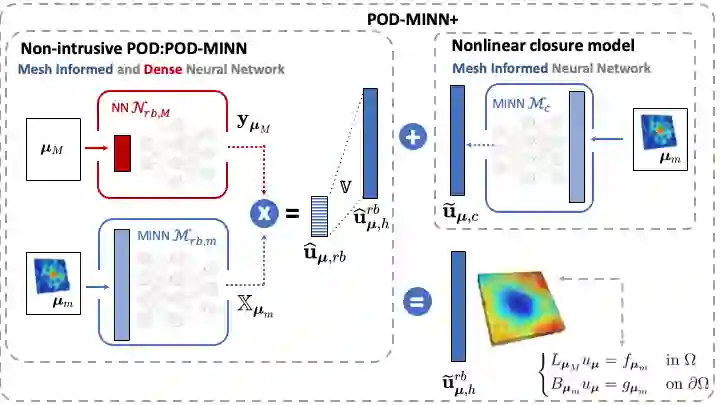
Many applications in computational physics involve approximating problems with microstructure, characterized by multiple spatial scales in their data. However, these numerical solutions are often computationally expensive due to the need to capture fine details at small scales. As a result, simulating such phenomena becomes unaffordable for many-query applications, such as parametrized systems with multiple scale-dependent features. Traditional projection-based reduced order models (ROMs) fail to resolve these issues, even for second-order elliptic PDEs commonly found in engineering applications. To address this, we propose an alternative nonintrusive strategy to build a ROM, that combines classical proper orthogonal decomposition (POD) with a suitable neural network (NN) model to account for the small scales. Specifically, we employ sparse mesh-informed neural networks (MINNs), which handle both spatial dependencies in the solutions and model parameters simultaneously. We evaluate the performance of this strategy on benchmark problems and then apply it to approximate a real-life problem involving the impact of microcirculation in transport phenomena through the tissue microenvironment.
翻译:计算物理学中的许多应用涉及近似具有微结构的问题,这类问题的数据通常包含多个空间尺度。然而,由于需要捕捉小尺度上的精细细节,这些数值解的计算成本往往很高。因此,对于多查询应用(如具有多尺度依赖特征的参数化系统)而言,模拟此类现象变得难以承受。传统的基于投影的降阶模型甚至无法解决工程应用中常见的二阶椭圆型偏微分方程问题。为此,我们提出了一种替代性的非侵入式策略来构建降阶模型,该策略将经典本征正交分解与合适的神经网络模型相结合,以考虑小尺度效应。具体而言,我们采用稀疏网格信息神经网络,该网络能够同时处理解的空间依赖性和模型参数。我们在基准问题上评估了该策略的性能,并将其应用于近似一个实际问题——微循环对组织微环境中传输现象的影响。




相关内容





 微信扫码咨询专知VIP会员