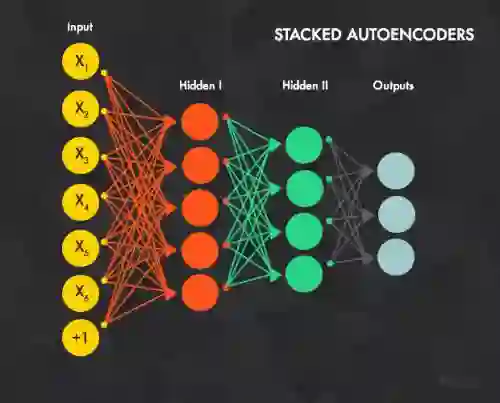
Multilayer neural networks set the current state of the art for many technical classification problems. But, these networks are still, essentially, black boxes in terms of analyzing them and predicting their performance. Here, we develop a statistical theory for the one-layer perceptron and show that it can predict performances of a surprisingly large variety of neural networks with different architectures. A general theory of classification with perceptrons is developed by generalizing an existing theory for analyzing reservoir computing models and connectionist models for symbolic reasoning known as vector symbolic architectures. Our statistical theory offers three formulas leveraging the signal statistics with increasing detail. The formulas are analytically intractable, but can be evaluated numerically. The description level that captures maximum details requires stochastic sampling methods. Depending on the network model, the simpler formulas already yield high prediction accuracy. The quality of the theory predictions is assessed in three experimental settings, a memorization task for echo state networks (ESNs) from reservoir computing literature, a collection of classification datasets for shallow randomly connected networks, and the ImageNet dataset for deep convolutional neural networks. We find that the second description level of the perceptron theory can predict the performance of types of ESNs, which could not be described previously. The theory can predict deep multilayer neural networks by being applied to their output layer. While other methods for prediction of neural networks performance commonly require to train an estimator model, the proposed theory requires only the first two moments of the distribution of the postsynaptic sums in the output neurons. The perceptron theory compares favorably to other methods that do not rely on training an estimator model.


翻译:多层神经网络在众多技术分类问题中确立了当前最先进的性能。然而,这些网络在性能分析与预测方面本质上仍是黑箱。本文为一层感知机建立了统计理论,并证明该理论能预测多种架构迥异的神经网络的性能。通过泛化现有用于分析储层计算模型与基于向量符号架构的符号推理联结主义模型的理论,我们发展出适用于感知机分类的通用理论框架。该统计理论提供了三个利用信号统计特性的公式,其细节层级逐级递增。这些公式虽无法解析求解,但可进行数值评估。捕获最大细节的描述层级需要随机采样方法。根据网络模型的不同,简化公式已能提供高精度的预测结果。我们通过三类实验设置评估理论预测质量:储层计算文献中回声状态网络(ESNs)的记忆任务、浅层随机连接网络的分类数据集集、以及深度卷积神经网络的ImageNet数据集。研究发现,感知机理论的第二描述层级可预测此前无法刻画的ESN类型性能。该理论通过作用于输出层,能够预测深度多层神经网络。尽管其他神经网络性能预测方法通常需要训练估计器模型,本理论仅需输出神经元中突触后和分布的前二阶矩。与不依赖训练估计器模型的其他方法相比,感知机理论展现出显著优势。


0
下载
关闭预览

相关内容

Networking:IFIP International Conferences on Networking。 Explanation:国际网络会议。 Publisher:IFIP。 SIT: http://dblp.uni-trier.de/db/conf/networking/index.html
FlowQA: Grasping Flow in History for Conversational Machine Comprehension
专知会员服务
34+阅读 · 2019年10月18日
Stabilizing Transformers for Reinforcement Learning
专知会员服务
60+阅读 · 2019年10月17日
《DeepGCNs: Making GCNs Go as Deep as CNNs》
专知会员服务
32+阅读 · 2019年10月17日
Keras François Chollet 《Deep Learning with Python 》, 386页pdf
专知会员服务
164+阅读 · 2019年10月12日
【SIGGRAPH2019】TensorFlow 2.0深度学习计算机图形学应用
专知会员服务
41+阅读 · 2019年10月9日
Hierarchically Structured Meta-learning
CreateAMind
27+阅读 · 2019年5月22日
Transferring Knowledge across Learning Processes
CreateAMind
29+阅读 · 2019年5月18日
强化学习的Unsupervised Meta-Learning
CreateAMind
18+阅读 · 2019年1月7日
Unsupervised Learning via Meta-Learning
CreateAMind
44+阅读 · 2019年1月3日
A Technical Overview of AI & ML in 2018 & Trends for 2019
待字闺中
18+阅读 · 2018年12月24日
disentangled-representation-papers
CreateAMind
26+阅读 · 2018年9月12日
STRCF for Visual Object Tracking
统计学习与视觉计算组
15+阅读 · 2018年5月29日
Focal Loss for Dense Object Detection
统计学习与视觉计算组
12+阅读 · 2018年3月15日
IJCAI | Cascade Dynamics Modeling with Attention-based RNN
KingsGarden
13+阅读 · 2017年7月16日
From Softmax to Sparsemax-ICML16(1)
KingsGarden
74+阅读 · 2016年11月26日
国家自然科学基金
13+阅读 · 2017年12月31日
国家自然科学基金
2+阅读 · 2015年12月31日
国家自然科学基金
3+阅读 · 2015年12月31日
国家自然科学基金
47+阅读 · 2015年12月31日
国家自然科学基金
2+阅读 · 2015年12月31日
国家自然科学基金
2+阅读 · 2015年12月31日
国家自然科学基金
3+阅读 · 2015年12月31日
国家自然科学基金
0+阅读 · 2014年12月31日
国家自然科学基金
0+阅读 · 2014年12月31日
国家自然科学基金
2+阅读 · 2014年12月31日
Learning in the Frequency Domain
Arxiv
11+阅读 · 2020年3月12日
VIP会员
最新内容
ICML 2026 | SARDI:扩散语言模型的自增强检索
专知会员服务
5+阅读 · 6月6日
《国防领域安全采用大语言模型的战略蓝图》
专知会员服务
8+阅读 · 6月6日
ICML 2026 | 演化选择的因果建模
专知会员服务
8+阅读 · 6月5日
综述|学习式3D表征最新进展与趋势
专知会员服务
7+阅读 · 6月5日
人工智能重塑威慑:算法优势的兴起
专知会员服务
8+阅读 · 6月5日
AgentOps综述:智能体系统运维框架
专知会员服务
17+阅读 · 6月4日
《美陆军最新条令:兵力防护》
专知会员服务
14+阅读 · 6月4日
相关VIP内容
FlowQA: Grasping Flow in History for Conversational Machine Comprehension
专知会员服务
34+阅读 · 2019年10月18日
Stabilizing Transformers for Reinforcement Learning
专知会员服务
60+阅读 · 2019年10月17日
《DeepGCNs: Making GCNs Go as Deep as CNNs》
专知会员服务
32+阅读 · 2019年10月17日
Keras François Chollet 《Deep Learning with Python 》, 386页pdf
专知会员服务
164+阅读 · 2019年10月12日
【SIGGRAPH2019】TensorFlow 2.0深度学习计算机图形学应用
专知会员服务
41+阅读 · 2019年10月9日
相关资讯
Hierarchically Structured Meta-learning
CreateAMind
27+阅读 · 2019年5月22日
Transferring Knowledge across Learning Processes
CreateAMind
29+阅读 · 2019年5月18日
强化学习的Unsupervised Meta-Learning
CreateAMind
18+阅读 · 2019年1月7日
Unsupervised Learning via Meta-Learning
CreateAMind
44+阅读 · 2019年1月3日
A Technical Overview of AI & ML in 2018 & Trends for 2019
待字闺中
18+阅读 · 2018年12月24日
disentangled-representation-papers
CreateAMind
26+阅读 · 2018年9月12日
STRCF for Visual Object Tracking
统计学习与视觉计算组
15+阅读 · 2018年5月29日
Focal Loss for Dense Object Detection
统计学习与视觉计算组
12+阅读 · 2018年3月15日
IJCAI | Cascade Dynamics Modeling with Attention-based RNN
KingsGarden
13+阅读 · 2017年7月16日
From Softmax to Sparsemax-ICML16(1)
KingsGarden
74+阅读 · 2016年11月26日
相关基金
国家自然科学基金
13+阅读 · 2017年12月31日
国家自然科学基金
2+阅读 · 2015年12月31日
国家自然科学基金
3+阅读 · 2015年12月31日
国家自然科学基金
47+阅读 · 2015年12月31日
国家自然科学基金
2+阅读 · 2015年12月31日
国家自然科学基金
2+阅读 · 2015年12月31日
国家自然科学基金
3+阅读 · 2015年12月31日
国家自然科学基金
0+阅读 · 2014年12月31日
国家自然科学基金
0+阅读 · 2014年12月31日
国家自然科学基金
2+阅读 · 2014年12月31日
Top
微信扫码咨询专知VIP会员