

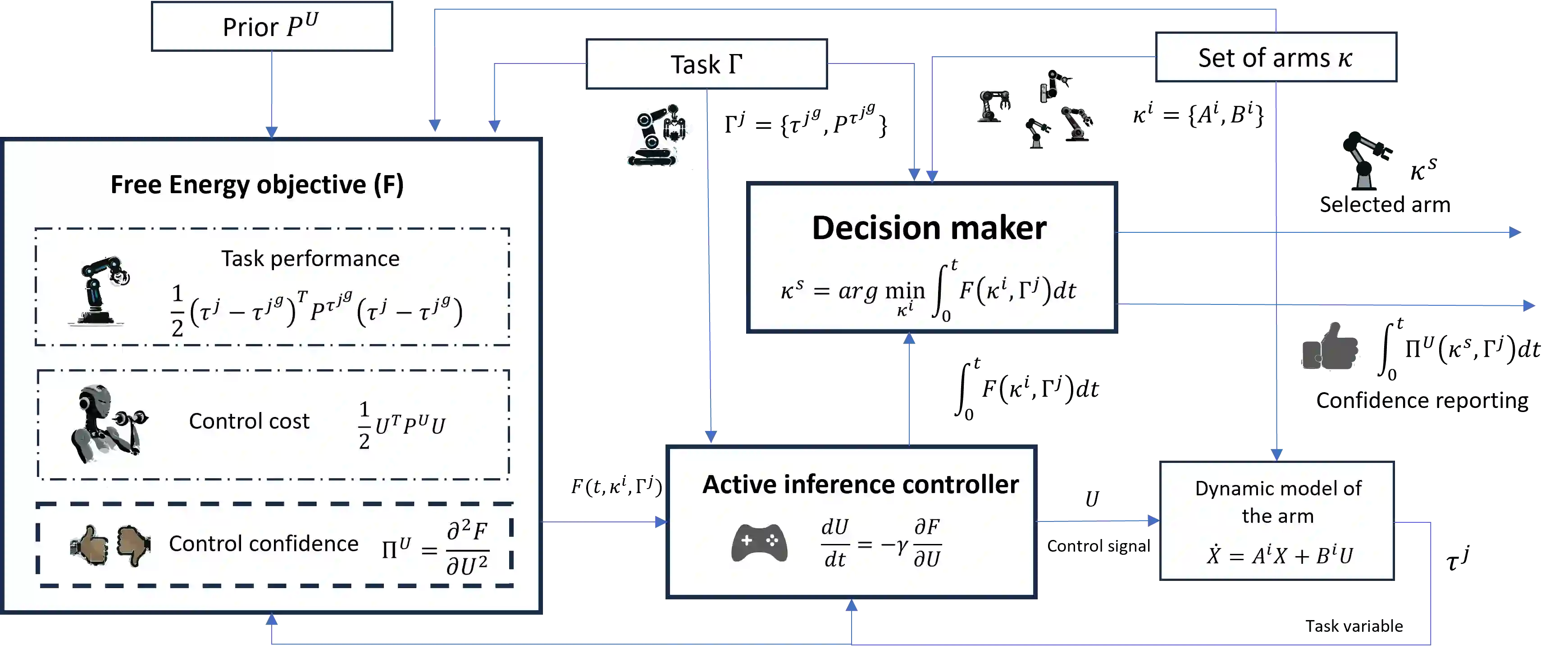
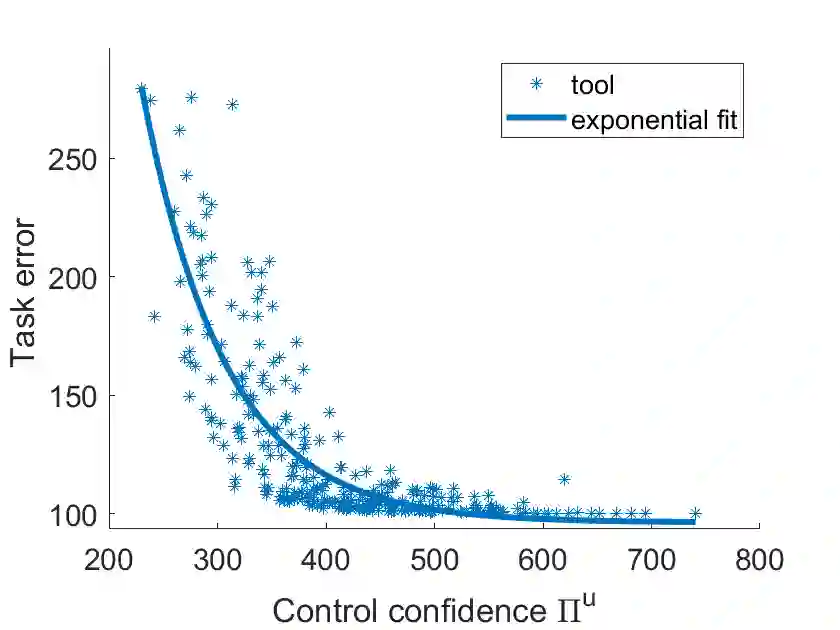
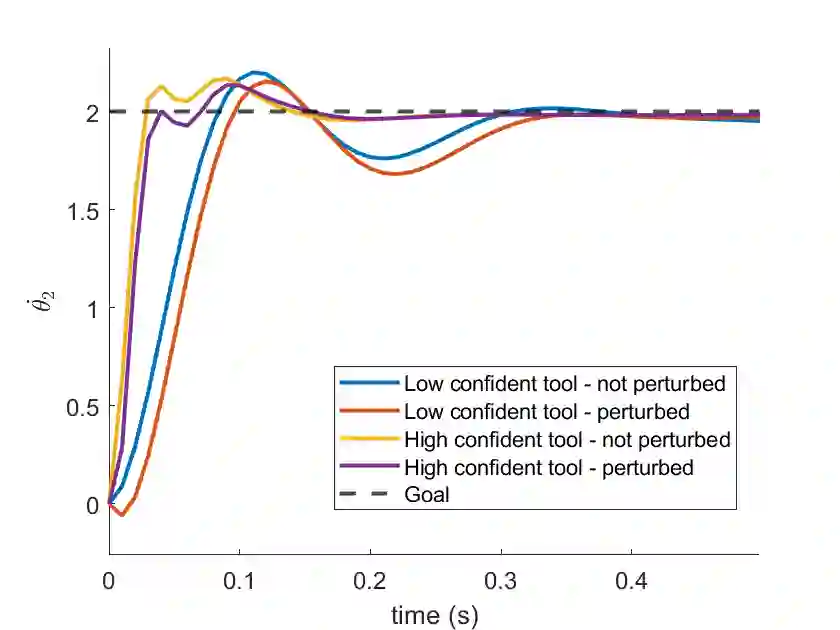
Self-reflecting about our performance (e.g., how confident we are) before doing a task is essential for decision making, such as selecting the most suitable tool or choosing the best route to drive. While this form of awareness -- thinking about our performance or metacognitive performance -- is well-known in humans, robots still lack this cognitive ability. This reflective monitoring can enhance their embodied decision power, robustness and safety. Here, we take a step in this direction by introducing a mathematical framework that allows robots to use their control self-confidence to make better-informed decisions. We derive a mathematical closed-form expression for control confidence for dynamic systems (i.e., the posterior inverse covariance of the control action). This control confidence seamlessly integrates within an objective function for decision making, that balances the: i) performance for task completion, ii) control effort, and iii) self-confidence. To evaluate our theoretical account, we framed the decision-making within the tool selection problem, where the agent has to select the best robot arm for a particular control task. The statistical analysis of the numerical simulations with randomized 2DOF arms shows that using control confidence during tool selection improves both real task performance, and the reliability of the tool for performance under unmodelled perturbations (e.g., external forces). Furthermore, our results indicate that control confidence is an early indicator of performance and thus, it can be used as a heuristic for making decisions when computation power is restricted or decision-making is intractable. Overall, we show the advantages of using confidence-aware decision-making and control scheme for dynamic systems.
翻译:在执行任务前反思自身表现(例如自信程度)对于决策制定至关重要,例如选择最合适的工具或规划最优驾驶路线。尽管这种反思自身表现(即元认知表现)的能力在人类中广为人知,但机器人仍缺乏这种认知能力。这种反思性监控可增强其具身决策能力、鲁棒性和安全性。本文通过引入一个数学框架来推进该研究方向,使机器人能够利用自身控制自信水平做出更明智的决策。我们推导出动态系统控制自信的数学闭式表达式(即控制动作的后验逆协方差)。该控制自信可无缝集成至决策目标函数中,平衡以下三者:i) 任务完成性能,ii) 控制能耗,及iii) 自信水平。为验证理论模型,我们将决策问题框架化为工具选择问题:智能体需为特定控制任务选择最优机械臂。基于随机化二自由度机械臂数值模拟的统计分析表明,在工具选择过程中引入控制自信不仅能提升实际任务性能,还能提高工具在未建模扰动(如外力)下的表现可靠性。此外,研究结果显示控制自信可作为性能早期指标,当计算能力受限或决策过程难以处理时,可将其用作决策启发式策略。总体而言,我们论证了面向动态系统的自信感知决策与控制方案的优势。





相关内容



 微信扫码咨询专知VIP会员