

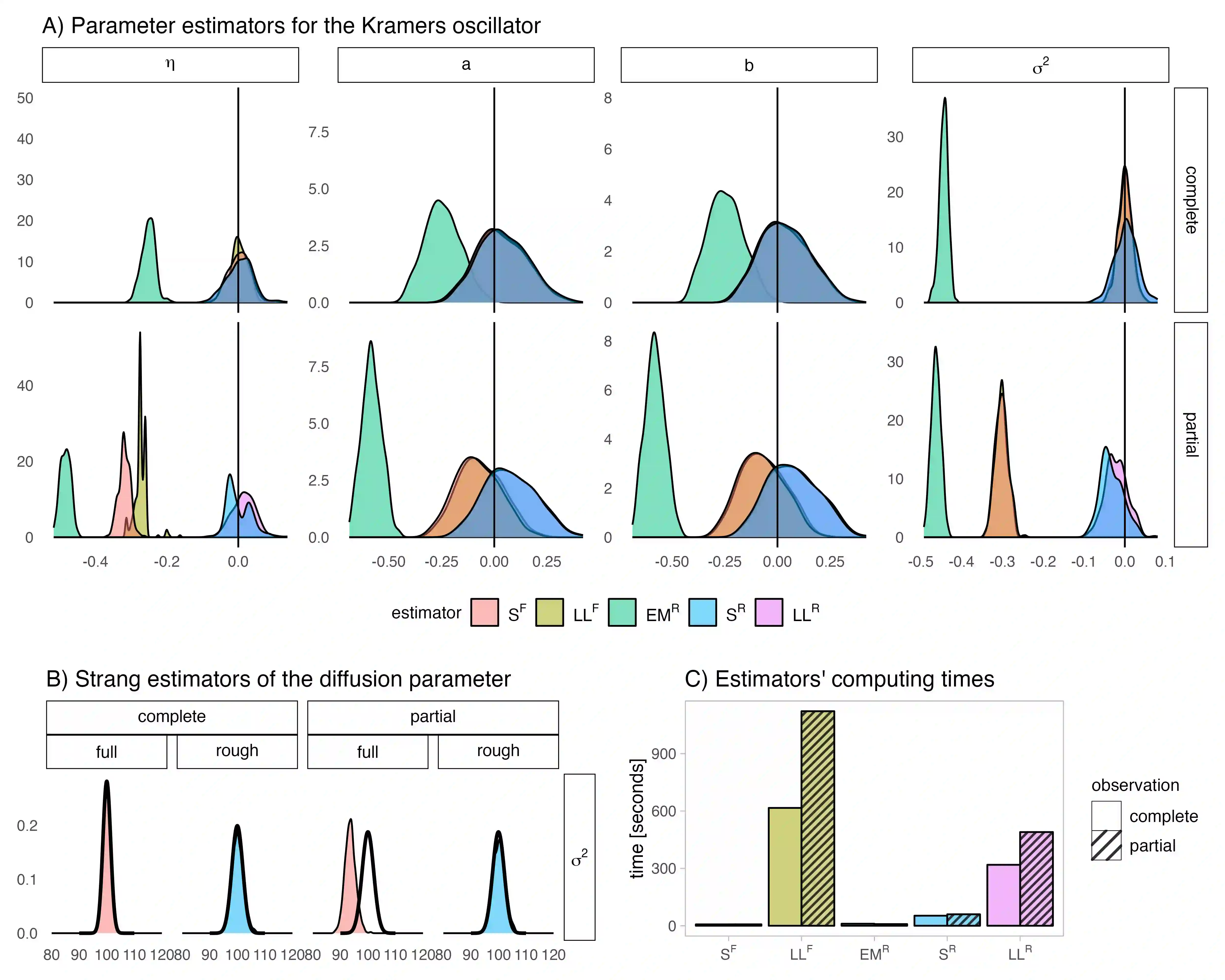
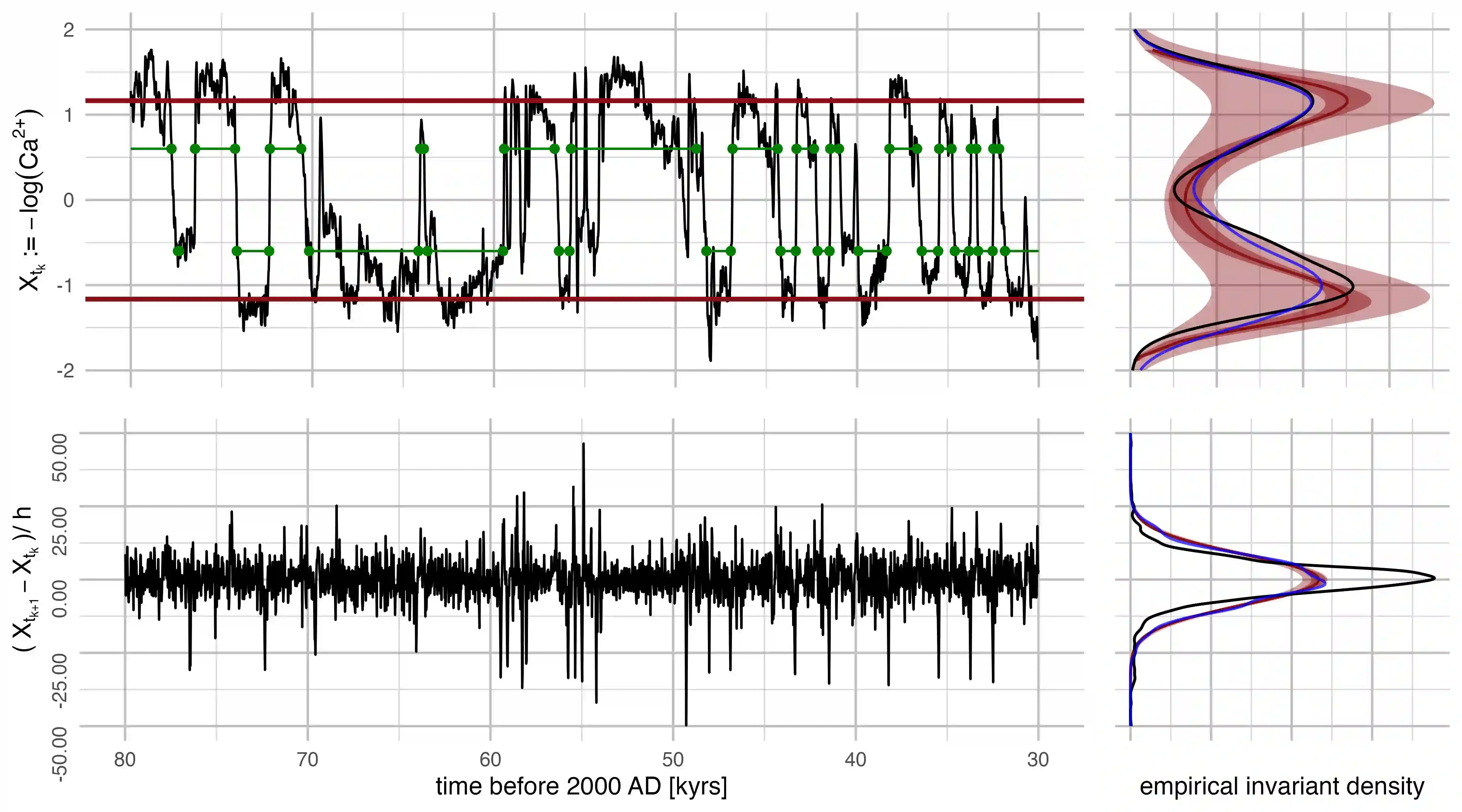
We address parameter estimation in second-order stochastic differential equations (SDEs), prevalent in physics, biology, and ecology. Second-order SDE is converted to a first-order system by introducing an auxiliary velocity variable raising two main challenges. First, the system is hypoelliptic since the noise affects only the velocity, making the Euler-Maruyama estimator ill-conditioned. To overcome that, we propose an estimator based on the Strang splitting scheme. Second, since the velocity is rarely observed we adjust the estimator for partial observations. We present four estimators for complete and partial observations, using full likelihood or only velocity marginal likelihood. These estimators are intuitive, easy to implement, and computationally fast, and we prove their consistency and asymptotic normality. Our analysis demonstrates that using full likelihood with complete observations reduces the asymptotic variance of the diffusion estimator. With partial observations, the asymptotic variance increases due to information loss but remains unaffected by the likelihood choice. However, a numerical study on the Kramers oscillator reveals that using marginal likelihood for partial observations yields less biased estimators. We apply our approach to paleoclimate data from the Greenland ice core and fit it to the Kramers oscillator model, capturing transitions between metastable states reflecting observed climatic conditions during glacial eras.
翻译:我们研究了物理学、生物学和生态学中常见的二阶随机微分方程(SDE)的参数估计问题。通过引入辅助速度变量,将二阶SDE转化为一阶系统,这带来了两大挑战。首先,由于噪声仅影响速度变量,系统呈现亚椭圆性,导致Euler-Maruyama估计量病态。为此,我们提出基于Strang分裂格式的估计量。其次,由于速度变量极少被观测到,我们调整了估计量以适应部分观测情形。我们提出了四种适用于完整观测与部分观测的估计量,分别基于完全似然或仅速度边际似然。这些估计量直观易行、计算高效,并证明了其一致性与渐近正态性。分析表明,在完整观测下使用完全似然可降低扩散估计量的渐近方差。在部分观测下,渐近方差因信息损失而增大,但不受似然选择的影响。然而,针对Kramers振荡器的数值研究表明,对部分观测使用边际似然能获得偏差更小的估计量。我们将该方法应用于格陵兰冰芯的古气候数据,并将其拟合至Kramers振荡器模型,成功捕捉了反映冰川时期观测气候条件的亚稳态间跃迁。




相关内容


 微信扫码咨询专知VIP会员