

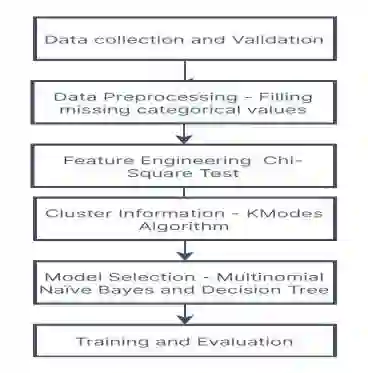
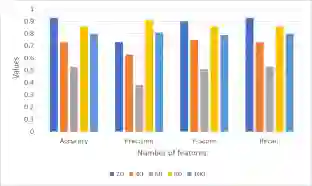
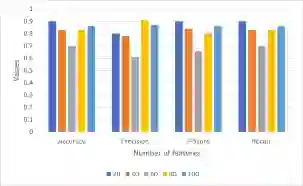
The identification of Prakriti types for the human body is a long-lost medical practice in finding the harmony between the nature of human beings and their behaviour. There are 3 fundamental Prakriti types of individuals. A person can belong to any Dosha. In the existing models, researchers have made use of SVM, KNN, PCA, Decision Tree, and various other algorithms. The output of these algorithms was quite decent, but it can be enhanced with the help of Multinomial Naive Bayes and K-modes clustering. Most of the researchers have confined themselves to 3 basic classes. This might not be accurate in the real-world scenario, where overlapping might occur. Considering these, we have classified the Doshas into 7 categories, which includes overlapping of Doshas. These are namely, VATT-Dosha, PITT-Dosha, KAPH-Dosha, VATT-PITT-Dosha, PITT-KAPH-Dosha, KAPH-VATT-Dosha, and VATT-PITT-KAPH-Dosha. The data used contains a balanced set of all individual entries on which preprocessing steps of machine learning have been performed. Chi-Square test for handling categorical data is being used for feature selection. For model fitting, the method used in this approach is K-modes clustering. The empirical results demonstrate a better result while using the MNB classifier. All key findings of this work have achieved 0.90 accuracy, 0.81 precision, 0.91 F-score, and 0.90 recall. The discussion suggests a provident analysis of the seven clusters and predicts their occurrence. The results have been consolidated to improve the Ayurvedic advancements with machine learning.
翻译:人体Prakriti体质类型的识别是一门旨在探寻人类本质与行为和谐共生的古老医学实践。个体共有3种基本Prakriti体质类型,可归属于任意一种Dosha(道夏)。现有模型中,研究人员已采用SVM、KNN、PCA、决策树等多种算法,其输出结果虽较为可观,但借助多项式朴素贝叶斯(Multinomial Naive Bayes)与K-modes聚类可进一步提升性能。然而,多数研究者局限于3个基本分类,这在现实场景中可能存在偏差——因实际情况下常出现体质重叠现象。基于此,我们将Dosha划分为7个类别,包含体质重叠情形,具体为:VATT-Dosha、PITT-Dosha、KAPH-Dosha、VATT-PITT-Dosha、PITT-KAPH-Dosha、KAPH-VATT-Dosha及VATT-PITT-KAPH-Dosha。所用数据集包含所有个体条目的均衡样本,并已完成机器学习预处理步骤。特征选择采用针对分类数据的卡方检验,模型拟合方法采用K-modes聚类。实验结果表明,使用MNB分类器可获得更优效果。本研究所有关键指标达到:准确率0.90、精确率0.81、F值0.91、召回率0.90。讨论部分对七个聚类进行了审慎分析并预测其发生概率。最终结果整合验证了机器学习对阿育吠陀医学发展的促进作用。




相关内容




 微信扫码咨询专知VIP会员