

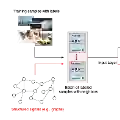
Discovering the underlying relationships among variables from temporal observations has been a longstanding challenge in numerous scientific disciplines, including biology, finance, and climate science. The dynamics of such systems are often best described using continuous-time stochastic processes. Unfortunately, most existing structure learning approaches assume that the underlying process evolves in discrete-time and/or observations occur at regular time intervals. These mismatched assumptions can often lead to incorrect learned structures and models. In this work, we introduce a novel structure learning method, SCOTCH, which combines neural stochastic differential equations (SDE) with variational inference to infer a posterior distribution over possible structures. This continuous-time approach can naturally handle both learning from and predicting observations at arbitrary time points. Theoretically, we establish sufficient conditions for an SDE and SCOTCH to be structurally identifiable, and prove its consistency under infinite data limits. Empirically, we demonstrate that our approach leads to improved structure learning performance on both synthetic and real-world datasets compared to relevant baselines under regular and irregular sampling intervals.
翻译:从时间观测数据中发现变量间潜在关系一直是生物学、金融学和气候学等众多科学领域的长期挑战。此类系统的动力学过程通常最适合用连续时间随机过程来描述。然而,现有的大多数结构学习方法均假设底层过程以离散时间演化,和/或观测发生在规则的时间间隔上。这些不匹配的假设往往会导致错误的学习结构和模型。在本工作中,我们提出了一种新颖的结构学习方法SCOTCH,该方法将神经随机微分方程与变分推断相结合,以推断可能结构的后验分布。这种连续时间方法能够自然地处理从任意时间点的观测中学习以及对其进行预测。理论上,我们建立了SDE和SCOTCH具有结构可辨识性的充分条件,并证明了其在无限数据极限下的相合性。实证上,我们证明在规则与不规则采样间隔下,与相关基线方法相比,我们的方法在合成数据集和真实数据集上均实现了更优的结构学习性能。




相关内容



 微信扫码咨询专知VIP会员