

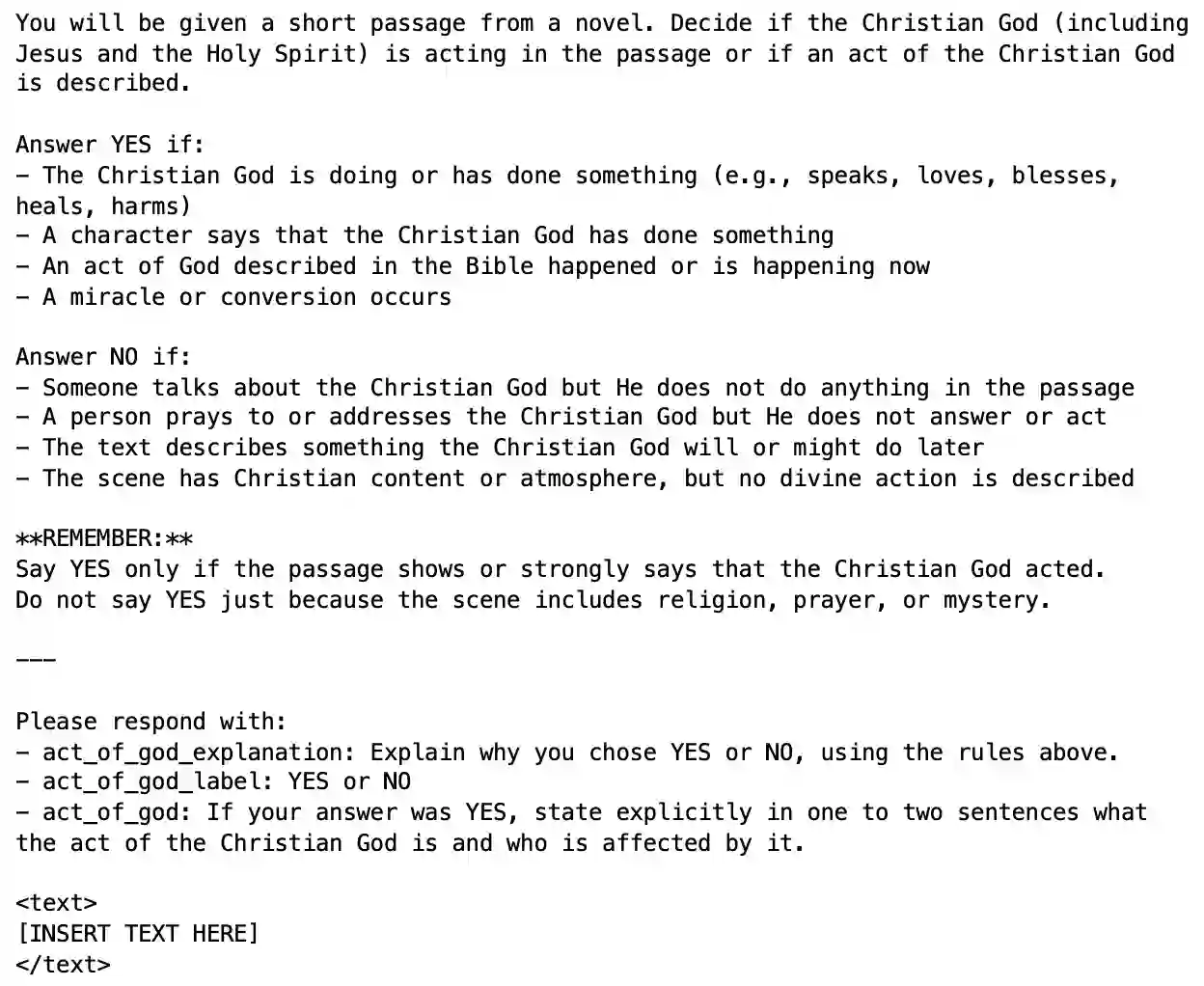
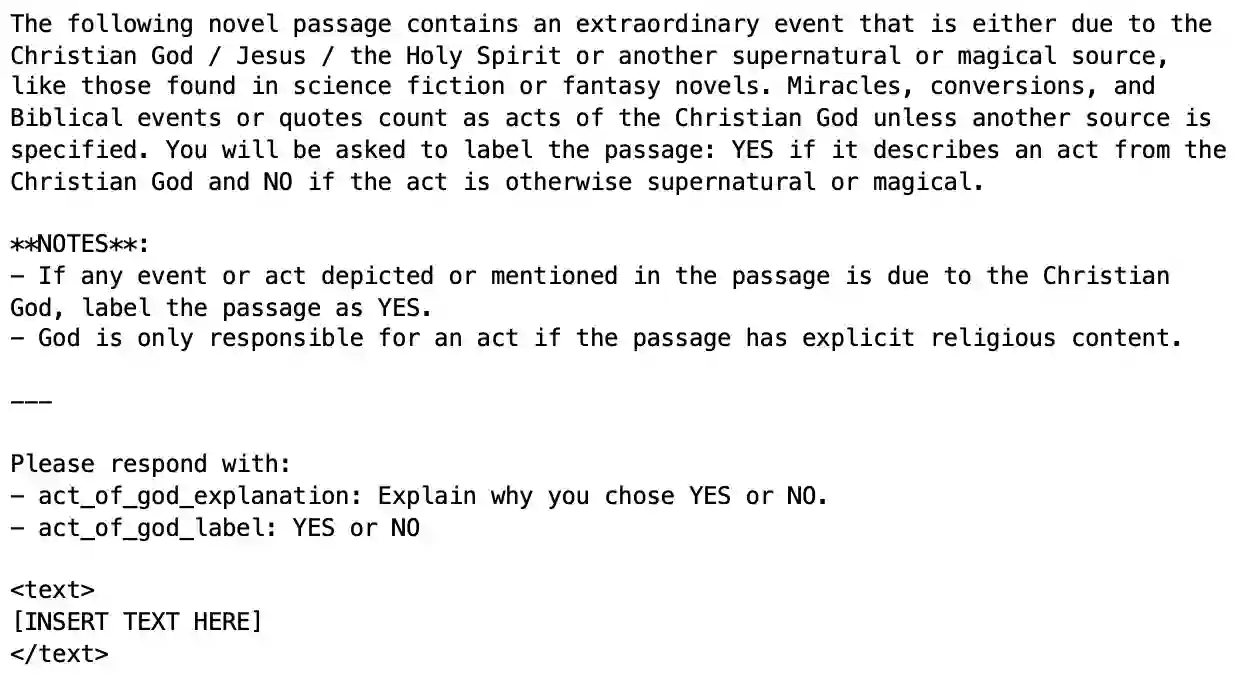
In addition to its more widely studied cultural movements, American Evangelicalism has a well-developed but less externally visible literary side. Christian Fiction, however, has been little studied, and what scholarly attention there is has focused on the explosively popular Left Behind series. In this work, we use computational tools to provide both a broad topical overview of Christian Fiction as a genre and a more directed exploration of how its authors depict divine acts. Working with human annotators, we first developed a codebook for identifying "acts of God." We then adapted the codebook for use by a recent, lightweight LM with the assistance of a much larger model. The laptop-scale LM is largely capable of matching human annotations, even when the task is subtle and challenging. Using these annotations, we show that significant and meaningful differences exist between divine acts depicted by the Left Behind books and Christian Fiction more broadly.
翻译:除了其广受研究的文化运动外,美国福音派还拥有一个发展成熟但对外界可见度较低的文学侧面。然而,基督教小说领域的研究甚少,现有学术关注主要集中在爆炸性流行的《末日迷踪》系列上。本研究运用计算工具,既提供了基督教小说作为一种文类的广泛主题概览,也对其作者如何描绘神圣行为进行了更具针对性的探索。通过与人工标注者协作,我们首先开发了一套用于识别“上帝行为”的编码手册。随后,在大型模型的辅助下,我们对该编码手册进行了适配,以供近期一款轻量级语言模型使用。这款可在笔记本电脑上运行的轻量级模型在很大程度上能够匹配人工标注结果,即使任务本身具有微妙性和挑战性。基于这些标注,我们揭示了《末日迷踪》系列所描绘的神圣行为与更广泛的基督教小说之间存在显著且有意义的差异。





相关内容





 微信扫码咨询专知VIP会员