

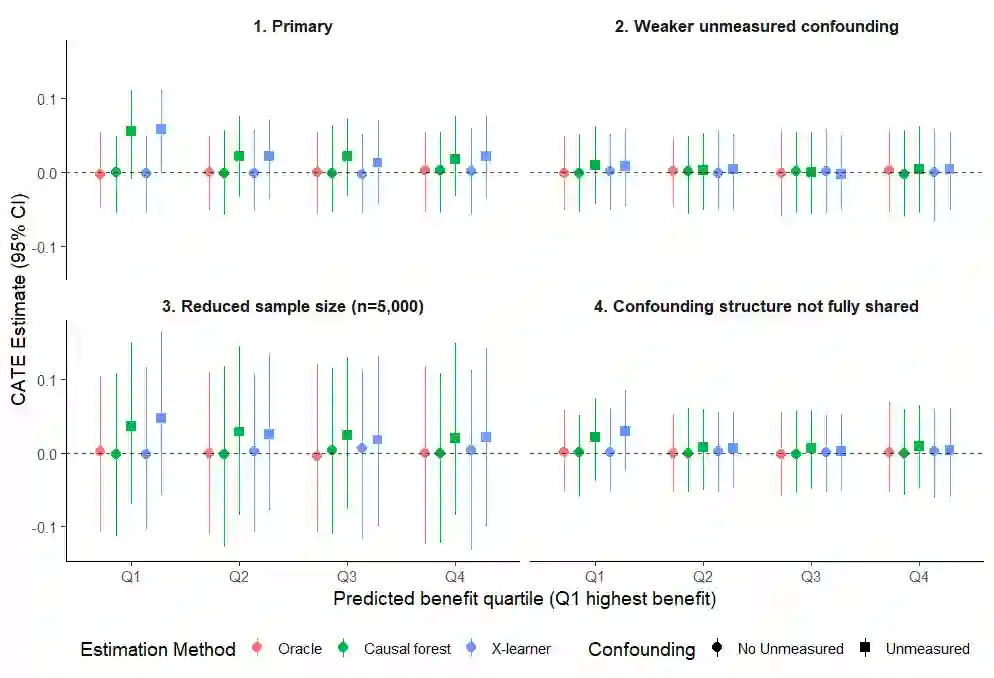
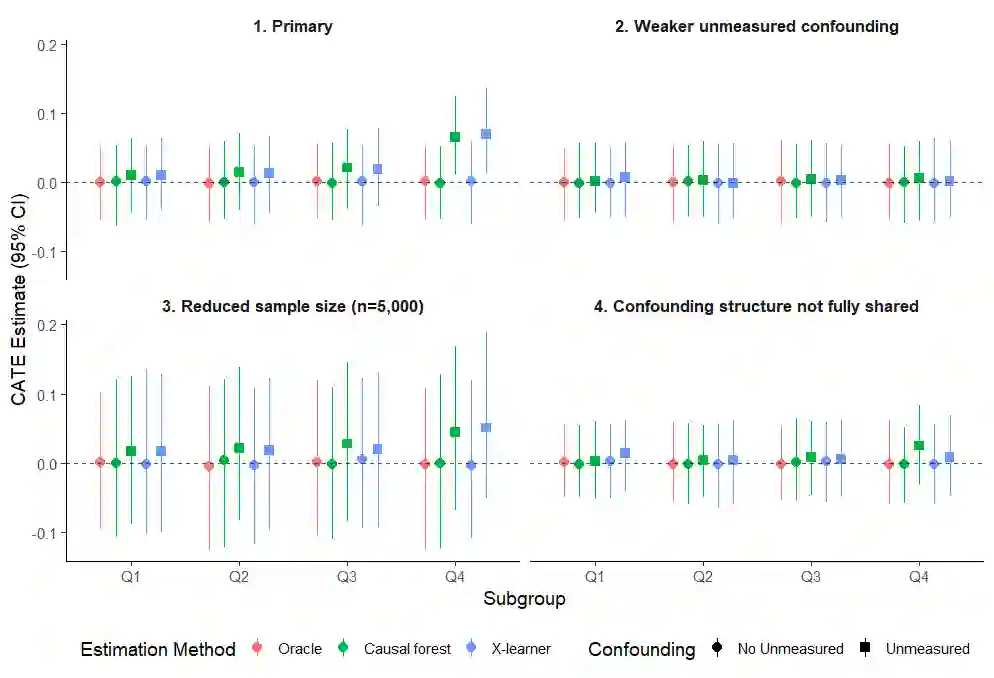
Observational studies developing causal machine learning (ML) models for the prediction of individualized treatment effects (ITEs) seldom conduct empirical evaluations to assess the conditional exchangeability assumption. We aimed to evaluate the performance of these models under conditional exchangeability violations and the utility of negative control outcomes (NCOs) as a diagnostic. We conducted a simulation study to examine confounding bias in ITE estimates generated by causal forest and X-learner models under varying conditions, including the presence or absence of true heterogeneity. We simulated data to reflect real-world scenarios with differing levels of confounding, sample size, and NCO confounding structures. We then estimated and compared subgroup-level treatment effects on the primary outcome and NCOs across settings with and without unmeasured confounding. When conditional exchangeability was violated, causal forest and X-learner models failed to recover true treatment effect heterogeneity and, in some cases, falsely indicated heterogeneity when there was none. NCOs successfully identified subgroups affected by unmeasured confounding. Even when NCOs did not perfectly satisfy its ideal assumptions, it remained informative, flagging potential bias in subgroup level estimates, though not always pinpointing the subgroup with the largest confounding. Violations of conditional exchangeability substantially limit the validity of ITE estimates from causal ML models in routinely collected observational data. NCOs serve a useful empirical diagnostic tool for detecting subgroup-specific unmeasured confounding and should be incorporated into causal ML workflows to support the credibility of individualized inference.
翻译:在观测性研究中,开发用于预测个体化治疗效应(ITEs)的因果机器学习(ML)模型时,很少对条件可交换性假设进行实证评估。本研究旨在评估这些模型在违反条件可交换性假设下的表现,以及阴性对照结局(NCOs)作为诊断工具的有效性。我们进行了一项模拟研究,以检验因果森林和X-learner模型在不同条件下(包括是否存在真实异质性)生成的ITE估计中的混杂偏倚。我们模拟的数据反映了现实世界场景,涉及不同水平的混杂、样本量以及NCO混杂结构。随后,我们估计并比较了在有和无未测量混杂的情况下,主要结局和NCOs的亚组水平治疗效应。当条件可交换性被违反时,因果森林和X-learner模型未能恢复真实的治疗效应异质性,并且在某些情况下,当不存在异质性时错误地指示了异质性。NCOs成功地识别了受未测量混杂影响的亚组。即使NCOs未能完全满足其理想假设,它仍具有信息价值,能够标记亚组水平估计中的潜在偏倚,尽管并非总能精确定位混杂最大的亚组。条件可交换性的违反严重限制了常规收集的观测数据中因果ML模型所得ITE估计的有效性。NCOs作为一种实用的实证诊断工具,可用于检测亚组特异性未测量混杂,应纳入因果ML工作流程,以支持个体化推断的可信度。




相关内容




 微信扫码咨询专知VIP会员