

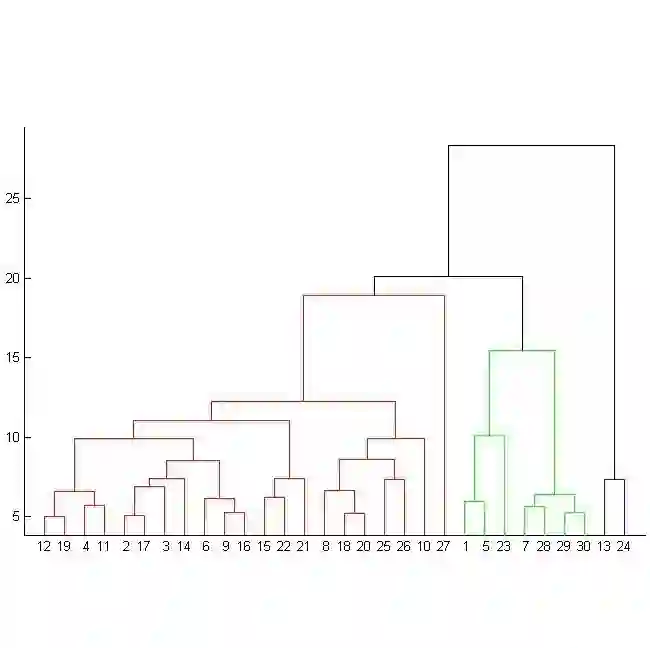
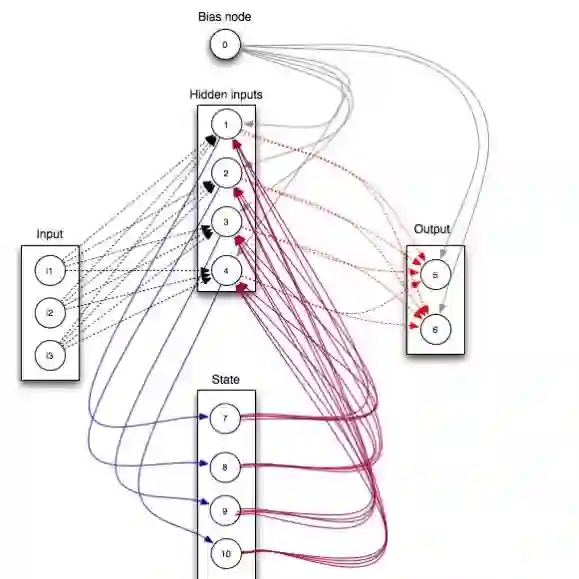
Datasets in the real world are often complex and to some degree hierarchical, with groups and sub-groups of data sharing common characteristics at different levels of abstraction. Understanding and uncovering the hidden structure of these datasets is an important task that has many practical applications. To address this challenge, we present a new and general method for building relational data trees by exploiting the learning dynamics of the Restricted Boltzmann Machine (RBM). Our method is based on the mean-field approach, derived from the Plefka expansion, and developed in the context of disordered systems. It is designed to be easily interpretable. We tested our method in an artificially created hierarchical dataset and on three different real-world datasets (images of digits, mutations in the human genome, and a homologous family of proteins). The method is able to automatically identify the hierarchical structure of the data. This could be useful in the study of homologous protein sequences, where the relationships between proteins are critical for understanding their function and evolution.
翻译:现实世界中的数据集往往复杂且具有一定层次性,数据分组和子分组在不同抽象层级上共享共同特征。理解并揭示这些数据集的隐藏结构是一项具有众多实际应用的重要任务。为应对这一挑战,我们提出了一种利用受限玻尔兹曼机(RBM)学习动力学构建关系数据树的新通用方法。该方法基于从Plefka展开推导出的平均场方法,并在无序系统背景下发展,旨在易于解释。我们分别在人工生成的层次数据集和三个不同真实世界数据集(数字图像、人类基因组突变及同源蛋白家族)上测试了该方法。该方法能够自动识别数据的层次结构,这对于研究同源蛋白质序列(其中蛋白质间关系对理解其功能与进化至关重要)可能具有重要价值。




相关内容



 微信扫码咨询专知VIP会员