

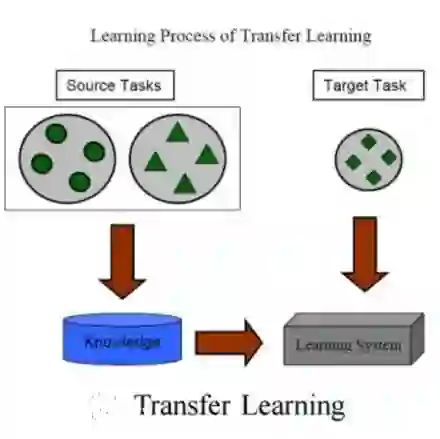
Developing machine learning-based interatomic potentials from ab-initio electronic structure methods remains a challenging task for computational chemistry and materials science. This work studies the capability of transfer learning, in particular discriminative fine-tuning, for efficiently generating chemically accurate interatomic neural network potentials on organic molecules from the MD17 and ANI data sets. We show that pre-training the network parameters on data obtained from density functional calculations considerably improves the sample efficiency of models trained on more accurate ab-initio data. Additionally, we show that fine-tuning with energy labels alone can suffice to obtain accurate atomic forces and run large-scale atomistic simulations, provided a well-designed fine-tuning data set. We also investigate possible limitations of transfer learning, especially regarding the design and size of the pre-training and fine-tuning data sets. Finally, we provide GM-NN potentials pre-trained and fine-tuned on the ANI-1x and ANI-1ccx data sets, which can easily be fine-tuned on and applied to organic molecules.
翻译:基于从头算电子结构方法开发机器学习原子间势仍然是计算化学与材料科学领域的挑战性任务。本文研究了迁移学习(特别是判别性微调)在从MD17和ANI数据集高效生成有机分子化学精度原子间神经网络势方面的能力。研究表明,在密度泛函计算数据上预训练网络参数可显著提升基于更精确从头算数据训练模型的样本效率。此外,通过精心设计微调数据集,仅使用能量标签进行微调即可获得精确的原子力并执行大规模原子模拟。我们还探讨了迁移学习的潜在局限性,特别是关于预训练与微调数据集的设计及规模问题。最后,我们提供了在ANI-1x和ANI-1ccx数据集上预训练并微调的GM-NN势,这些势可便捷地应用于有机分子的微调与预测。




相关内容



 微信扫码咨询专知VIP会员