

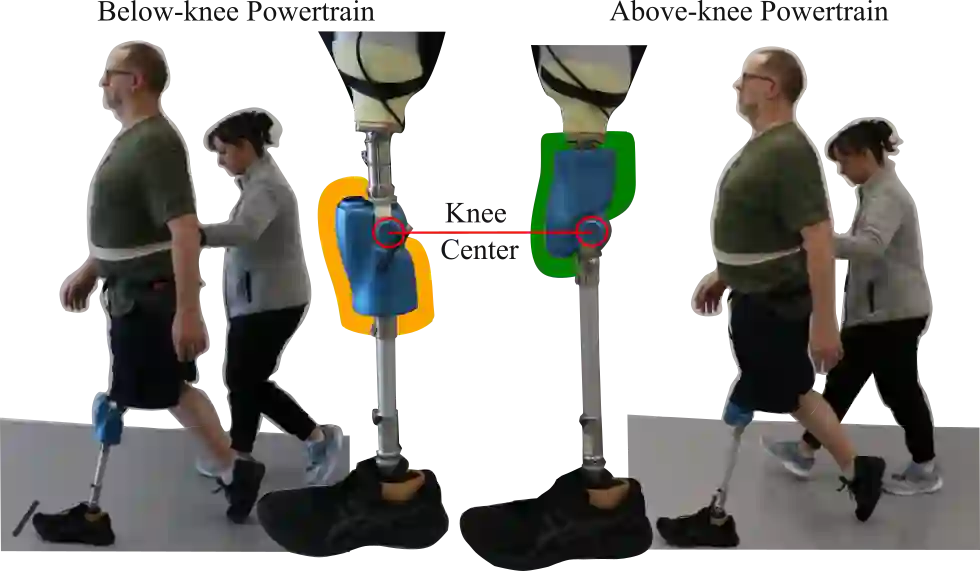
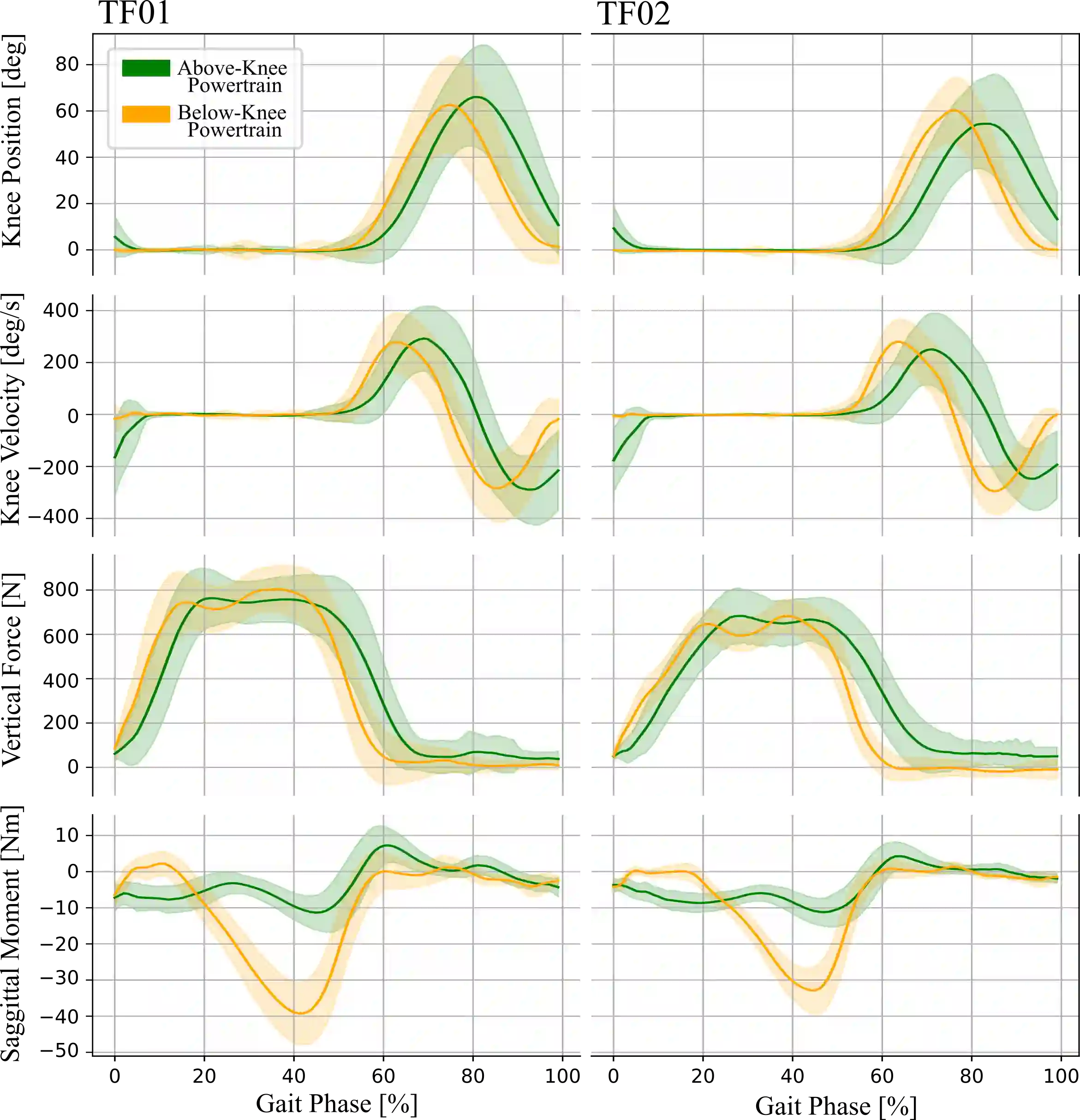
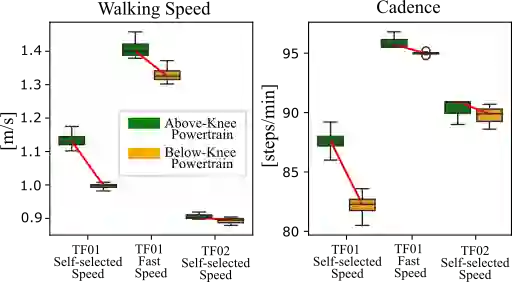
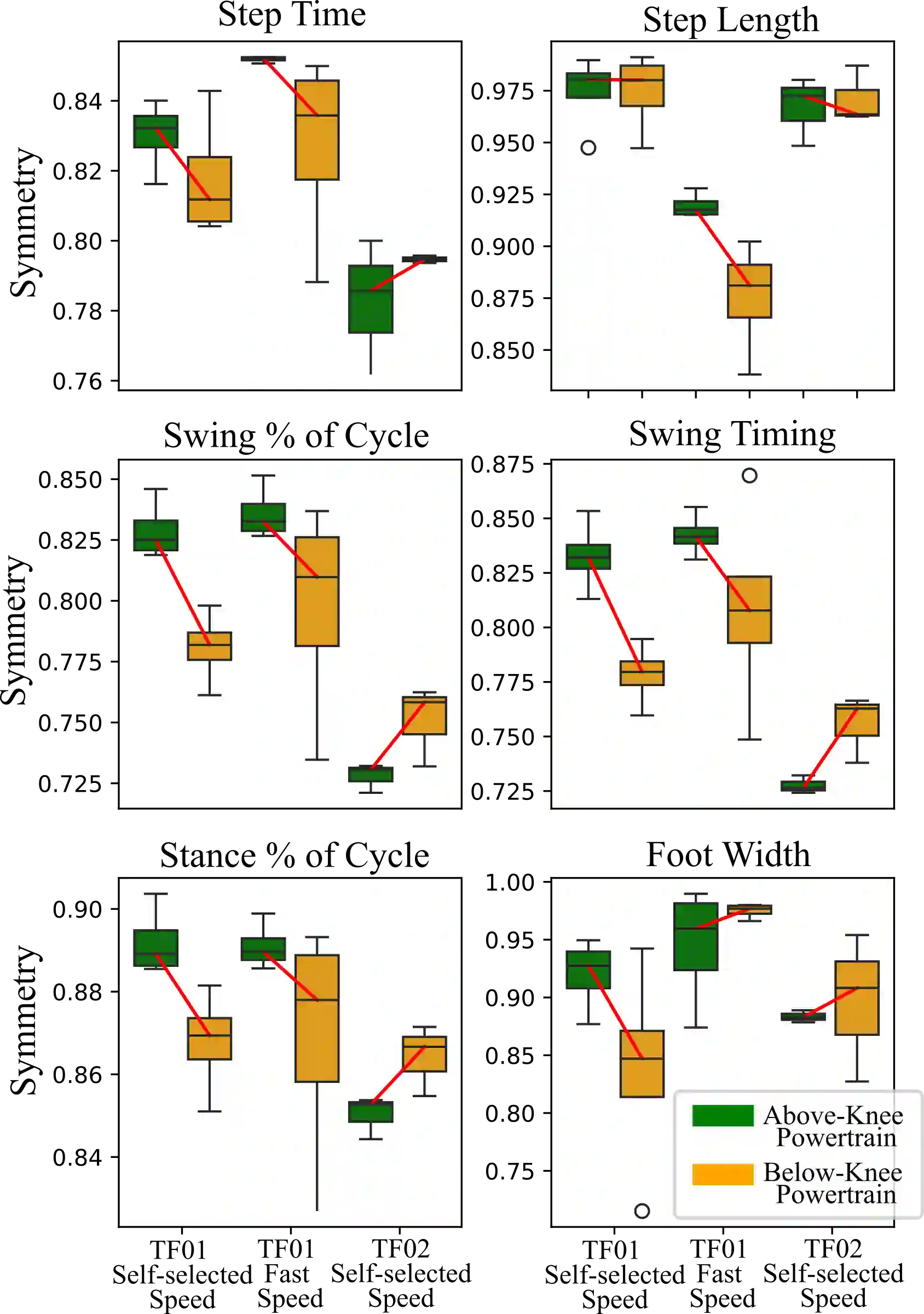
Lower limb amputation affects millions worldwide, leading to impaired mobility, reduced walking speed, and limited participation in daily and social activities. Powered prosthetic knees can partially restore mobility by actively assisting knee joint torque, improving gait symmetry, sit-to-stand transitions, and walking speed. However, added mass from powered components may diminish these benefits, negatively affecting gait mechanics and increasing metabolic cost. Consequently, optimizing mass distribution, rather than simply minimizing total mass, may provide a more effective and practical solution. In this exploratory study, we evaluated the feasibility of above-knee powertrain placement for a powered prosthetic knee in a small cohort. Compared to below-knee placement, the above-knee configuration demonstrated improved walking speed (+9.2% for one participant) and cadence (+3.6%), with mixed effects on gait symmetry. Kinematic measures indicated similar knee range of motion and peak velocity across configurations. Additional testing on ramps and stairs confirmed the robustness of the control strategy across multiple locomotion tasks. These preliminary findings suggest that above-knee placement is functionally feasible and that careful mass distribution can preserve the benefits of powered assistance while mitigating adverse effects of added weight. Further studies are needed to confirm these trends and guide design and clinical recommendations.
翻译:下肢截肢影响着全球数百万人,导致行动能力受损、步行速度下降以及日常和社交活动参与受限。动力式假肢膝关节通过主动辅助膝关节扭矩,可部分恢复行动能力,改善步态对称性、坐站转换和步行速度。然而,动力部件增加的质量可能削弱这些益处,对步态力学产生负面影响并增加代谢消耗。因此,优化质量分布而非单纯最小化总质量,可能提供更有效且实用的解决方案。在这项探索性研究中,我们评估了动力式假肢膝关节的膝上动力总成安置方案在小规模队列中的可行性。与膝下安置相比,膝上配置显示出更优的步行速度(一名参与者提升9.2%)和步频(提升3.6%),但对步态对称性的影响存在差异。运动学测量表明两种配置的膝关节活动范围和峰值速度相似。在斜坡和楼梯上的额外测试证实了控制策略在多种运动任务中的鲁棒性。这些初步发现表明膝上安置具有功能可行性,且精细的质量分布能在保留动力辅助优势的同时,缓解附加重量的不利影响。需进一步研究以确认这些趋势,并为设计与临床建议提供指导。




相关内容




 微信扫码咨询专知VIP会员