

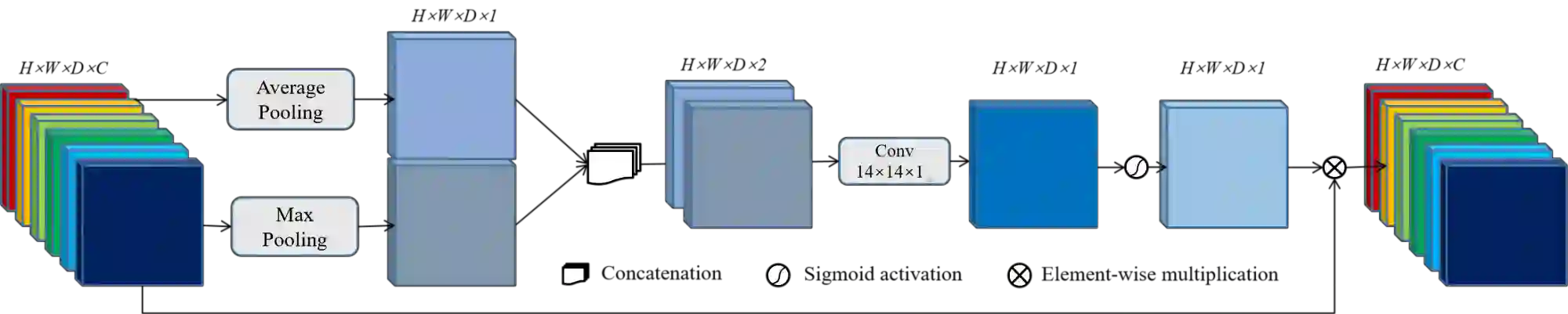
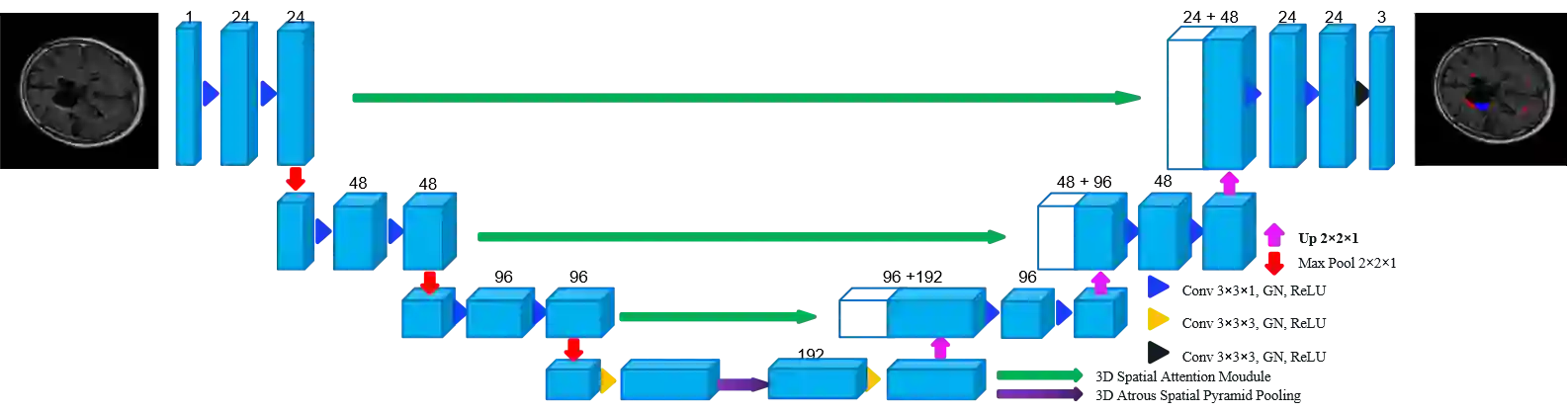
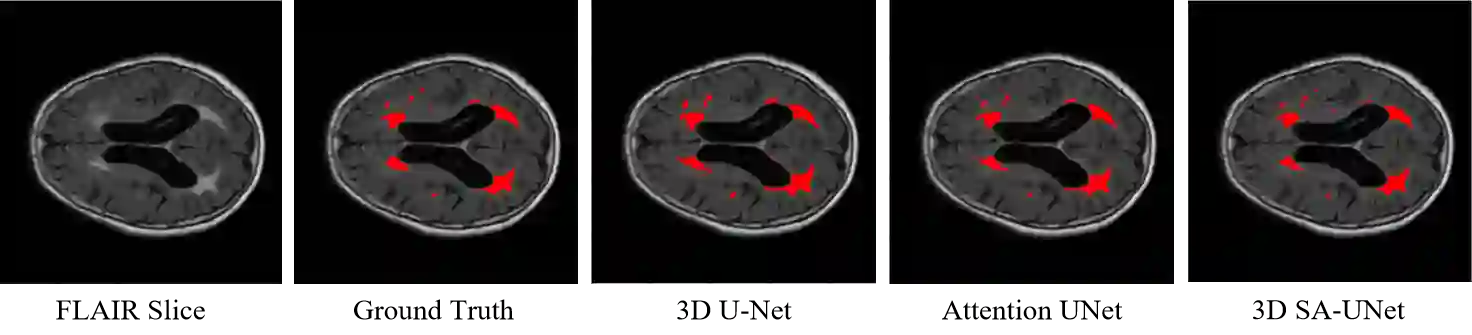
White Matter Hyperintensity (WMH) is an imaging feature related to various diseases such as dementia and stroke. Accurately segmenting WMH using computer technology is crucial for early disease diagnosis. However, this task remains challenging due to the small lesions with low contrast and high discontinuity in the images, which contain limited contextual and spatial information. To address this challenge, we propose a deep learning model called 3D Spatial Attention U-Net (3D SA-UNet) for automatic WMH segmentation using only Fluid Attenuation Inversion Recovery (FLAIR) scans. The 3D SA-UNet introduces a 3D Spatial Attention Module that highlights important lesion features, such as WMH, while suppressing unimportant regions. Additionally, to capture features at different scales, we extend the Atrous Spatial Pyramid Pooling (ASPP) module to a 3D version, enhancing the segmentation performance of the network. We evaluate our method on publicly available dataset and demonstrate the effectiveness of 3D spatial attention module and 3D ASPP in WMH segmentation. Through experimental results, it has been demonstrated that our proposed 3D SA-UNet model achieves higher accuracy compared to other state-of-the-art 3D convolutional neural networks.
翻译:白质高信号(White Matter Hyperintensity, WMH)是一种与痴呆、中风等多种疾病相关的影像学特征。利用计算机技术精确分割WMH对疾病的早期诊断至关重要。然而,由于病灶体积小、对比度低且图像中高度不连续,导致上下文和空间信息有限,这一任务仍充满挑战。为解决该问题,我们提出了一种名为3D空间注意力U-Net(3D SA-UNet)的深度学习模型,该模型仅使用液体衰减反转恢复(FLAIR)扫描实现WMH自动分割。3D SA-UNet引入了三维空间注意力模块,在抑制非重要区域的同时,突出WMH等关键病灶特征。此外,为捕获不同尺度的特征,我们将空洞空间金字塔池化(ASPP)模块扩展至三维版本,进一步提升了网络的分割性能。我们在公开数据集上评估了该方法,验证了3D空间注意力模块与三维ASPP在WMH分割中的有效性。实验结果表明,与当前最先进的三维卷积神经网络相比,我们提出的3D SA-UNet模型达到了更高的分割精度。





相关内容



 微信扫码咨询专知VIP会员