

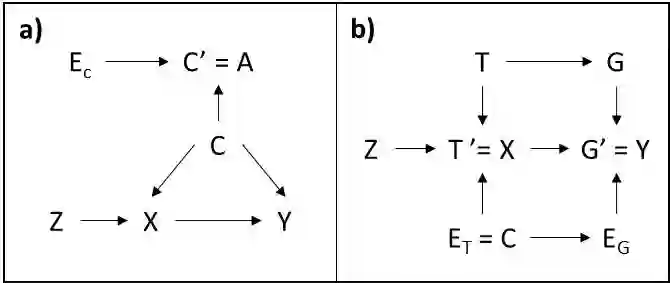
The possibility of unmeasured confounding is one of the main limitations for causal inference from observational studies. There are different methods for partially empirically assessing the plausibility of unconfoundedness. However, most currently available methods require (at least partial) assumptions about the confounding structure, which may be difficult to know in practice. In this paper we describe a simple strategy for empirically assessing the plausibility of conditional unconfoundedness (i.e., whether the candidate set of covariates suffices for confounding adjustment) which does not require any assumptions about the confounding structure, requiring instead assumptions related to temporal ordering between covariates, exposure and outcome (which can be guaranteed by design), measurement error and selection into the study. The proposed method essentially relies on testing the association between a subset of covariates (those associated with the exposure given all other covariates) and the outcome conditional on the remaining covariates and the exposure. We describe the assumptions underlying the method, provide proofs, use simulations to corroborate the theory and illustrate the method with an applied example assessing the causal effect of length-for-age measured in childhood and intelligence quotient measured in adulthood using data from the 1982 Pelotas (Brazil) birth cohort. We also discuss the implications of measurement error and some important limitations.
翻译:未测量的混杂因素是观测研究因果推断的主要局限性之一。目前已有多种方法可部分经验评估无混杂假设的合理性,但大多数现有方法需要对混杂结构(至少部分地)做出假设,而这在实践中可能难以获知。本文描述了一种简单策略,用于经验评估条件无混杂假设的合理性(即候选协变量集是否足以调整混杂)。该方法无需对混杂结构做出任何假设,而是依赖于与协变量、暴露和结局之间的时间顺序(可通过设计保证)、测量误差以及研究选择相关的假设。该方法本质上通过检验部分协变量(即给定其他协变量后与暴露相关的协变量)与条件于剩余协变量和暴露的结局之间的关联性来实现。我们阐述了该方法所依赖的假设,提供了理论证明,通过模拟验证了理论,并利用1982年巴西佩洛塔斯出生队列数据,通过评估儿童期身长别年龄与成年期智商之间的因果关系进行了应用实例说明。此外,我们还讨论了测量误差的影响及该方法的一些重要局限性。






相关内容




 微信扫码咨询专知VIP会员