

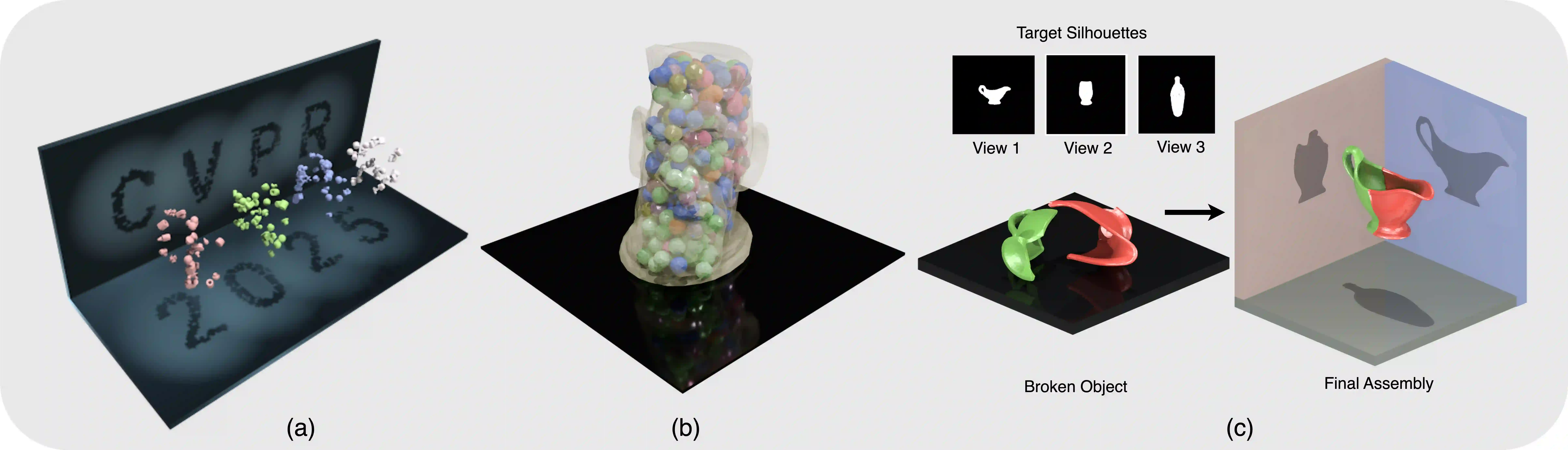
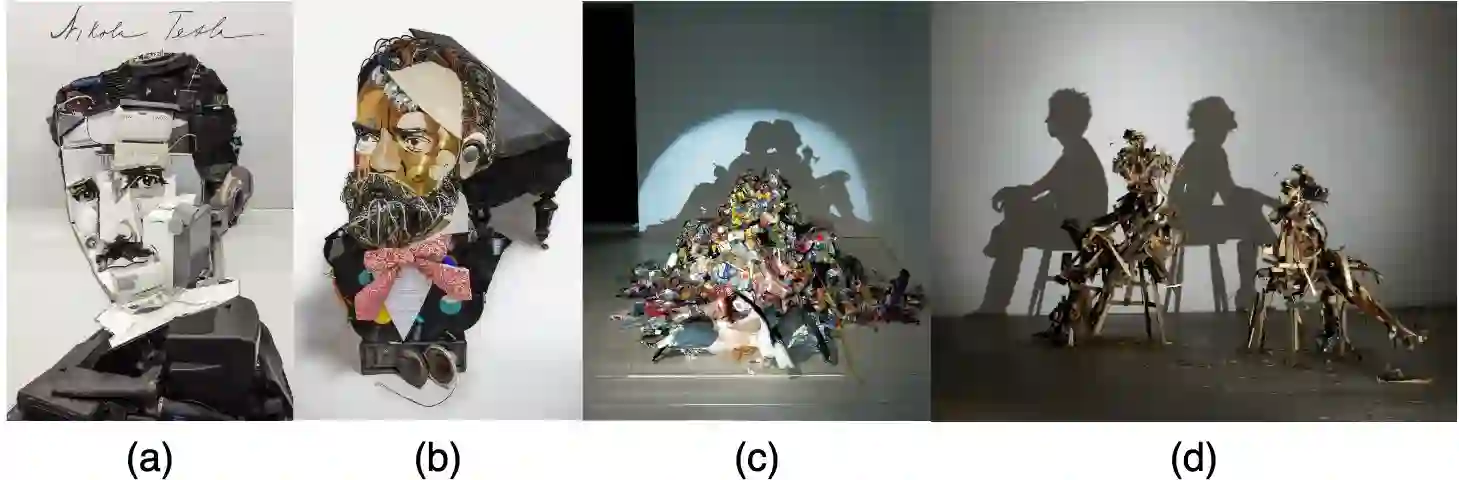
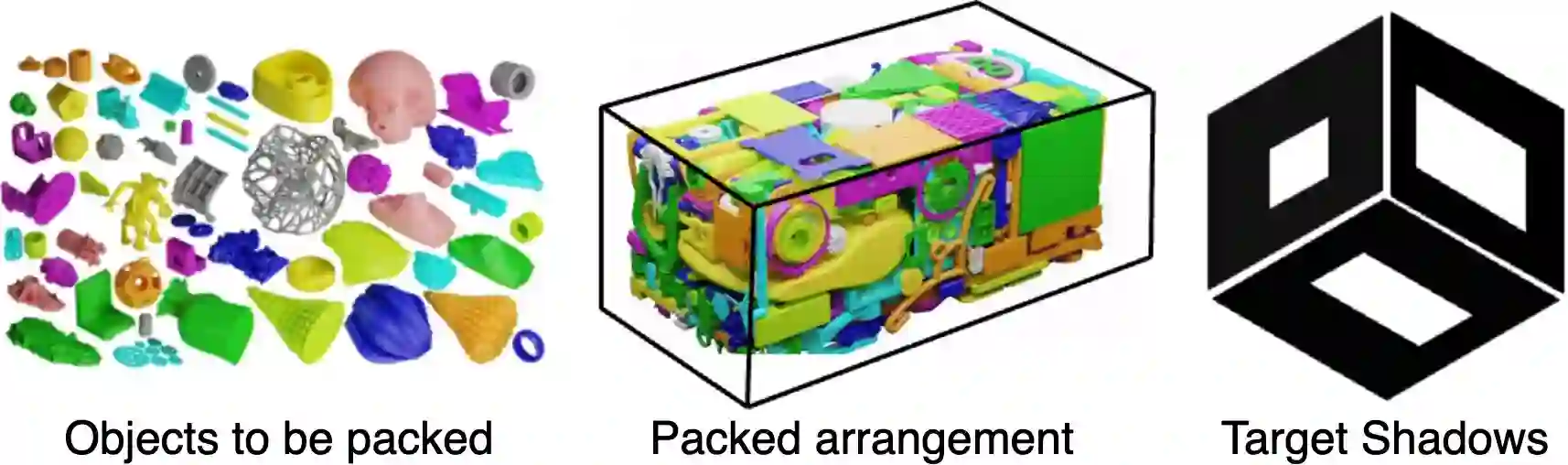
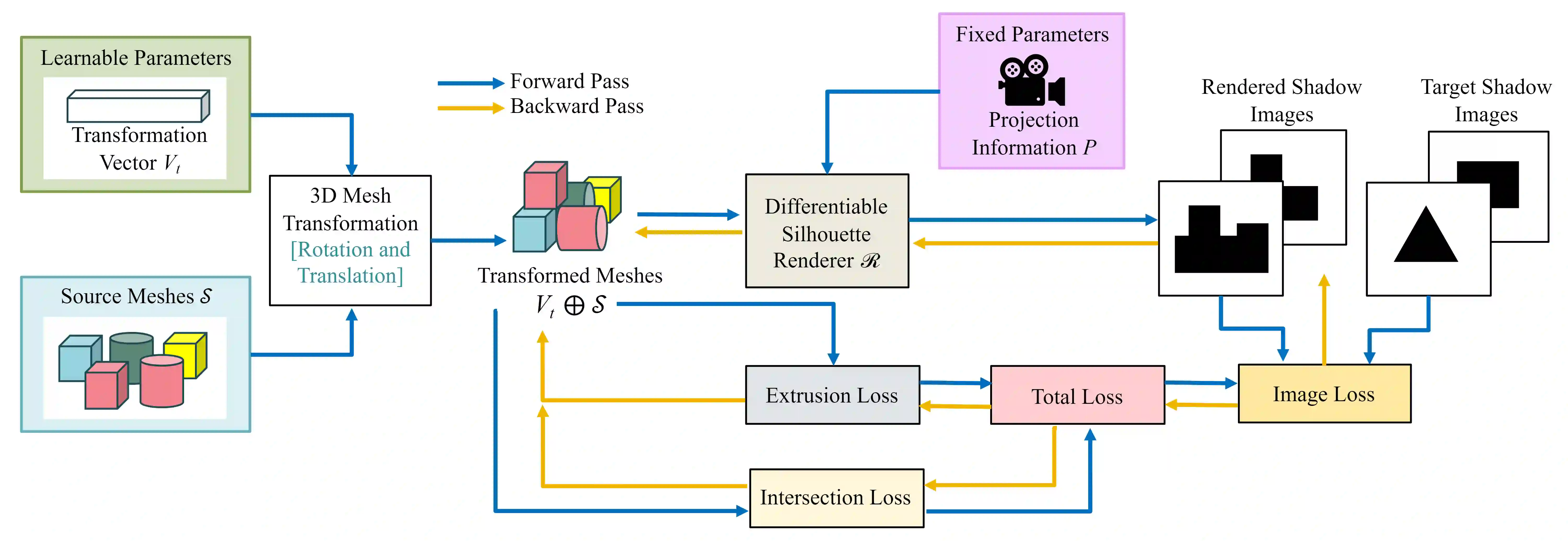
Recent advancements in learning-based methods have opened new avenues for exploring and interpreting art forms, such as shadow art, origami, and sketch art, through computational models. One notable visual art form is 3D Anamorphic Art in which an ensemble of arbitrarily shaped 3D objects creates a realistic and meaningful expression when observed from a particular viewpoint and loses its coherence over the other viewpoints. In this work, we build on insights from 3D Anamorphic Art to perform 3D object arrangement. We introduce RASP, a differentiable-rendering-based framework to arrange arbitrarily shaped 3D objects within a bounded volume via shadow (or silhouette)-guided optimization with an aim of minimal inter-object spacing and near-maximal occupancy. Furthermore, we propose a novel SDF-based formulation to handle inter-object intersection and container extrusion. We demonstrate that RASP can be extended to part assembly alongside object packing considering 3D objects to be "parts" of another 3D object. Finally, we present artistic illustrations of multi-view anamorphic art, achieving meaningful expressions from multiple viewpoints within a single ensemble.
翻译:近年来,基于学习的方法为通过计算模型探索和阐释艺术形式(如阴影艺术、折纸艺术和素描艺术)开辟了新途径。其中一种值得关注的视觉艺术形式是3维变形艺术,即一组任意形状的3D物体在特定观察视角下会呈现逼真且有意义的表达,而在其他视角下则失去其视觉连贯性。本研究基于3维变形艺术的原理,提出一种3D物体排列方法。我们引入RASP框架,该框架基于可微分渲染技术,通过阴影(或轮廓)引导的优化方法,在有限容积内排列任意形状的3D物体,以实现最小化物体间距与接近最大化的空间占用率。此外,我们提出一种新颖的基于SDF的数学表述来处理物体间交叉与容器外溢问题。实验证明,RASP可扩展至部件装配与物体堆叠场景,此时3D物体被视为另一3D物体的“部件”。最后,我们展示了多视角变形艺术的艺术图示,在单一组合体中实现了多视角下的有意义视觉表达。





相关内容





 微信扫码咨询专知VIP会员