

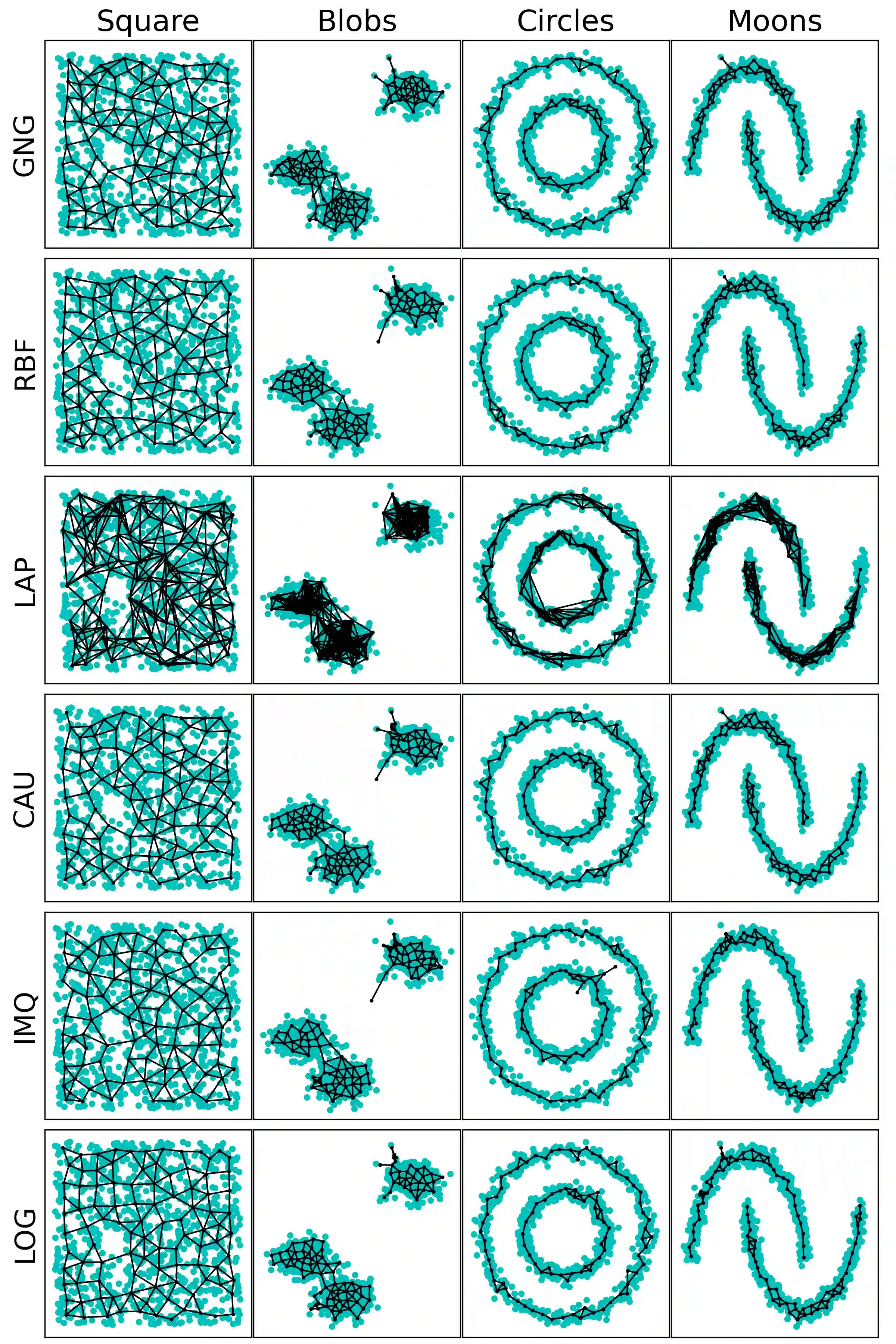
This research aims to develop kernel GNG, a kernelized version of the growing neural gas (GNG) algorithm, and to investigate the features of the networks generated by the kernel GNG. The GNG is an unsupervised artificial neural network that can transform a dataset into an undirected graph, thereby extracting the features of the dataset as a graph. The GNG is widely used in vector quantization, clustering, and 3D graphics. Kernel methods are often used to map a dataset to feature space, with support vector machines being the most prominent application. This paper introduces the kernel GNG approach and explores the characteristics of the networks generated by kernel GNG. Five kernels, including Gaussian, Laplacian, Cauchy, inverse multiquadric, and log kernels, are used in this study. The results of this study show that the average degree and the average clustering coefficient decrease as the kernel parameter increases for Gaussian, Laplacian, Cauchy, and IMQ kernels. If we avoid more edges and a higher clustering coefficient (or more triangles), the kernel GNG with a larger value of the parameter will be more appropriate.
翻译:本研究旨在开发核生长神经气(kernel GNG)算法——即生长神经气(GNG)算法的核化版本,并探究核GNG所生成网络的特征。GNG是一种无监督人工神经网络,能将数据集转化为无向图,从而以图形式提取数据集特征,广泛应用于向量量化、聚类及三维图形学领域。核方法常用于将数据集映射至特征空间,其中最典型的应用是支持向量机。本文引入核GNG方法,并深入分析其生成网络的特性。研究采用五种核函数:高斯核、拉普拉斯核、柯西核、逆多二次核及对数核。结果表明:对于高斯核、拉普拉斯核、柯西核及逆多二次核,随核参数增大,网络的平均度与平均聚类系数均呈下降趋势。若需避免生成过多边或较高聚类系数(即大量三角形结构),则选用较大参数的核GNG更为适宜。




相关内容




 微信扫码咨询专知VIP会员