

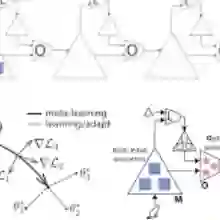
Over the past few years, significant advancements have been made in the field of machine learning (ML) to address resource management, interference management, autonomy, and decision-making in wireless networks. Traditional ML approaches rely on centralized methods, where data is collected at a central server for training. However, this approach poses a challenge in terms of preserving the data privacy of devices. To address this issue, federated learning (FL) has emerged as an effective solution that allows edge devices to collaboratively train ML models without compromising data privacy. In FL, local datasets are not shared, and the focus is on learning a global model for a specific task involving all devices. However, FL has limitations when it comes to adapting the model to devices with different data distributions. In such cases, meta learning is considered, as it enables the adaptation of learning models to different data distributions using only a few data samples. In this tutorial, we present a comprehensive review of FL, meta learning, and federated meta learning (FedMeta). Unlike other tutorial papers, our objective is to explore how FL, meta learning, and FedMeta methodologies can be designed, optimized, and evolved, and their applications over wireless networks. We also analyze the relationships among these learning algorithms and examine their advantages and disadvantages in real-world applications.
翻译:近年来,机器学习领域在解决无线网络中的资源管理、干扰管理、自主决策与优化方面取得了显著进展。传统机器学习方法依赖集中式数据训练模式,即所有设备将数据汇集至中央服务器进行模型训练。然而,这种模式对保护设备数据隐私构成了严峻挑战。为此,联邦学习应运而生,其作为有效解决方案使边缘设备能够在不牺牲数据隐私的前提下协同训练机器学习模型。在联邦学习中,本地数据集无需共享,其核心目标是为所有设备参与的特定任务学习全局模型。但联邦学习在适应不同数据分布的设备时存在局限性,而元学习通过仅需少量数据样本即可实现学习模型对不同数据分布的适配。本教程对联邦学习、元学习及联邦元学习进行了全面综述。与其他教程类论文不同,本文旨在深入探究联邦学习、元学习及联邦元学习三类方法的设计优化、演进路径及其在无线网络中的应用,系统分析这些学习算法间的内在联系,并评估其在实际应用中的优劣特性。




相关内容




 微信扫码咨询专知VIP会员