

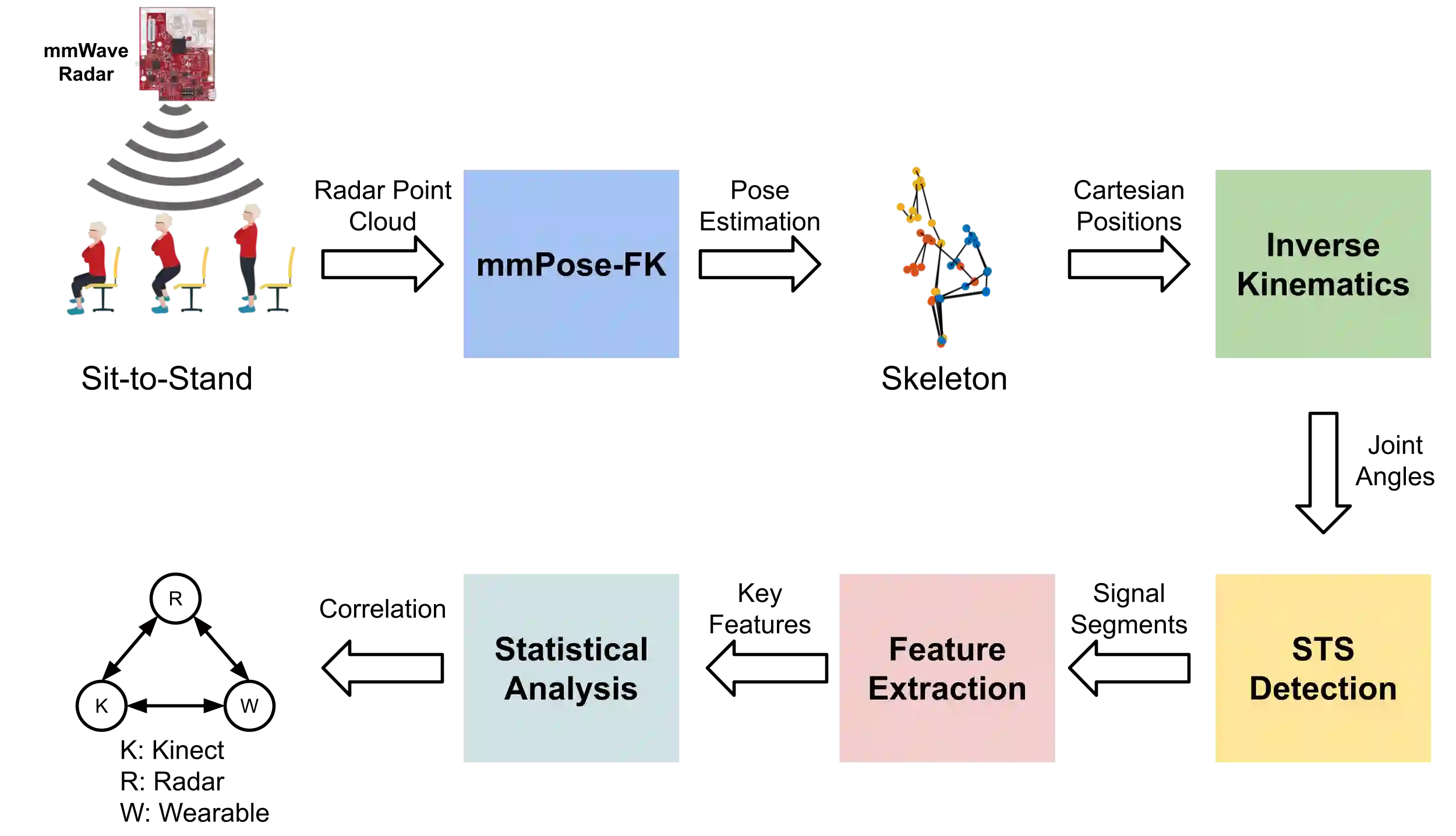
This study explores a novel approach for analyzing Sit-to-Stand (STS) movements using millimeter-wave (mmWave) radar technology. The goal is to develop a non-contact sensing, privacy-preserving, and all-day operational method for healthcare applications, including fall risk assessment. We used a 60GHz mmWave radar system to collect radar point cloud data, capturing STS motions from 45 participants. By employing a deep learning pose estimation model, we learned the human skeleton from Kinect built-in body tracking and applied Inverse Kinematics (IK) to calculate joint angles, segment STS motions, and extract commonly used features in fall risk assessment. Radar extracted features were then compared with those obtained from Kinect and wearable sensors. The results demonstrated the effectiveness of mmWave radar in capturing general motion patterns and large joint movements (e.g., trunk). Additionally, the study highlights the advantages and disadvantages of individual sensors and suggests the potential of integrated sensor technologies to improve the accuracy and reliability of motion analysis in clinical and biomedical research settings.
翻译:本研究探索了一种利用毫米波雷达技术分析坐立动作的新方法,旨在开发一种适用于医疗健康应用的非接触式、保护隐私且可全天候运行的感知方案,包括跌倒风险评估。我们采用60GHz毫米波雷达系统采集雷达点云数据,记录了45名参与者的坐立动作。通过部署深度学习姿态估计模型,我们从Kinect内置人体追踪数据中学习人体骨架结构,并应用逆向运动学算法计算关节角度、分割坐立动作序列,进而提取跌倒风险评估中常用的特征参数。随后,将雷达提取的特征与Kinect及可穿戴传感器获取的特征进行对比分析。结果表明,毫米波雷达在捕捉整体运动模式及大关节活动方面具有显著效果。此外,本研究系统阐述了各类传感器的优势与局限性,并指出融合多传感器技术有望提升临床与生物医学研究场景中运动分析的准确性与可靠性。





相关内容




 微信扫码咨询专知VIP会员