

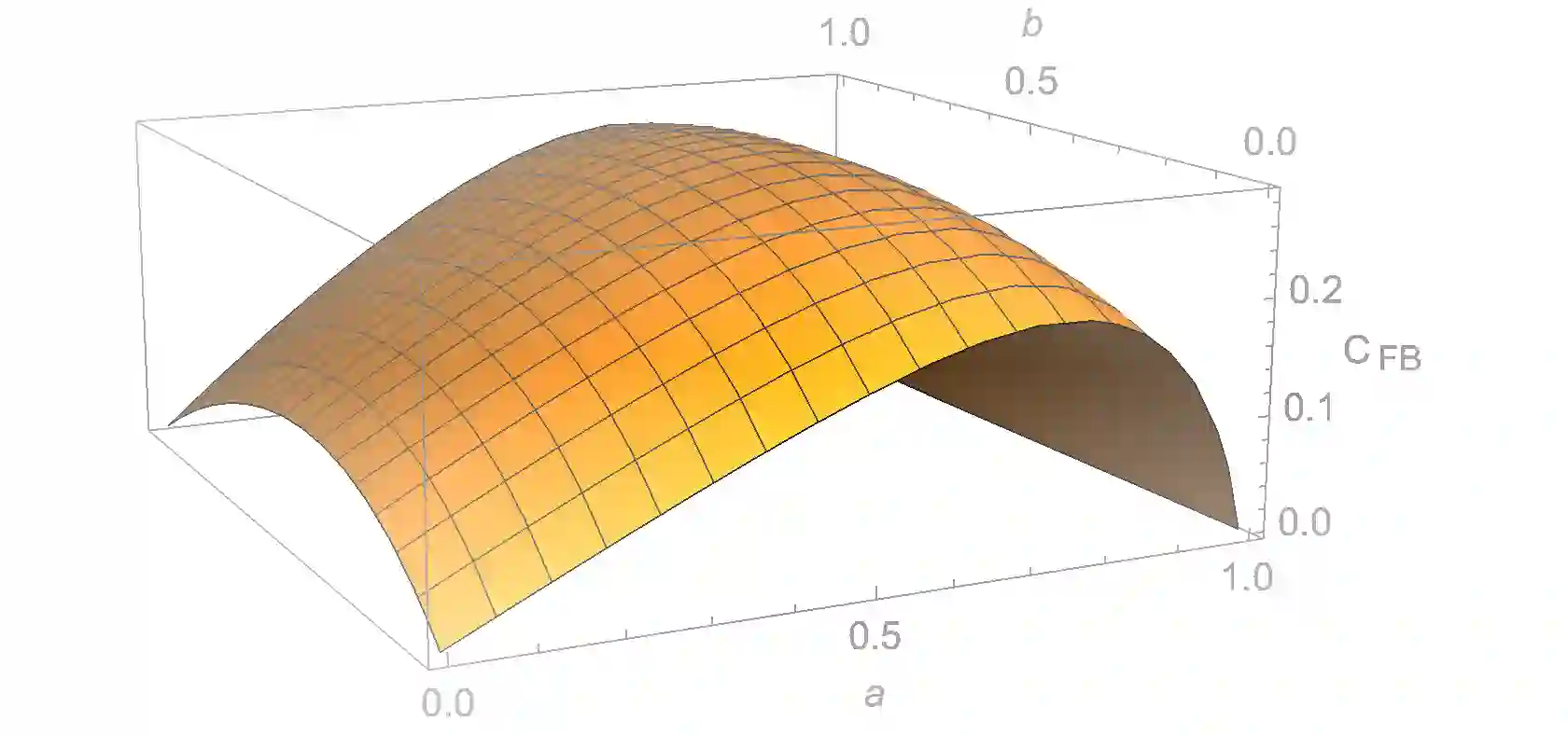
We consider finite-state channels (FSCs) where the channel state is stochastically dependent on the previous channel output. We refer to these as Noisy Output is the STate (NOST) channels. We derive the feedback capacity of NOST channels in two scenarios: with and without causal state information (CSI) available at the encoder. If CSI is unavailable, the feedback capacity is $C_{\text{FB}}= \max_{P(x|y')} I(X;Y|Y')$, while if it is available at the encoder, the feedback capacity is $C_{\text{FB-CSI}}= \max_{P(u|y'),x(u,s')} I(U;Y|Y')$, where $U$ is an auxiliary random variable with finite cardinality. In both formulas, the output process is a Markov process with stationary distribution. The derived formulas generalize special known instances from the literature, such as where the state is distributed i.i.d. and where it is a deterministic function of the output. $C_{\text{FB}}$ and $C_{\text{FB-CSI}}$ are also shown to be computable via concave optimization problem formulations. Finally, we give a sufficient condition under which CSI available at the encoder does not increase the feedback capacity, and we present an interesting example that demonstrates this.
翻译:我们考虑的是频道状态取决于上一个频道输出的有限状态频道( FSCs) 。 我们称之为 Nosy 输出是STate (NOST) 频道。 我们从两个情景中获取NOST 频道的反馈能力: 有或无因果状态信息( CSI ) 在编码器中。 如果 CSI 无法提供, 反馈能力是 $C ⁇ text{FB}\\\\max ⁇ P(x ⁇ y) } I(X); Y ⁇ Y') 美元, 而如果在编码器中可以找到, 反馈能力是 $C{FSI 的 值。 在两种公式中, 输出进程是 Markov 进程, 且有固定分布。 衍生公式概括了文献中已知的特殊案例, 例如, 国家分布了 {FSI \\\\\\\\\\\\\\\\\\\\\\\\\\\\\\\\\\\\\\\\\\\\\\\\\\\\\\\\\\\\\\\\\\\\\\\\\\\\\\\\\\\\\\\\\\\\\\\\\\\\\\\\\\\\\\\\\\\\\\\\\\\\\\\\\\\\\\\\\\\\\\\\\\\\\\\\\\\\\\\\\\\\\\\\\\\\\\\\\\\\\\\\\\\\\\\\\\\\\\\\\\\\\\\\\\\\\\\\\\\\\\\\\\\\\\\\\\\\\\\\\\\\\\\\\\\\\\\\\\\\\\\\\\\\\\\\\\\\\\\\\\\\\\\\\\\\\\\\\\\\\\\\\\\\\\\\\\\\\\\\\\\\\\




相关内容




 微信扫码咨询专知VIP会员