

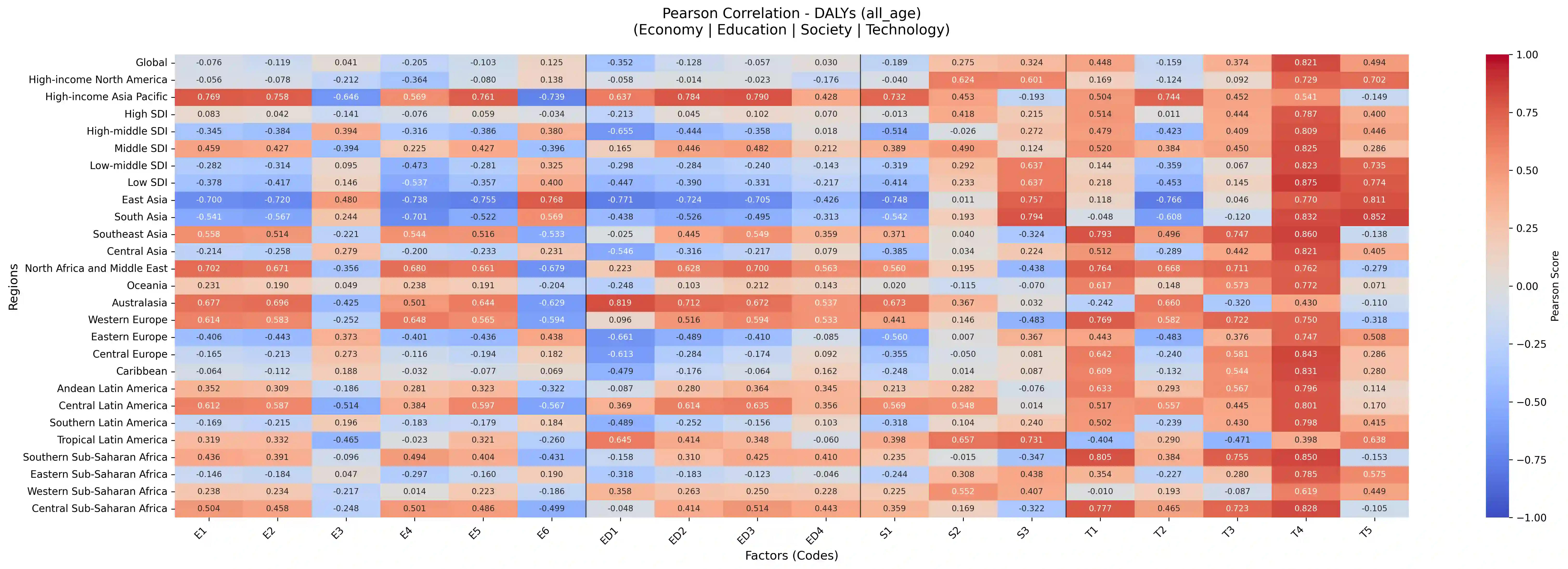
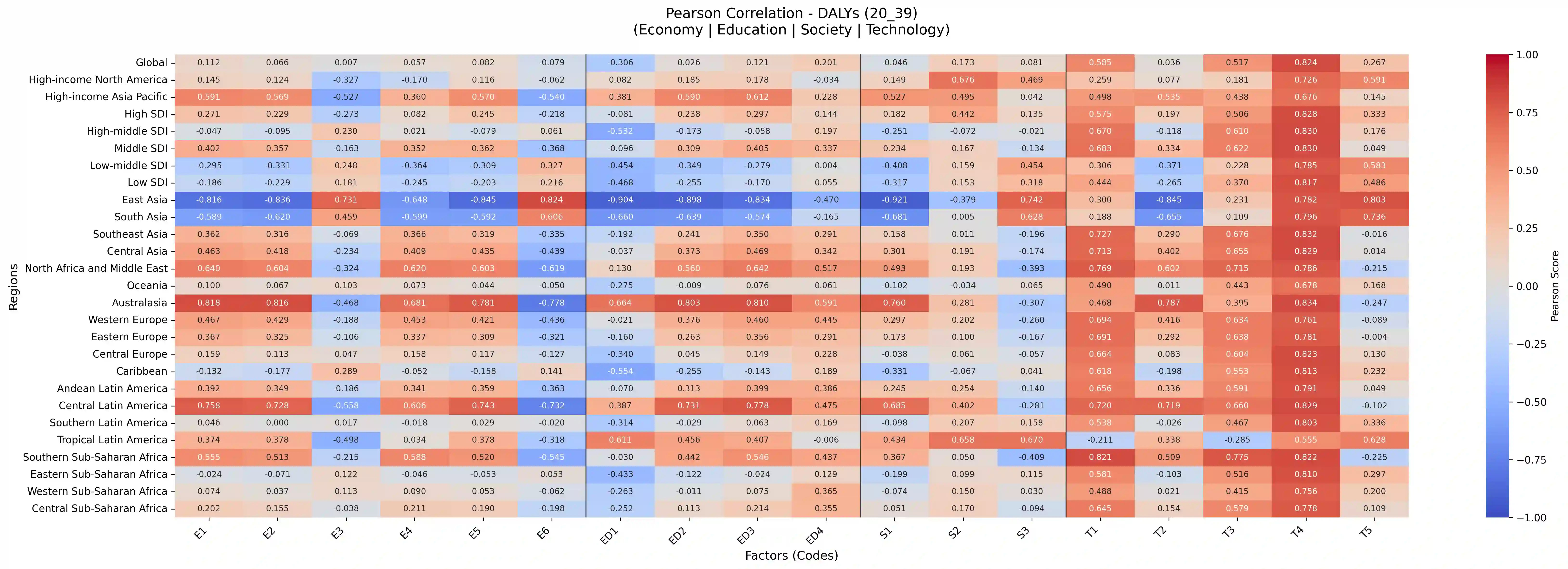
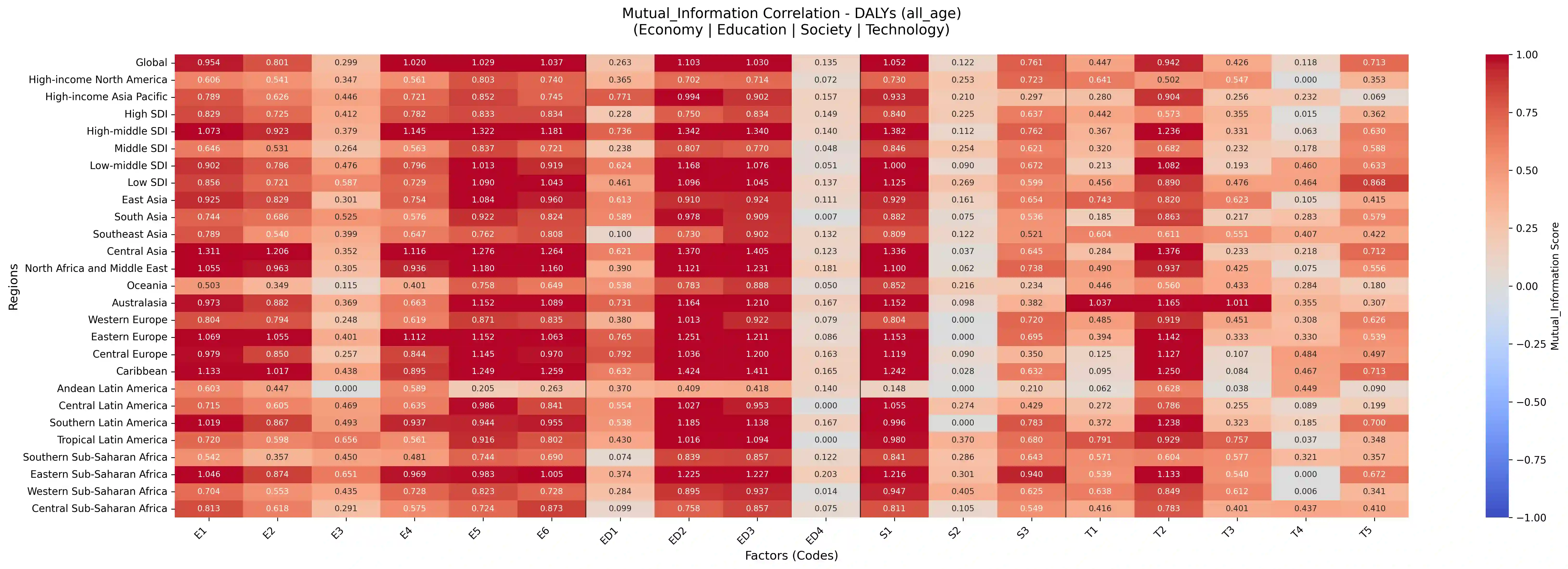
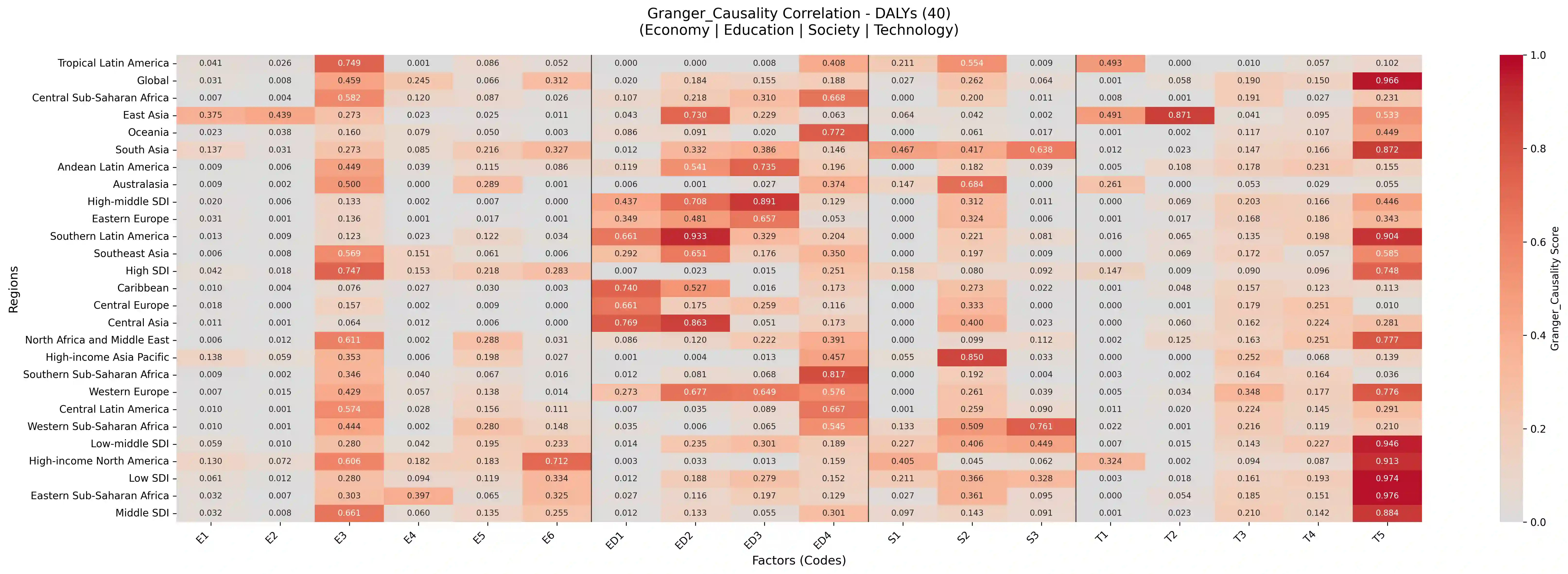
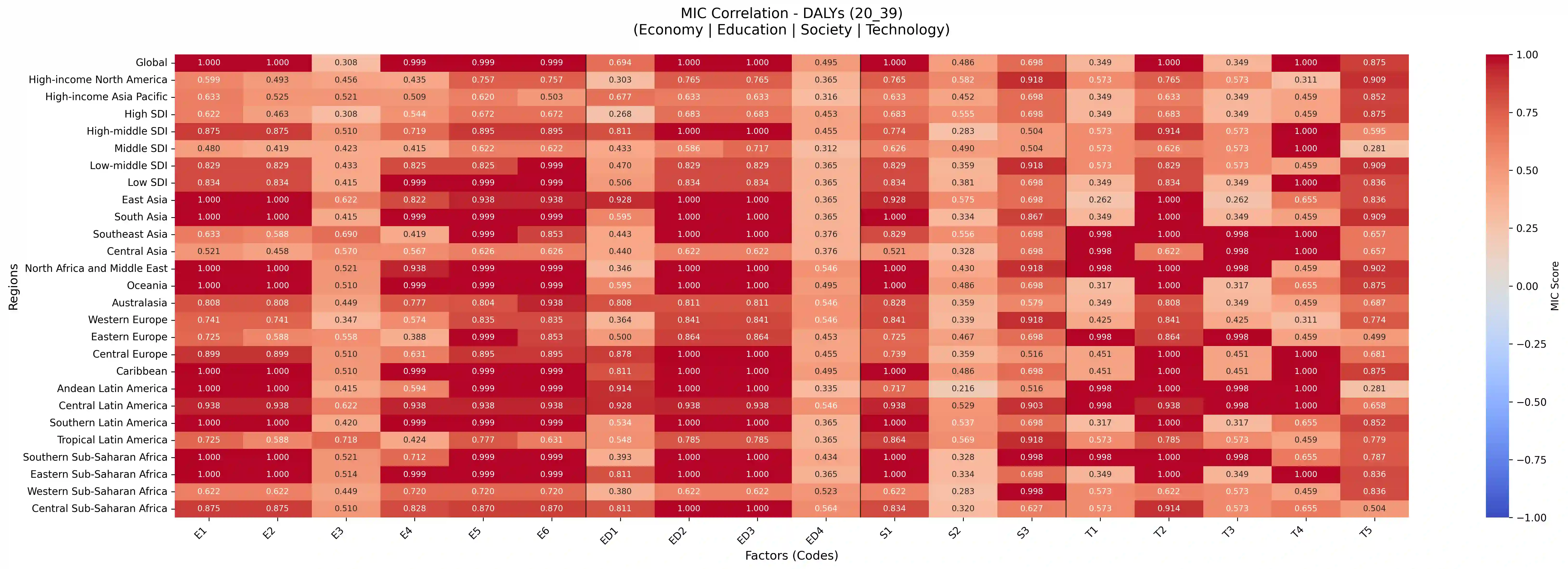
This paper quantifies the age-stratified global burden of four mental disorders in 27 regions from 1990 to 2021 using GBD 2021. To put it in detail, it links the age-standardized years of disability adjustment with 18 world development indicators across economic, educational, social and information technology sectors. Then, by means of Pearson correlation, mutual information, Granger causality and maximum information coefficient and other methods, the linear, nonlinear and lagged dependency relationships were evaluated. After research, it was found that there is a very prominent spatio-temporal heterogeneity among young people aged 20 to 39, and the coupling relationship is stronger. From the overall situation, education corresponds to a low burden. Unemployment corresponds to a high burden. Through lag analysis, it can be known that the influence time of economic and technological factors is relatively short, while that of educational factors is relatively long. These results highlight the macro determinants that play a role at different time scales and also provide population-level references for verifying computational mental health models and for intervention measures in specific regions and for specific ages.
翻译:本文利用GBD 2021数据,量化了1990年至2021年间27个地区四种精神障碍的年龄分层全球负担。具体而言,研究将年龄标准化伤残调整生命年与涵盖经济、教育、社会和信息技术领域的18项世界发展指标相关联。随后,通过皮尔逊相关、互信息、格兰杰因果检验和最大信息系数等方法,评估了线性、非线性及滞后依赖关系。研究发现,20至39岁青年群体中存在非常显著的时空异质性,且耦合关系更强。从整体情况看,教育水平对应较低的疾病负担,而失业率则对应较高的负担。通过滞后分析可知,经济与技术因素的影响时间相对较短,而教育因素的影响时间相对较长。这些结果凸显了在不同时间尺度上起作用的宏观决定因素,同时也为验证计算心理健康模型以及为特定地区和特定年龄群体制定干预措施提供了人口层面的参考依据。




相关内容




 微信扫码咨询专知VIP会员