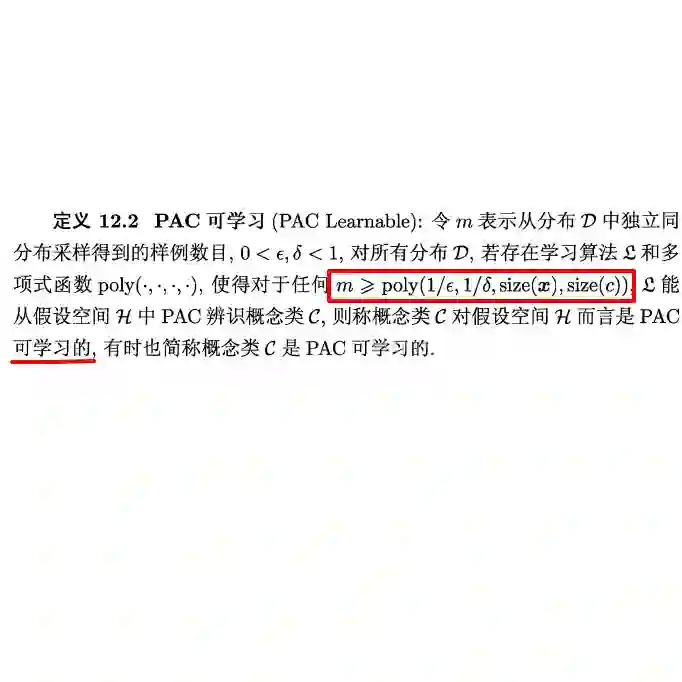
The success of language models has motivated theoretical work on learning to sample from distributions on discrete domains. A prominent abstraction is the model of language generation in the limit, introduced by Kleinberg and Mullainathan (NeurIPS 2024), in which the algorithm must generate from the target language after some finite but unspecified number of positive examples. While its positive results are surprisingly general, most guarantees are qualitative. In this work, we seek quantitative guarantees on sample and time complexity, inspired by statistical and computational learning theory. To this end, we study a PAC model of language generation, proposed (in a different context) by De, Diakonikolas, and Servedio (SODA 2015), in which a Boolean concept class $C$ over $\{-1,1\}^n$ defines the target languages: given uniformly random positive examples of an unknown concept $f \in C$, the learner must output a sampler whose output distribution (conditioned on the training data) is close in total variation to the uniform distribution over $f^{-1}(1)$. Their work implicitly gives an efficient algorithm for PAC learning to sample $C$, given three primitives for $C$: an online learner, approximate sampling and counting oracles, and an SQ learner. We ask whether these ingredients, in particular online learnability, are necessary. First, we construct a Boolean concept class $C$ for which online learning is cryptographically hard, yet PAC learning to sample is computationally efficient. Then, we develop new algorithms that use offline ERM oracles instead of online learners, together with approximate sampling/counting oracles for intersections of concepts in $C$ and an SQ learner for $C$. We view our results, together with the work of De, Diakonikolas, and Servedio, as a first step towards understanding the computational complexity of language generation.


翻译:暂无翻译

0
下载
关闭预览

相关内容

EMNLP2024|从知识图谱中习得大语言模型的规划能力
专知会员服务
31+阅读 · 2024年11月27日
Stabilizing Transformers for Reinforcement Learning
专知会员服务
61+阅读 · 2019年10月17日
Hierarchically Structured Meta-learning
CreateAMind
27+阅读 · 2019年5月22日
Transferring Knowledge across Learning Processes
CreateAMind
29+阅读 · 2019年5月18日
近期语音类前沿论文
深度学习每日摘要
14+阅读 · 2019年3月17日
Unsupervised Learning via Meta-Learning
CreateAMind
44+阅读 · 2019年1月3日
《pyramid Attention Network for Semantic Segmentation》
统计学习与视觉计算组
44+阅读 · 2018年8月30日
语料库构建——自然语言理解的基础
计算机研究与发展
11+阅读 · 2017年8月21日
国家自然科学基金
21+阅读 · 2015年12月31日
国家自然科学基金
0+阅读 · 2015年12月31日
国家自然科学基金
0+阅读 · 2015年12月31日
国家自然科学基金
3+阅读 · 2015年12月31日
国家自然科学基金
0+阅读 · 2014年12月31日
国家自然科学基金
3+阅读 · 2014年12月31日
国家自然科学基金
12+阅读 · 2014年12月31日
国家自然科学基金
12+阅读 · 2014年12月31日
国家自然科学基金
8+阅读 · 2014年12月31日
国家自然科学基金
4+阅读 · 2014年12月31日
VIP会员
最新内容
北约400亿美元反无人机能力投资建设
专知会员服务
6+阅读 · 11月25日
反小型无人机系统方案评估(27页)
专知会员服务
8+阅读 · 11月25日
乌克兰无人机饱和战场中的错误教训
专知会员服务
18+阅读 · 11月17日
面向最后一战术英里:美军无人机创新尝试
专知会员服务
14+阅读 · 11月17日
《美空军2026条令文件:对海压制作战》
专知会员服务
31+阅读 · 11月9日
人工智能与战争的未来
专知会员服务
14+阅读 · 11月8日
《Agent Mosaic:识别智能体LLM系统中的机密泄露》
专知会员服务
14+阅读 · 11月8日
相关VIP内容
EMNLP2024|从知识图谱中习得大语言模型的规划能力
专知会员服务
31+阅读 · 2024年11月27日
Stabilizing Transformers for Reinforcement Learning
专知会员服务
61+阅读 · 2019年10月17日
相关资讯
Hierarchically Structured Meta-learning
CreateAMind
27+阅读 · 2019年5月22日
Transferring Knowledge across Learning Processes
CreateAMind
29+阅读 · 2019年5月18日
近期语音类前沿论文
深度学习每日摘要
14+阅读 · 2019年3月17日
Unsupervised Learning via Meta-Learning
CreateAMind
44+阅读 · 2019年1月3日
《pyramid Attention Network for Semantic Segmentation》
统计学习与视觉计算组
44+阅读 · 2018年8月30日
语料库构建——自然语言理解的基础
计算机研究与发展
11+阅读 · 2017年8月21日
相关基金
国家自然科学基金
21+阅读 · 2015年12月31日
国家自然科学基金
0+阅读 · 2015年12月31日
国家自然科学基金
0+阅读 · 2015年12月31日
国家自然科学基金
3+阅读 · 2015年12月31日
国家自然科学基金
0+阅读 · 2014年12月31日
国家自然科学基金
3+阅读 · 2014年12月31日
国家自然科学基金
12+阅读 · 2014年12月31日
国家自然科学基金
12+阅读 · 2014年12月31日
国家自然科学基金
8+阅读 · 2014年12月31日
国家自然科学基金
4+阅读 · 2014年12月31日
Top
微信扫码咨询专知VIP会员