

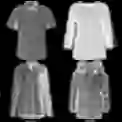
We present a demonstration of image classification using an echo-state network (ESN) relying on a single simulated spintronic nanostructure known as the vortex-based spin-torque oscillator (STVO) delayed in time. We employ an ultrafast data-driven simulation framework called the data-driven Thiele equation approach (DD-TEA) to simulate the STVO dynamics. This allows us to avoid the challenges associated with repeated experimental manipulation of such a nanostructured system. We showcase the versatility of our solution by successfully applying it to solve classification challenges with the MNIST, EMNIST-letters and Fashion MNIST datasets. Through our simulations, we determine that within a large ESN the results obtained using the STVO dynamics as an activation function are comparable to the ones obtained with other conventional nonlinear activation functions like the reLU and the sigmoid. While achieving state-of-the-art accuracy levels on the MNIST dataset, our model's performance on EMNIST-letters and Fashion MNIST is lower due to the relative simplicity of the system architecture and the increased complexity of the tasks. We expect that the DD-TEA framework will enable the exploration of deeper architectures, ultimately leading to improved classification accuracy.
翻译:我们展示了一种利用单一时延模拟自旋电子纳米结构——即基于涡旋的自旋扭矩振荡器(STVO)——的回声状态网络(ESN)进行图像分类的示范。我们采用了一种称为数据驱动Thiele方程方法(DD-TEA)的超快数据驱动仿真框架来模拟STVO动力学。这使我们能够避免对该纳米结构系统进行重复实验操作所带来的挑战。我们通过成功将其应用于MNIST、EMNIST-letters和Fashion MNIST数据集的分类问题,展示了我们解决方案的通用性。通过仿真,我们确定在大型ESN中,使用STVO动力学作为激活函数所获得的结果与使用其他常规非线性激活函数(如ReLU和Sigmoid)所获得的结果相当。尽管在MNIST数据集上达到了最先进的准确率水平,但由于系统架构的相对简单性和任务复杂性的增加,我们的模型在EMNIST-letters和Fashion MNIST上的性能较低。我们预计DD-TEA框架将有助于探索更深层的架构,最终提高分类准确率。




相关内容



 微信扫码咨询专知VIP会员