

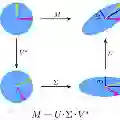
PDE solutions are numerically represented by basis functions. Classical methods employ pre-defined bases that encode minimum desired PDE properties, which naturally cause redundant computations. What are the best bases to numerically represent PDE solutions? From the analytical perspective, the Kolmogorov $n$-width is a popular criterion for selecting representative basis functions. From the Bayesian computation perspective, the concept of optimality selects the modes that, when known, minimize the variance of the conditional distribution of the rest of the solution. We show that these two definitions of optimality are equivalent. Numerically, both criteria reduce to solving a Singular Value Decomposition (SVD), a procedure that can be made numerically efficient through randomized sampling. We demonstrate computationally the effectiveness of the basis functions so obtained on several linear and nonlinear problems. In all cases, the optimal accuracy is achieved with a small set of basis functions.
翻译:偏微分方程解通过基函数进行数值表示。经典方法采用预定义的基函数,这些基函数编码了最小所需的PDE特性,这自然会导致冗余计算。那么,数值表示PDE解的最佳基函数是什么?从分析角度来看,Kolmogorov $n$-宽度是选择代表性基函数的流行准则。从贝叶斯计算角度来看,最优性概念选择的是那些一旦已知就能最小化解其余部分条件分布方差的模态。我们证明了这两种最优性定义是等价的。在数值上,这两种准则都归结为解决奇异值分解,而这一过程可以通过随机采样实现数值高效性。我们通过计算实验展示了所获得基函数在多个线性和非线性问题上的有效性。在所有情况下,仅需少量基函数即可达到最优精度。




相关内容



 微信扫码咨询专知VIP会员