

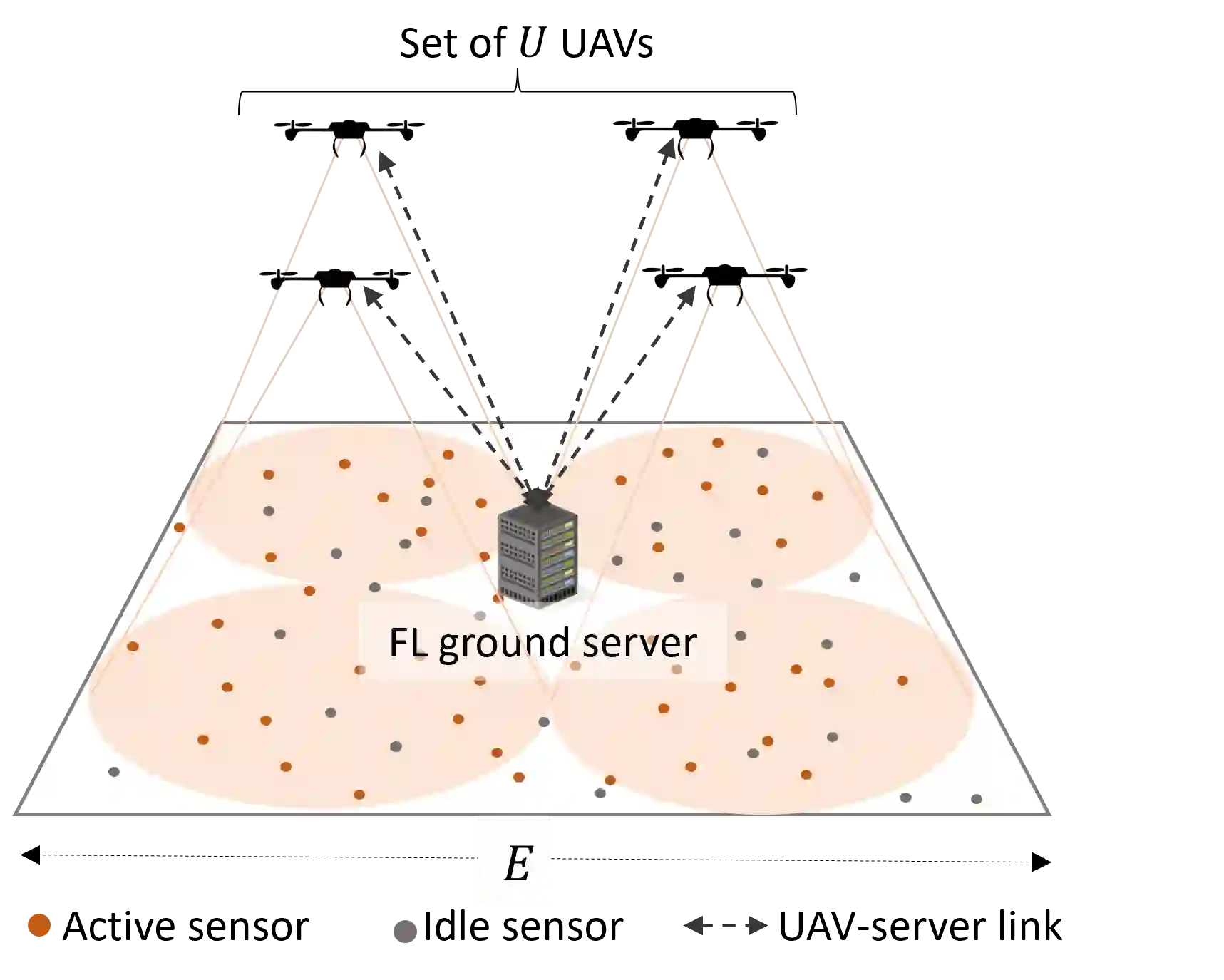
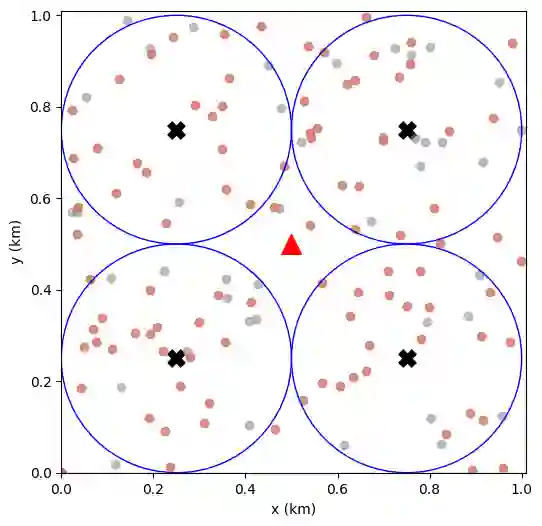
Federated learning (FL) involves several devices that collaboratively train a shared model without transferring their local data. FL reduces the communication overhead, making it a promising learning method in UAV-enhanced wireless networks with scarce energy resources. Despite the potential, implementing FL in UAV-enhanced networks is challenging, as conventional UAV placement methods that maximize coverage increase the FL delay significantly. Moreover, the uncertainty and lack of a priori information about crucial variables, such as channel quality, exacerbate the problem. In this paper, we first analyze the statistical characteristics of a UAV-enhanced wireless sensor network (WSN) with energy harvesting. We then develop a model and solution based on the multi-objective multi-armed bandit theory to maximize the network coverage while minimizing the FL delay. Besides, we propose another solution that is particularly useful with large action sets and strict energy constraints at the UAVs. Our proposal uses a scalarized best-arm identification algorithm to find the optimal arms that maximize the ratio of the expected reward to the expected energy cost by sequentially eliminating one or more arms in each round. Then, we derive the upper bound on the error probability of our multi-objective and cost-aware algorithm. Numerical results show the effectiveness of our approach.
翻译:联邦学习(FL)允许多个设备协同训练共享模型,而无需传输本地数据。FL降低了通信开销,使其成为能量资源稀缺的无人机增强无线网络中一种有前景的学习方法。尽管潜力巨大,但在无人机增强网络中部署FL仍面临挑战:传统的无人机部署方法虽能最大化覆盖范围,却显著增加了FL延迟。此外,关键变量(如信道质量)的不确定性及先验信息缺失加剧了这一问题。本文首先分析了具有能量收集功能的无人机增强无线传感器网络(WSN)的统计特性。随后,基于多目标多臂老虎机理论,我们开发了一种模型与解决方案,以在最小化FL延迟的同时最大化网络覆盖。此外,针对无人机关联动作集庞大且能量约束严格的情形,我们提出另一种解决方案。该方案采用标量化最优臂识别算法,通过逐轮剔除一个或多个动作臂,找到能使期望奖励与期望能量成本之比最大化的最优动作臂。然后,我们推导了该多目标且具成本意识的算法的错误概率上界。数值结果验证了我们方法的有效性。




相关内容




 微信扫码咨询专知VIP会员