

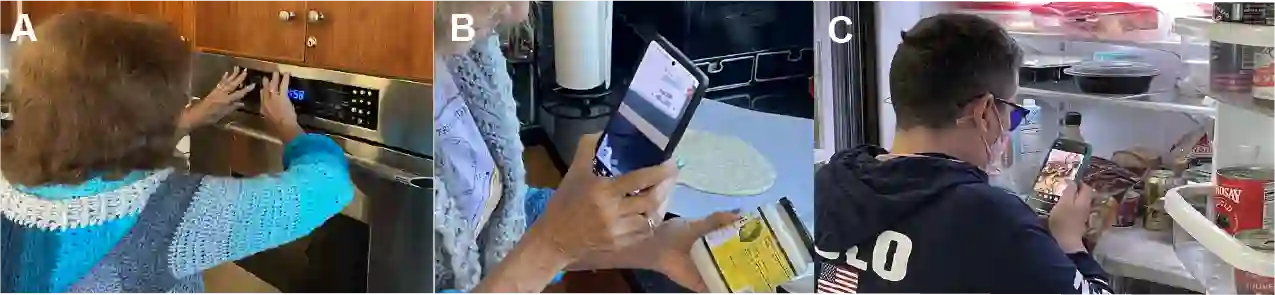
People who are blind face unique challenges in performing instrumental activities of daily living (iADLs), which require them to rely on their senses as well as assistive technology. Existing research on the strategies used by people who are blind to conduct different iADLs has focused largely on outdoor activities such as wayfinding and navigation. However, less emphasis has been placed on information needs for indoor activities around the home. We present a mixed-methods approach that combines 16 semi-structured interviews with a follow-up behavioral study to understand current and potential future use of technologies for daily activities around the home, especially for cooking. We identify common practices, challenges, and strategies that exemplify user-specific and task-specific needs for effectively performing iADLs at home. Despite this heterogeneity in user needs, we were able to reveal a near universal preference for tactile over digital aids, which has important implications for the design of future assistive technologies. Our work extends existing research on iADLs at home and identifies barriers to technology adoption. Addressing these barriers will be critical to increasing adoption rates of assistive technologies and improving the overall quality of life for individuals who are blind.
翻译:盲人在执行工具性日常生活活动(iADLs)时面临独特挑战,这要求他们依赖自身感官及辅助技术。现有关于盲人实施不同iADLs策略的研究主要聚焦于户外活动(如寻路与导航),但对室内居家活动的信息需求关注不足。我们采用混合研究方法,结合16项半结构化访谈与后续行为研究,以了解当前及未来潜在技术在家居日常活动——尤其是烹饪——中的应用。我们归纳了体现用户特定性与任务特定性需求的常见实践、挑战与策略,这些需求对有效执行居家iADLs至关重要。尽管用户需求存在异质性,但我们发现触觉辅助相较于数字辅助具有近乎普遍的优势偏好,这对未来辅助技术的设计具有重要启示。本研究拓展了居家iADLs的现有研究,并识别了技术采纳的障碍。克服这些障碍对于提升辅助技术采纳率、改善盲人群体整体生活质量至关重要。




相关内容




 微信扫码咨询专知VIP会员