

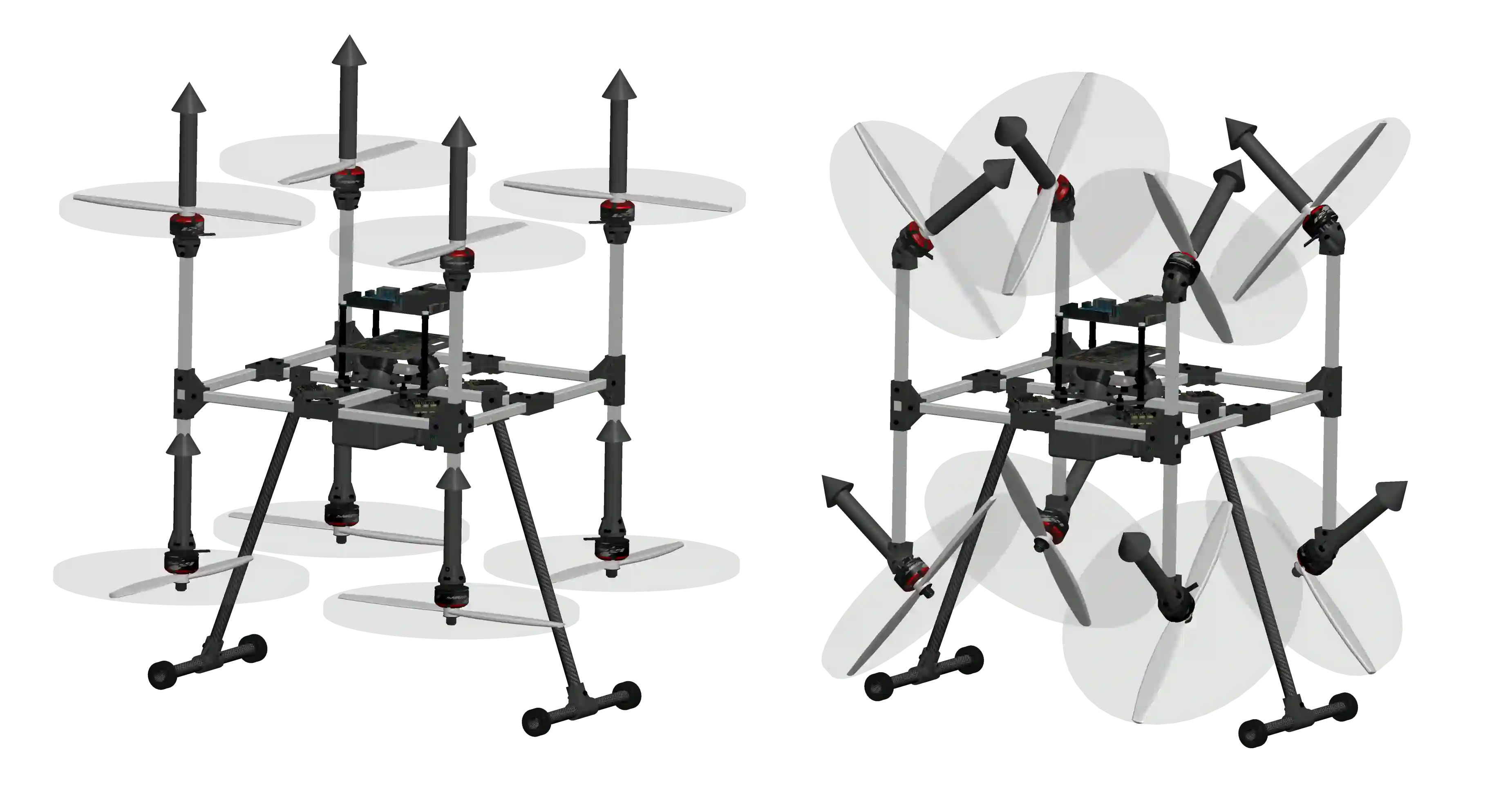
The integration of Multi-Rotor Aerial Vehicles (MRAVs) into 5G and 6G networks enhances coverage, connectivity, and congestion management. This fosters communication-aware robotics, exploring the interplay between robotics and communications, but also makes the MRAVs susceptible to malicious attacks, such as jamming. One traditional approach to counter these attacks is the use of beamforming on the MRAVs to apply physical layer security techniques. In this paper, we explore pose optimization as an alternative approach to countering jamming attacks on MRAVs. This technique is intended for omnidirectional MRAVs, which are drones capable of independently controlling both their position and orientation, as opposed to the more common underactuated MRAVs whose orientation cannot be controlled independently of their position. In this paper, we consider an omnidirectional MRAV serving as a Base Station (BS) for legitimate ground nodes, under attack by a malicious jammer. We optimize the MRAV pose (i.e., position and orientation) to maximize the minimum Signal-to-Interference-plus-Noise Ratio (SINR) over all legitimate nodes.
翻译:将多旋翼飞行器(MRAV)集成至5G和6G网络可增强覆盖范围、连接性与拥塞管理能力。这一发展推动了通信感知机器人技术——探索机器人与通信系统间的协同作用——但同时也使MRAV易受恶意攻击(如干扰)的影响。传统应对方案是采用波束赋形技术,在MRAV上实施物理层安全机制。本文提出将姿态优化作为对抗MRAV干扰攻击的替代方法。该技术面向全向MRAV设计——这类无人机能独立控制自身位置与朝向,不同于常见的欠驱动MRAV(其朝向无法独立于位置进行控制)。本研究考虑一个充当合法地面节点基站的(BS)全向MRAV,其在遭受恶意干扰机攻击的场景下,通过优化MRAV姿态(即位置与朝向),以最大化所有合法节点中最小的信干噪比(SINR)。




相关内容


 微信扫码咨询专知VIP会员