

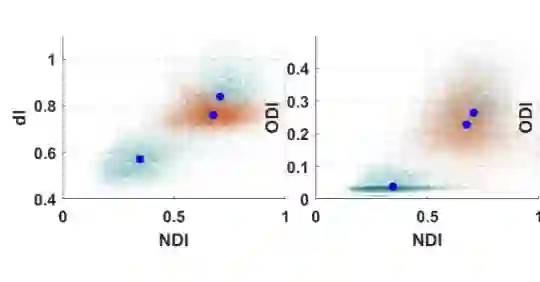
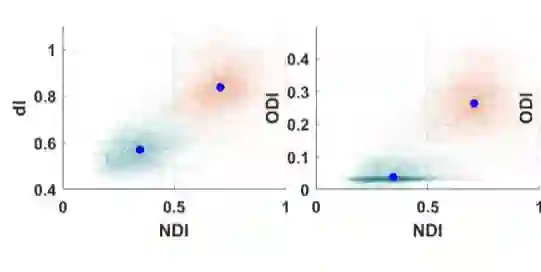
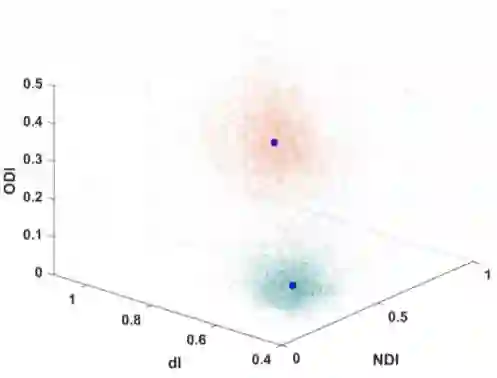
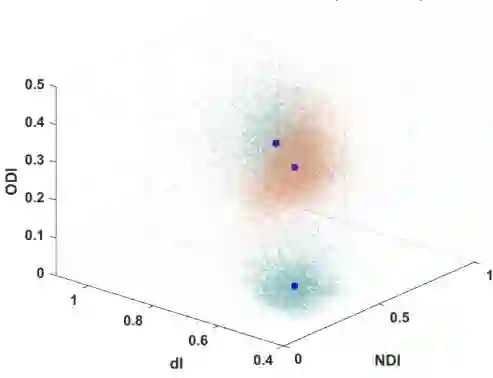
Quantitative MRI (qMRI) aims to map tissue properties non-invasively via models that relate these unknown quantities to measured MRI signals. Estimating these unknowns, which has traditionally required model fitting - an often iterative procedure, can now be done with one-shot machine learning (ML) approaches. Such parameter estimation may be complicated by intrinsic qMRI signal model degeneracy: different combinations of tissue properties produce the same signal. Despite their many advantages, it remains unclear whether ML approaches can resolve this issue. Growing empirical evidence appears to suggest ML approaches remain susceptible to model degeneracy. Here we demonstrate under the right circumstances ML can address this issue. Inspired by recent works on the impact of training data distributions on ML-based parameter estimation, we propose to resolve model degeneracy by designing training data distributions. We put forward a classification of model degeneracies and identify one particular kind of degeneracies amenable to the proposed attack. The strategy is demonstrated successfully using the Revised NODDI model with standard multi-shell diffusion MRI data as an exemplar. Our results illustrate the importance of training set design which has the potential to allow accurate estimation of tissue properties with ML.
翻译:定量MRI(qMRI)旨在通过将未知组织特性与测量的MRI信号相关联的模型,无创地映射组织特性。传统上需要模型拟合(一种通常为迭代过程)来估计这些未知量,而现在可通过一次性机器学习(ML)方法完成。此类参数估计可能因固有的qMRI信号模型退化而复杂化:不同的组织特性组合会产生相同的信号。尽管ML方法具有诸多优势,但其能否解决这一问题仍不明确。越来越多的实证证据表明,ML方法可能仍易受模型退化影响。本文证明,在适当条件下,ML可以解决这一问题。受近期关于训练数据分布对基于ML的参数估计影响的研究启发,我们提出通过设计训练数据分布来解决模型退化。我们提出了模型退化的分类,并识别出一类特别适合采用所提出方法处理的退化类型。该策略通过使用修订版NODDI模型与标准多壳扩散MRI数据作为示例成功演示。我们的结果说明了训练集设计的重要性,其具有通过ML实现组织特性精确估计的潜力。




相关内容





 微信扫码咨询专知VIP会员