

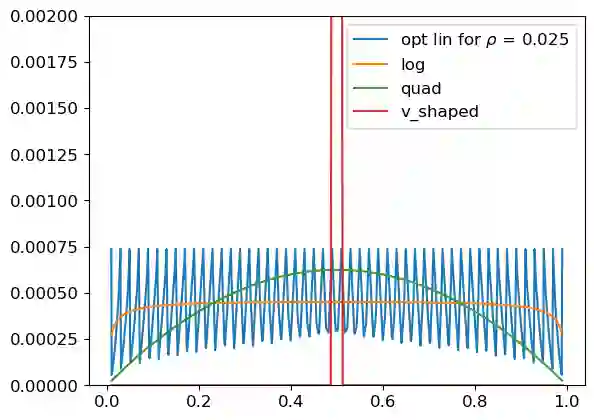
This paper studies the design of optimal proper scoring rules when the principal has partial knowledge of an agent's signal distribution. Recent work characterizes the proper scoring rules that maximize the increase of an agent's payoff when the agent chooses to access a costly signal to refine a posterior belief from her prior prediction, under the assumption that the agent's signal distribution is fully known to the principal. In our setting, the principal only knows about a set of distributions where the agent's signal distribution belongs. We formulate the scoring rule design problem as a max-min optimization that maximizes the worst-case increase in payoff across the set of distributions. We propose an efficient algorithm to compute an optimal scoring rule when the set of distributions is finite, and devise a fully polynomial-time approximation scheme that accommodates various infinite sets of distributions. We further remark that widely used scoring rules, such as the quadratic and log rules, as well as previously identified optimal scoring rules under full knowledge, can be far from optimal in our partial knowledge settings.
翻译:本文研究当委托人拥有代理人信号分布的部分知识时,最优真实评分规则的设计问题。近期研究表明,在假设委托人完全知晓代理人信号分布的条件下,存在最大化代理人因获取昂贵信号以修正先验预测后验信念所得收益增量的真实评分规则。在我们的设定中,委托人仅了解代理人信号分布所属的分布集合。我们将评分规则设计问题建模为最大化该分布集合中最坏情况收益增量的最大-最小优化问题。针对有限分布集合,我们提出一种有效算法计算最优评分规则;针对各类无限分布集合,我们设计了全多项式时间近似方案。进一步研究表明,广泛使用的评分规则(如二次规则和对数规则)以及先前在完全知识条件下识别出的最优评分规则,在部分知识设定下可能远非最优。




相关内容



 微信扫码咨询专知VIP会员