

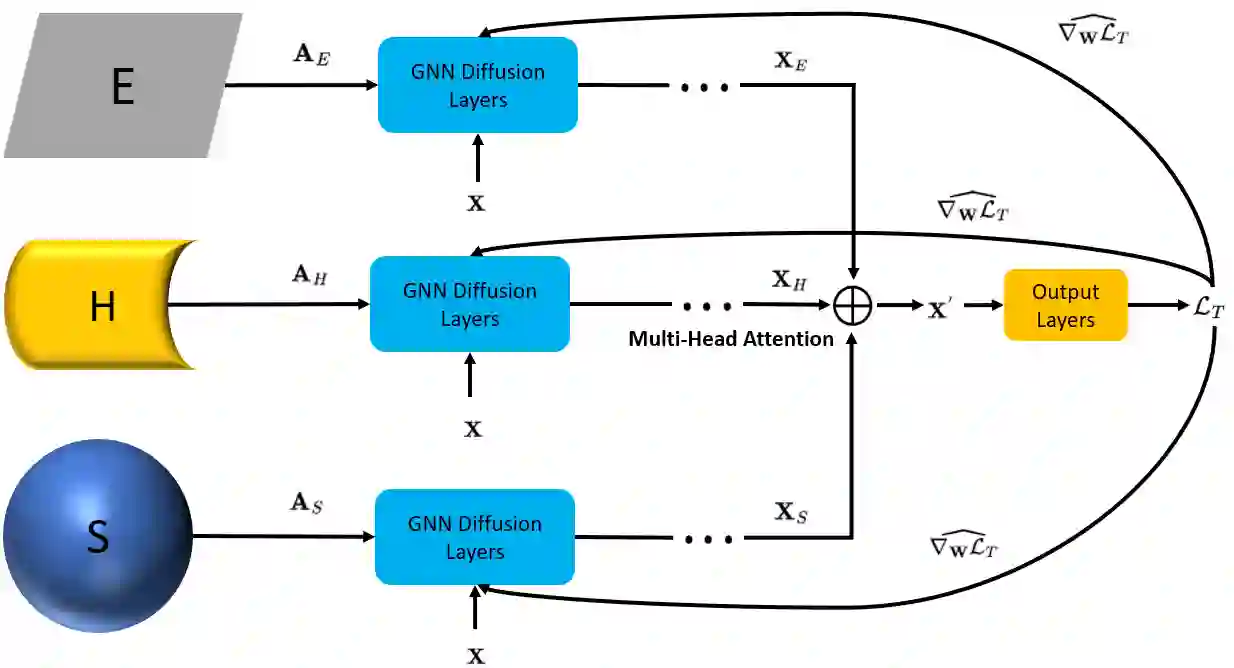
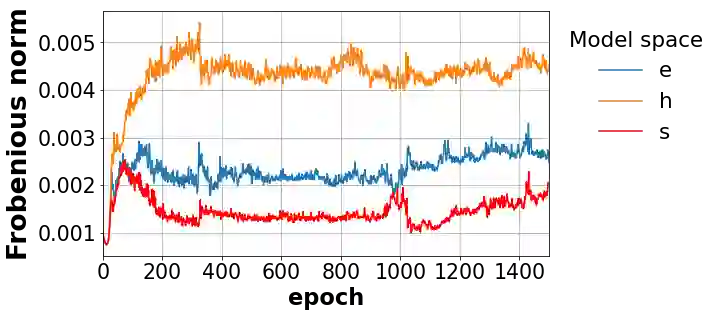
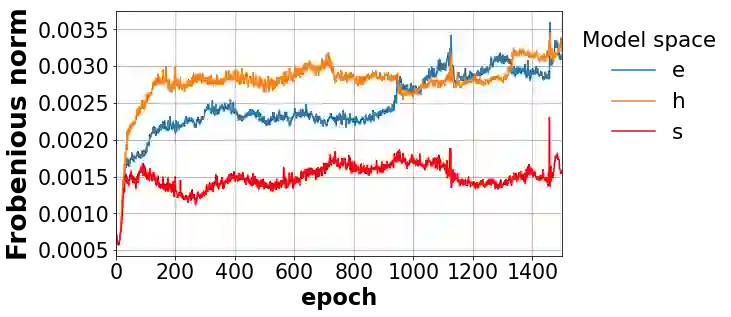
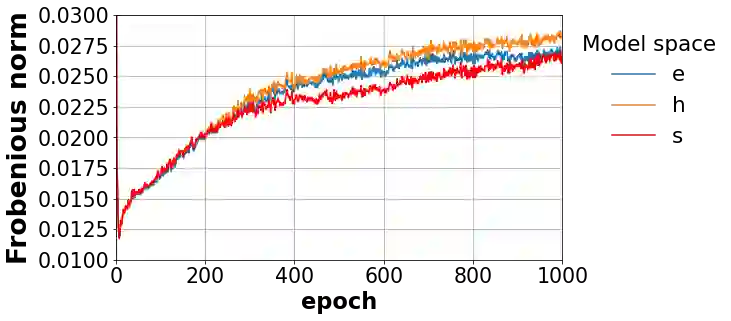
In real-world scenarios, although data entities may possess inherent relationships, the specific graph illustrating their connections might not be directly accessible. Latent graph inference addresses this issue by enabling Graph Neural Networks (GNNs) to operate on point cloud data, dynamically learning the necessary graph structure. These graphs are often derived from a latent embedding space, which can be modeled using Euclidean, hyperbolic, spherical, or product spaces. However, currently, there is no principled differentiable method for determining the optimal embedding space. In this work, we introduce the Attentional Multi-Embedding Selection (AMES) framework, a differentiable method for selecting the best embedding space for latent graph inference through backpropagation, considering a downstream task. Our framework consistently achieves comparable or superior results compared to previous methods for latent graph inference across five benchmark datasets. Importantly, our approach eliminates the need for conducting multiple experiments to identify the optimal embedding space. Furthermore, we explore interpretability techniques that track the gradient contributions of different latent graphs, shedding light on how our attention-based, fully differentiable approach learns to choose the appropriate latent space. In line with previous works, our experiments emphasize the advantages of hyperbolic spaces in enhancing performance. More importantly, our interpretability framework provides a general approach for quantitatively comparing embedding spaces across different tasks based on their contributions, a dimension that has been overlooked in previous literature on latent graph inference.
翻译:在现实场景中,尽管数据实体可能具有内在关联,但直接刻画其连接关系的具体图结构往往不可获取。潜在图推理通过使图神经网络(GNNs)能够处理点云数据,动态学习所需的图结构来应对这一问题。这些图通常源自潜在嵌入空间,该空间可采用欧几里得空间、双曲空间、球面空间或乘积空间进行建模。然而,当前尚缺乏一种原则性的可微方法来判定最优嵌入空间。本文提出注意力多嵌入选择(AMES)框架,这是一种面向下游任务、通过反向传播选择最优潜在图嵌入空间的可微方法。在五个基准数据集上,我们的框架始终取得与既有潜在图推理方法相当或更优的结果。更重要的是,该方法无需进行多组实验来甄别最优嵌入空间。此外,我们探索了追踪不同潜在图梯度贡献的可解释性技术,揭示了基于注意力的全可微方法如何学习选择适当潜在空间。与既往研究一致,我们的实验强调双曲空间在提升性能方面的优势。更具意义的是,所提出的可解释性框架提供了一种通用方法,可基于不同嵌入空间的贡献进行跨任务定量比较——这一维度在既有潜在图推理文献中常被忽视。




相关内容



 微信扫码咨询专知VIP会员