

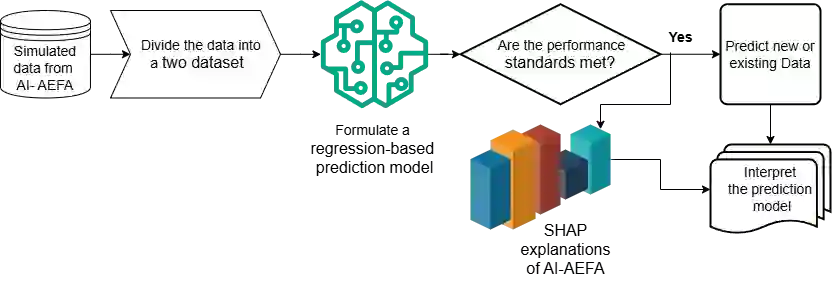
Industrial and reliability optimization problems often involve complex constraints and require efficient, interpretable solutions. This paper presents AI-AEFA, an advanced parameter reconfiguration-based metaheuristic algorithm designed to address large-scale industrial and reliability-redundancy allocation problems. AI-AEFA enhances search space exploration and convergence efficiency through a novel log-sigmoid-based parameter adaptation and chaotic mapping mechanism. The algorithm is validated across twenty-eight IEEE CEC 2017 constrained benchmark problems, fifteen large-scale industrial optimization problems, and seven reliability-redundancy allocation problems, consistently outperforming state-of-the-art optimization techniques in terms of feasibility, computational efficiency, and convergence speed. The additional key contribution of this work is the integration of SHAP (Shapley Additive Explanations) to enhance the interpretability of AI-AEFA, providing insights into the impact of key parameters such as Coulomb's constant, charge, acceleration, and electrostatic force. This explainability feature enables a deeper understanding of decision-making within the AI-AEFA framework during the optimization processes. The findings confirm AI-AEFA as a robust, scalable, and interpretable optimization tool with significant real-world applications.
翻译:工业与可靠性优化问题通常涉及复杂约束,且需要高效、可解释的解决方案。本文提出AI-AEFA——一种基于高级参数重构的元启发式算法,旨在解决大规模工业及可靠性冗余分配问题。AI-AEFA通过新颖的基于对数S型函数的参数自适应机制与混沌映射机制,增强了搜索空间探索能力与收敛效率。该算法在28个IEEE CEC 2017约束基准问题、15个大规模工业优化问题以及7个可靠性冗余分配问题上进行了验证,在可行性、计算效率与收敛速度方面均持续优于当前最先进的优化技术。本工作的另一关键贡献在于集成SHAP(沙普利加性解释)以增强AI-AEFA的可解释性,从而深入揭示库仑常数、电荷、加速度及静电力等关键参数的影响机制。这一可解释性特征使得我们能够更深入地理解优化过程中AI-AEFA框架内的决策逻辑。研究结果证实,AI-AEFA是一种鲁棒性强、可扩展且具备可解释性的优化工具,具有重要的实际应用价值。




相关内容




 微信扫码咨询专知VIP会员