

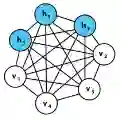
Restricted Boltzmann Machines are generative models that consist of a layer of hidden variables connected to another layer of visible units, and they are used to model the distribution over visible variables. In order to gain a higher representability power, many hidden units are commonly used, which, in combination with a large number of visible units, leads to a high number of trainable parameters. In this work we introduce the Structural Restricted Boltzmann Machine model, which taking advantage of the structure of the data in hand, constrains connections of hidden units to subsets of visible units in order to reduce significantly the number of trainable parameters, without compromising performance. As a possible area of application, we focus on image modelling. Based on the nature of the images, the structure of the connections is given in terms of spatial neighbourhoods over the pixels of the image that constitute the visible variables of the model. We conduct extensive experiments on various image domains. Image denoising is evaluated with corrupted images from the MNIST dataset. The generative power of our models is compared to vanilla RBMs, as well as their classification performance, which is assessed with five different image domains. Results show that our proposed model has a faster and more stable training, while also obtaining better results compared to an RBM with no constrained connections between its visible and hidden units.
翻译:受限玻尔兹曼机是由一层隐变量与另一层可见单元相连构成的生成模型,用于对可见变量分布进行建模。为提升表征能力,通常使用大量隐单元,而结合大规模可见单元会导致可训练参数数量剧增。本文提出结构受限玻尔兹曼机模型,通过利用数据固有结构,将隐单元连接约束至可见单元的子集,从而在保持性能的前提下显著减少可训练参数。我们聚焦图像建模这一潜在应用领域:基于图像特性,连接结构依据构成模型可见变量的像素空间邻域进行定义。我们在多个图像域开展广泛实验:利用MNIST数据集的噪声图像评估去噪性能;通过五种图像域数据集,将模型生成能力及分类性能与标准RBM进行对比。结果表明,与传统可见-隐单元全连接RBM相比,所提模型在训练过程中具有更快收敛速度与更优稳定性,且获得更优的分类结果。




相关内容



 微信扫码咨询专知VIP会员