

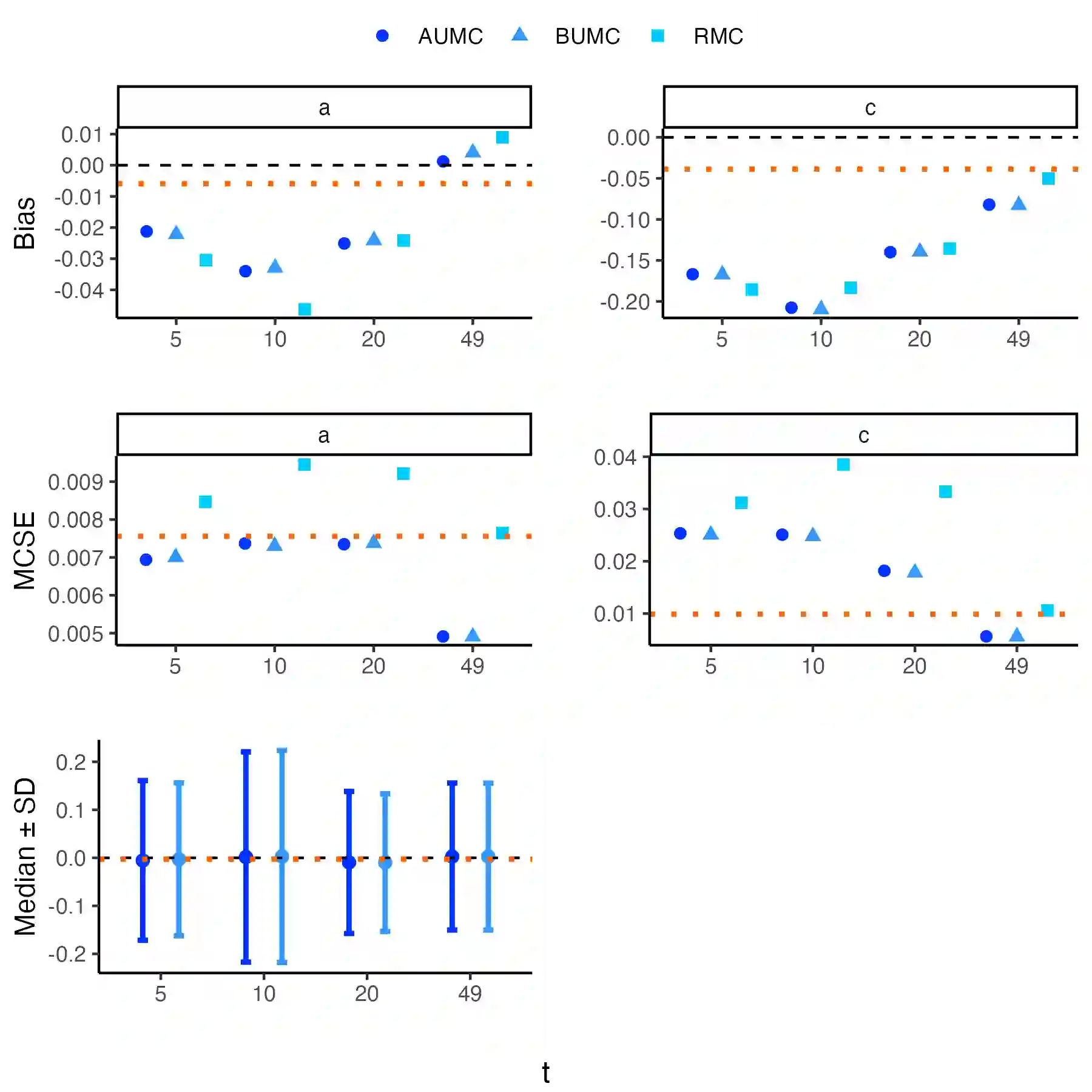
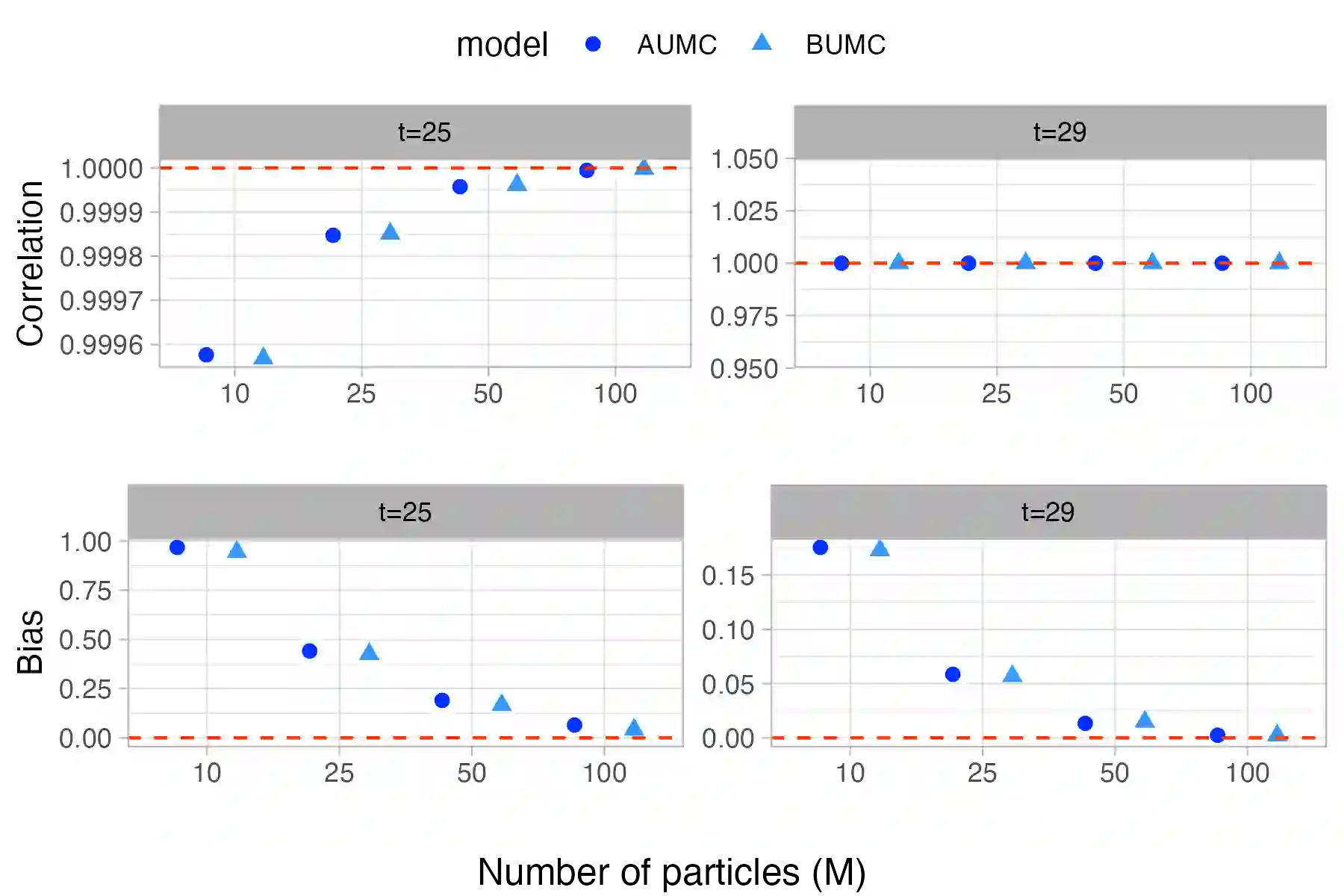
1. Temporal trends in species distributions are necessary for monitoring changes in biodiversity, which aids policymakers and conservationists in making informed decisions. Dynamic species distribution models are often fitted to ecological time series data using Markov Chain Monte Carlo algorithms to produce these temporal trends. However, the fitted models can be time-consuming to produce and run, making it inefficient to refit them as new observations become available. 2. We propose an algorithm that updates model parameters and the latent state distribution (e.g. true occupancy) using the saved information from a previously fitted model. This algorithm capitalises on the strength of importance sampling to generate new posterior samples of interest by updating the model output. The algorithm was validated with simulation studies on linear Gaussian state space models and occupancy models, and we applied the framework to Crested Tits in Switzerland and Yellow Meadow Ants in the UK. 3. We found that models updated with the proposed algorithm captured the true model parameters and latent state values as good as the models refitted to the expanded dataset. Moreover, the updated models were much faster to run and preserved the trajectory of the derived quantities. 4. The proposed approach serves as an alternative to conventional methods for updating state-space models (SSMs), and it is most beneficial when the fitted SSMs have a long run time. Overall, we provide a Monte Carlo algorithm to efficiently update complex models, a key issue in developing biodiversity models and indicators.
翻译:1. 物种分布的时空趋势对于监测生物多样性变化至关重要,这有助于政策制定者和保护工作者做出明智决策。动态物种分布模型通常通过马尔可夫链蒙特卡洛算法拟合生态时间序列数据,以生成这些时空趋势。然而,已拟合模型在生成与运行时可能耗时较长,导致当新观测数据可用时重新拟合模型效率低下。2. 我们提出一种利用先前已拟合模型保存信息来更新模型参数与潜状态分布(如真实占据状态)的算法。该算法借助重要性抽样的优势,通过更新模型输出来生成新的目标后验样本。我们通过线性高斯状态空间模型和占据模型的仿真研究验证了该算法,并将其框架应用于瑞士冠山雀和英国黄蚁案例。3. 研究发现,使用所提算法更新的模型对真实模型参数与潜状态值的捕捉效果与基于扩展数据集重新拟合的模型相当。此外,更新模型的运行速度显著提升,并完整保留了推导量的轨迹特征。4. 该算法为更新状态空间模型(SSMs)提供了传统方法之外的替代方案,尤其适用于已拟合SSMs运行时间较长的场景。总体而言,我们提供了一种高效更新复杂模型的蒙特卡洛算法,这恰好是开发生物多样性模型与指标的核心挑战。




相关内容




 微信扫码咨询专知VIP会员